
Rare earth element (REE) production is a five-stage chain — ore concentration, roasting/cracking, solvent-extraction separation, metallothermic reduction or molten-salt electrolysis, and vacuum/electrorefining — with route choice governed by chloride vs oxide feed and by the element's vapour pressure [S1].
The 17 REEs (15 lanthanides plus Sc and Y) are split by metallurgical behaviour: light REEs (La–Gd) are typically produced as metals by fused-salt electrolysis of chlorides or oxides, while the heavy, vapour-prone REEs (Sm, Eu, Tm, Yb) are reduced from oxides with Ca or Li reductants in vacuum [S1].
Process Chain From Ore to Separated Oxide
Most REE feeds start as bastnäsite (REECO3F), monazite (REPO4), or ion-adsorption clays; after physical concentration the concentrates are typically roasted with sulphuric acid (wet route) or with NaOH (alkaline route) to crack the phosphate/fluorocarbonate matrix and drive rare earths into a water-soluble or acid-soluble form [S1].
Subsequent impurity removal (Fe, Th, U, P) is followed by multi-stage solvent extraction, commonly using D2EHPA (di-(2-ethylhexyl) phosphoric acid) and PC88A (2-ethylhexyl phosphonic acid mono-2-ethylhexyl ester) in kerosene, with hundreds of mixer-settler stages needed to reach 4N–5N (99.99–99.999%) oxide purity required for NdFeB magnets and phosphors [S1].
Two Reduction Routes, Two Operating Windows
For light REEs the dominant route is fused-salt electrolysis: a 700–950 °C cell with a graphite anode, Mo or W cathode, and a fluoride-oxide electrolyte (typically LiF–REF3 or LiF–BaF2–REF3) operating at 6–25 V cell voltage and 20–40 kA per cell, yielding liquid metal that is cast under Ar [S1].
For the heavy, high-vapour-pressure REEs (Sm, Eu, Tm, Yb), the standard process is calciothermic reduction of the oxide or fluoride — lanthanide oxide plus Ca metal reacted in a tantalum crucible at 1000–1100 °C under Ar, then the CaO slag and excess Ca are distilled off at 1200–1400 °C in vacuum to leave a consolidated metal regulus [S1]. Similar calciothermic or lithiothermic reduction of anhydrous RF3 is used to make Tb, Dy, and Y metals.
Selection Criteria: Which Route Fits Which Element
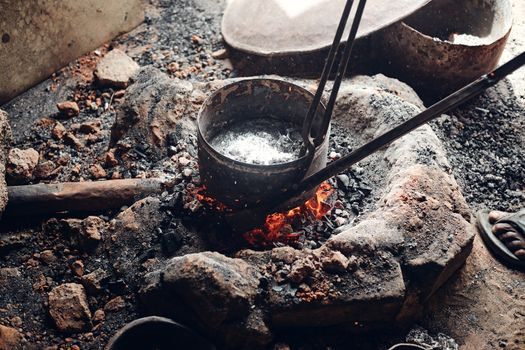
The decision gate is simple: light REEs with low vapour pressure go to electrolysis, heavy REEs with high vapour pressure go to metallothermic reduction. The cut-off roughly tracks the standard vapour-pressure series — at 1000 °C, Sm, Eu, Tm, and Yb have measurable losses in molten-salt cells, so electrolytic yield collapses and Ca reduction in sealed Ta crucibles becomes the only practical route [S1].
Purity-wise, electrolytic lanthanides typically land at 99.5–99.9% with the balance dominated by C (from the anode) and O; metallothermic heavy REE metal can reach 99.9–99.99% because the vacuum-distillation slag-removal step strips both Ca and most non-volatile impurities. For instrument-grade spec work — e.g. sputter targets for pressure sensor calibration cells or Y-stabilised coatings on industrial valve trim — the metallothermic route's higher purity is the default pick.
Process Comparison Across the Main Production Routes
Comparing the four commercial routes against the spec gates that actually drive selection: fused-salt electrolysis wins on throughput and cost for La/Ce/Pr/Nd, metallothermic reduction wins on purity and on elements that vaporise, oxide-to-metal direct reduction is a smaller-volume route, and electrorefining sits at the back end for ultra-high-purity grades [S1].
Concretely, a LiF–REF3 electrolytic cell at 850 °C running 25 kA produces tens of kg per day of Nd metal at modest capital cost, whereas a single Ta-crucible Ca reduction of Sm2O3 yields 1–10 kg per batch over a 12–24 h cycle with higher refractory cost. If your downstream is NdFeB magnets, you buy electrolytic Nd-Pr alloy; if it is SmCo magnets or Sm metal for nuclear/medical shielding, you buy metallothermic Sm regulus.
Use Cases, Constraints and Failure Modes
The primary use case for fused-salt REE electrolysis is NdFeB permanent magnets (Nd, Pr, Dy, Tb), which are the input to EV traction motors and wind-turbine generators — explicitly cited in the Springer overview as the strategic driver of REE metallurgical demand [S1]. Phosphors and catalysts pull smaller volumes of Eu, Ce, La, Y oxides; metal Sm, Eu, and Yb go into nuclear control rods, specialty alloys, and infrared optics.
The recurring failure modes are predictable: anode consumption in electrolytic cells (graphite burn-off plus carbide formation with RE metals) caps cell life; moisture pickup by RECl3 or REF3 feeds generates HF in the electrolyte, which attacks the cell lining; vacuum-distillation residues of CaO slag can occlude metal if the reduction step is under-stoichiometric. RETi (Rare Earth Technologies, Inc.) positions its separation work on this exact set of constraints — energy intensity, reagent recycling, and effluent handling — when it claims to lower the environmental load per kg of separated REE [S3].
Sourcing, Standards and Market Signal
There is no single ISO or ASTM standard that pins the entire REE production chain; the widely referenced practice documents are ISO 9001 for producer quality systems, ASTM B869 for Co/REE sputtering targets, and the REACH SVHC list (EU) for end-use regulatory gating of Eu and certain Y compounds. Buyers instrumenting spec sheets should demand a 4N-minimum assay, ICP-MS impurity breakdown to 50 ppm per element, O/N/C LECO analysis below 500 ppm each, and a Ta- or Mo-grade crucible provenance statement for the heavy REE metals. [S1]
Commercial REE pricing and inventory coverage outside China is consolidated through Argus, which publishes independent REE assessments across all 17 elements and is a common procurement reference for non-Chinese buyers [S4]. Academic and producer pipelines in China (e.g. Jiangxi University of Science and Technology, which established a dedicated Rare Earth college to serve the national REE development strategy) remain the dominant source of process-engineering talent feeding the largest separation and reduction capacity in the world [S2].
Adjacent Process Signal for Spec Auditors
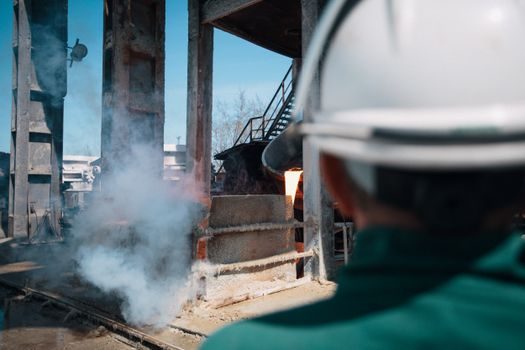
Process auditors who already work on metal-powder flow, high-temperature crucibles, and gas-handling skids will recognise the same spec gates that govern flow meter calibration baths and pressure transmitter test loops: gas-tight fittings, Mo/W-grade wetted parts, and traceable assay chains. The same discipline — independent third-party assay, batch-level CoA, and ISO 9001-anchored QA — applies whether you are buying 1 kg of Yb metal or 20 t of Nd-Pr alloy. [S2]
Two trackable signals for the next reporting window: (1) any post-2024 disclosure from RETi on pilot-scale throughput and reagent-recycle ratios at its separation plant, which would let a buyer benchmark its environmental claims against Chinese producers [S3]; and (2) Argus's quarterly REE price assessments for Nd-Pr oxide and Dy oxide, which remain the cleanest public read on whether electrolytic light-REE demand from the magnet chain is re-accelerating or rolling over [S4].
For related coverage, see Climbing Formwork 2026 Buying Guide: System Type, Lift Method and Wall Geometry.