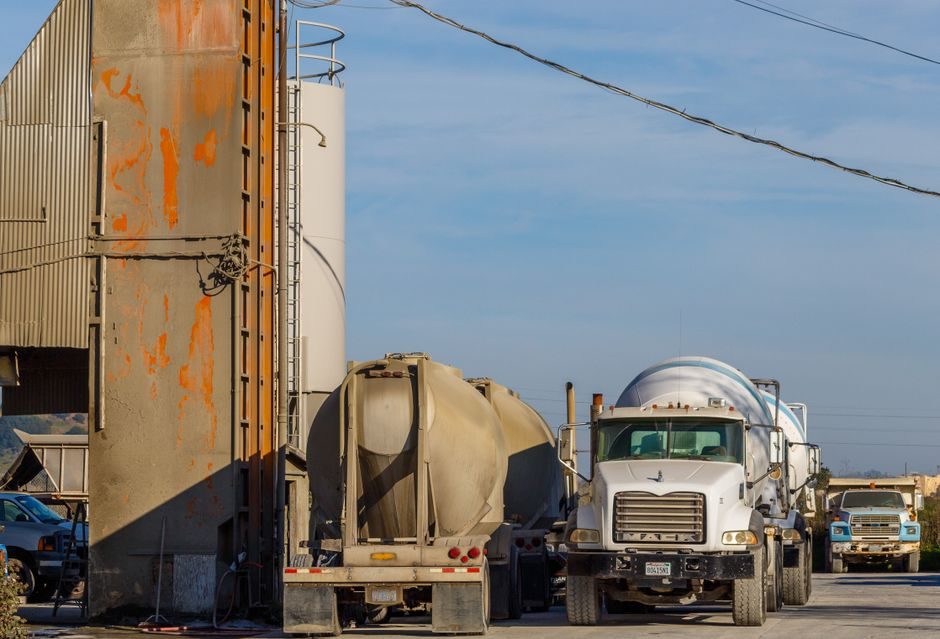
Ready-mix concrete is a factory-batched, truck-delivered mixture of cement, water, aggregates, and admixtures proportioned to a project mix design and discharged on site, supplied by regional producers such as Kay Concrete in Monett, MO [S1], Silvi Materials across Pennsylvania and the mid-Atlantic [S3], Tex-Mix Concrete in central Texas [S4], Kansas Sand & Concrete in Topeka [S6], and Haley Construction Inc. in central Maine.
Typical service segments include residential, commercial, industrial, municipal, and government work, with suppliers commonly covering every phase from footings and house pads through driveways, sidewalks, retaining walls, and large-scale commercial slabs [S1][S4]. Producer scope in the source pages ranges from single-region family operations to multi-decade firms (Kay Concrete over 50 years, Silvi Materials since 1947) with global raw-material reach [S1][S3].
Definition and Material Composition
Ready-mix is defined by The Free Dictionary as "a mixture in proper proportions of two or more ingredients, as of concrete or a food product, marketed for convenience; a premix" [S5]; the Hujiang English entry glosses it as a commercial preparation requiring only the addition of water, with the adjectival forms ready-mix and ready-mixed used interchangeably [S2].
Standard production terminology groups ready-mix into three plant categories: central-mixed (fully mixed at plant), shrink-mixed (partially mixed at plant then completed in truck), and transit-mixed (dry-batched into the truck and mixed in transit), all of which rely on a controlled concrete batching plant and calibrated concrete admixture dosing. Source pages reference ACI and ASTM membership among suppliers, indicating conformance to American Concrete Institute mix-design methods and ASTM C94 for ready-mixed concrete [S1][S6].
Core Advantages: Quality Control and Speed of Placement
Factory batching under plant QC is the central advantage: aggregates, cementitious materials, water, and chemical admixtures are dosed by weight on calibrated plant equipment, then discharged into a truck mixer for delivery, with optional concrete fiber reinforcement added to the mix to improve crack resistance [S3]. The Texas, Pennsylvania, Missouri, and Kansas supplier pages all emphasise "high-quality," "right proportions," and "consistency" as the value proposition over hand-batched site mixing [S1][S3][S4][S6].
Speed of placement is the second advantage: a single truck typically discharges 8-10 yd³ (roughly 6-7.5 m³) per load, allowing a slab or foundation to be poured in hours rather than days, with concrete vibrator consolidation on the receiving end to remove entrapped air. Topeka-area producer Kansas Sand & Concrete advertises coverage across the Topeka and eastern Kansas region for nearly a century, illustrating that geographic reach is itself a procurement advantage over bagged or site-mixed alternatives [S6].
Core Limitations: Transport Time, Slump Loss and Minimum Orders
Transport time from plant to site is the defining constraint: standard practice targets discharge within 90 minutes of batching (and no more than 300 drum revolutions) before slump loss and setting begin, which restricts supplier radius in rural areas such as southwest Missouri and central Maine [S1]. The Texas producer's coverage of Austin, San Antonio, and "surrounding communities" reflects the practical haul envelope of central-mixed concrete [S4].
Minimum-order thresholds and scheduling are the second constraint: a short-load fee is industry standard for orders below roughly 3-4 yd³, and most plants require scheduled placement slots rather than on-call delivery, which complicates small DIY pours. Environmental exposure between plant and site also drives the need for concrete curing compound or wet-burlap curing once placed, since premature moisture loss degrades the surface.
Comparison: Ready-Mix vs Site-Mixed vs Bagged Concrete
Decision criteria for a project engineer or homeowner typically reduce to volume, mix-design precision, lead time, and unit cost. Ready-mix scores high on mix-design precision (ASTM C94 plant QC) and on speed for pours above about 1 yd³, while site-mixed and bagged remain options for very small or remote jobs where truck access is constrained [S1].
Compared with bagged concrete (60- or 80-lb sacks hand-mixed on site), ready-mix at typical 2026 U.S. delivered prices sits in the USD 130-180 per yd³ band for standard 3000-4000 psi mixes, with short-load and fuel surcharges added; bagged concrete equivalent in ready-mix concrete volume works out 2-3× higher per yd³ once labour and mixer rental are included. Compared with volumetric (mobile) mixing, central-mixed ready-mix offers tighter QC, while volumetric trucks allow on-site mix adjustment and zero waste on short pours.
Who It Is For — and Who Should Avoid It
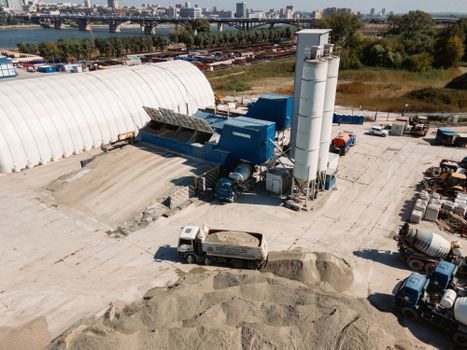
Ready-mix is the right call for commercial slabs, foundations, driveways, sidewalks, and structural pours above roughly 1 yd³ where consistent w/c ratio, air entrainment, and 28-day strength are spec'd; it is also the default for residential subdivisions where producers such as Tex-Mix Concrete serve "residential, commercial, industrial and government projects" on a recurring basis [S4]. Producers in Missouri and Kansas additionally market themselves for footings, house pads, retaining wall blocks, and hardscape solutions, covering the full residential envelope [S1][S6].
Ready-mix is the wrong call for very small repairs (a single fence-post footing), for sites with no truck access (steep urban alleys, indoor floor repairs), and for jobs that must start on an unscheduled basis with no plant slot. For these, bagged concrete or a small electric mixer is the lower-friction option, accepting lower strength uniformity in exchange for flexibility [S2][S5].
Standards, Sourcing and Procurement Signals
The governing U.S. standard is ASTM C94/C94M for ready-mixed concrete, which sets batching tolerances, delivery-time limits, agitation requirements, and the ticket-information format that accompanies every load; ACI 211 governs mix proportioning and ACI 318 governs structural use, with ACI and ASTM memberships shown in the supplier logos of Kay Concrete and Kansas Sand & Concrete [S1][S6]. For related industrial process equipment choices, see the 55-gallon drum selection spec map and the industrial gasket selection guide.
Trackable procurement signals for the back half of 2026: (1) Silvi Materials lists CarbonCure™ CO₂-mineralized concrete and E-ticketing among its sustainability offerings, indicating low-carbon mix options are now procurable through mainstream regional suppliers [S3]; (2) Texas, Pennsylvania, and Maine producers explicitly market to government projects, meaning municipal procurement is an open channel rather than a closed bid pool [S3][S4].