
Industrial-facility ready-mix orders in 2026 are still spec'd primarily to ACI 318 strength classes — the common band remains 3,000 to 5,000 PSI mixes, with American Concrete Co (Pittsburg, KS) listing 3,000 and 4,000 PSI as its standard production grades and DOT-approved variants for heavy-pavement tie-ins [S1]. Specifiers should treat strength as a starting point, not a finish line, because durability under chemical, sulfate, or freeze-thaw exposure will often drive the mix design past the basic PSI rating.
On the supply side, the global ready-mix market was valued at $448.0 billion in 2020 and is projected to reach $704.2 billion by 2030, a 4.5% CAGR (2021–2030), with the strongest demand pull coming from developing-country industrial corridors [S9]. That scale is the reason regional suppliers — OMANMIX in Muscat, Kansas Sand & Concrete in Topeka, Haley's Inc. in central Maine — now compete on certified QC systems, not just on delivered price [S2][S5][S8].
Strength Class and Mix Design Anchors
Compressive-strength class is the first selection filter and is set by structural design drawings (typically ACI 318 for buildings, ACI 360 for slabs-on-ground, ACI 350 for environmental structures) [S1]. American Concrete Co's published range of 3,000 PSI (≈ 21 MPa) for non-structural slabs and 4,000 PSI (≈ 28 MPa) for structural slabs matches the lower bound of what most industrial specifiers call out, while higher-strength orders — 5,000 PSI (≈ 35 MPa) and up — are typically reserved for column footings, heavy-equipment foundations, and forklift-traffic floors [S1].
Mix design itself is governed by ACI 211.1 (proportioning normal-weight concrete) plus ASTM C150 (portland cement) and ASTM C33 (aggregates), and most North-American plants default to Type I/II cement with a 0.40–0.45 w/cm ratio for 4,000 PSI work [S3]. For interior industrial slabs, water-reducing concrete admixtures are routinely dosed to hold slump at 4–6 in. while trimming cement content, which directly cuts the CO₂/yd³ figure that sustainability bidders now report [S3].
Exposure Class, Durability, and SCM Substitution
Exposure class — sulfate (S1–S3), freeze-thaw (F1–F3), and corrosion (C0–C2) per ACI 318 — overrides raw PSI for chemical-plant, coastal, and cold-storage builds. Haley's Inc. in central Maine flags commercial and municipal exposure conditions (freeze-thaw cycles, deicing salt exposure) on its product line, which drives a Type II or Type IL (limestone-blended) cement callout plus air-entrainment at 5–7% for F2/F3 service [S8].
Sustainability has crossed from a marketing line to a spec line: Vulcan's Superior Concrete Materials group lists a dedicated "Sustainability and Low-Carbon Mixes" sub-category for ready-mix concrete products [S3]. SCM substitution lowers the embodied carbon by roughly 30–40% versus a straight Type I/II mix at the same 28-day strength, but it slows early strength gain — a trade-off that matters on fast-track industrial schedules.
Production, QC Systems, and Plant Certification
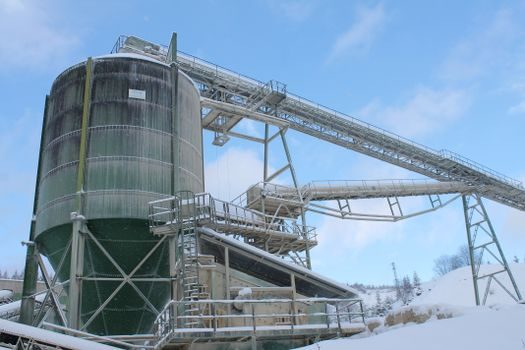
Plant-level QC under ready-mix concrete operations in 2026 is most commonly documented to ISO 9001:2015 (Quality Management Systems) plus ACI/ASTM laboratory accreditation, and OMANMIX publishes ISO 9001:2015 certification for its design and production system, with an in-house lab for physical testing of fresh and hardened concrete plus raw-material control from its own crusher [S2]. That in-house raw-material control is a non-trivial spec point: aggregate and sand variability is the single largest contributor to in-place strength scatter, and owning the quarry eliminates one interface out of the supply chain.
For batch traceability, NRMCA-certified plants and ASTM C94 (ready-mixed concrete specification) compliance are the baseline expectations in U.S. industrial work; American Concrete Co, Kay Concrete, and Kansas Sand & Concrete all list NRMCA, ACI, and ASTM links on their sites, and Kansas Sand & Concrete specifically calls out its parent Monarch Cement as the cement-side quality anchor [S1][S4][S5]. For facility owners running audit-driven supply chains, that chain-of-custody documentation is the difference between a 3-day and a 3-week mix-design approval cycle.
Logistics, Delivery Window, and Site Constraints
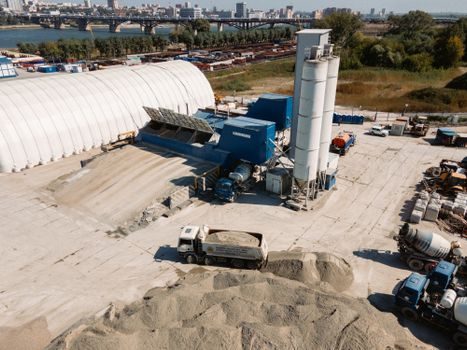
Ready-mix is a perishable engineered product, not a commodity: ASTM C94 sets a 90-min discharge limit (or 300 revolutions of the drum) from water-on-cement contact, which forces every plant layout decision to account for haul distance and queuing at the chute [S1]. For large industrial pours — equipment-pit foundations, mat pours in the 500–1,500 yd³ range — specifiers routinely switch to a concrete batching plant on site to bypass haul-time risk.
Volumetric (mobile) mixers are the alternative when access is tight or pour sizes are small and intermittent; Allied Market Research notes volumetric ready-mix concrete plants as a growing sub-segment because they batch on-site and let the contractor dial water and admixture at the point of placement [S9]. For the cut, demo, and trim-out phase that follows a structural pour, dry-cut, water-suppressed tools are specified in the spec book; the cut-off machine selection guide for concrete work lines blade diameter, power, and duty against the same concrete class the ready-mix spec defines, which is why the two documents travel together in industrial submittal packages.
Reinforcement, Curing, and the Spec Package
Concrete gains its industrial performance from the system around it, not the bucket alone. Steel-fiber or macro-synthetic-fiber reinforcement is now called out separately from rebar on many industrial slab specs, and product data is documented under concrete fiber — fibers bridge shrinkage cracks and improve impact resistance for forklift and AGV traffic, but they do not replace structural rebar in load-bearing elements [S3].
Curing compounds, applied within minutes of final finishing, are the most under-spec'd line item in industrial pours. A Type 1-D (ASTM C309) curing compound at the manufacturer's recommended coverage rate is the minimum for slab-on-ground work; for high-performance floors, an internal-curing admixture plus a 7-day wet cure is increasingly common [S3]. The encyclopedia entry on concrete curing compound walks the chemistries (wax, resin, sodium-silicate) and their compatibility with subsequent floor coatings — a frequent failure point in pharma and food-plant builds.
Placement consolidation is the third leg: spec-grade concrete vibrators sized to the section depth and rebar spacing are required to hit the design strength in real structures, not just the lab-cast cylinder. All three of these — fiber, cure, and consolidation — ride on the same mix-design submittal and should be reviewed as one package, not three.
Selection Map: Mixing the Options Against Plant Type
For a typical industrial facility spec, the four common options line up against decision criteria as follows. (1) Standard 4,000 PSI Type I/II, 0.45 w/cm — lowest cost, default for interior slabs and footings in mild-exposure zones [S1]. (3) 5,000–6,000 PSI ternary blend (Type IL + slag + silica fume), low w/cm, corrosion inhibitor — used for chemical-tank pads, vehicle wash bays, and coastal sites; the high end of the cost band, justified by 50-year design life [S2][S3]. (4) Volumetric on-site batched mix — used where haul time > 60 min or pour size < 50 yd³, gives mix flexibility but trades off the QC tightness of a central-mix plant [S9].
Industrial procurement should treat the mixer-truck dispatch sheet, the mill cert, and the fresh-concrete test report (slump, air, temperature, unit weight) as contract deliverables, not paperwork — that is the enforcement mechanism for the entire spec above. For owners building multiple sites, locking those QC checkpoints into the master service agreement with the supplier is cheaper than any single pour rejection.
Watch, over the next two reporting cycles, for (a) Type IL (ASTM C595) cement penetration moving past Type I/II as the default U.S. spec cement, (b) NRMCA or EPD transparency shifts that will let facility owners benchmark CO₂/yd³ the way they benchmark $/yd³ today, and (c) tighter ASTM C94 discharge-window enforcement as plants push for longer haul radii to win industrial-corridor work. Those three signals will move the ready-mix submittal conversation from PSI to embodied-carbon + traceability within a single planning cycle.