
Rebar bending equipment splits cleanly into five operating classes — manual, electric, hydraulic, CNC and portable — each defined by its power source, maximum bar capacity and intended production volume [S3][S6]. Capacities stretch from light 16 mm (#5) hand-fed portable units up to 45 mm (#14 / 45M) hydraulic shop machines, and the specifier's first call is always bar diameter × daily bend count × power available on site.
The article covers the five-class taxonomy, the rotary-vs-three-point kinematic split that sits underneath it, the standard capacity ladder (#4 through #14), the ACI 318-05 bend-angle compliance window, and the matching reference categories on the rebar bender and rebar cutter encyclopedia pages so a buyer can cross-check any catalog row against a defined machine class.
Five-Class Taxonomy: Manual, Electric, Hydraulic, CNC, Portable
The widely-used industry grouping of rebar benders lists five named classes, each pinned to a power source and capacity band: manual (human-operated, light tasks), electric (motor-driven, Φ6–Φ40 mm), hydraulic (hydraulic-powered, Φ50 mm+), CNC (automated angle control for mass production) and portable (lightweight, on-site flexibility) [S3]. The five classes are not parallel — manual and portable describe form-factor and deployment, while electric, hydraulic and CNC describe drive technology — but in vendor catalogs they are presented as a single decision tree keyed off bar diameter and daily bend count.
Mapping that taxonomy to actual machine rows, the BN Products table-style line covers the light/medium end with the DBD-16X (#5 / 16 mm), DBD-25H (#8) and DBD-32X 1-1/8″ (#9), while the DBC-16H and DBC-25H are listed as hydraulic cutter/bender combinations — the same model can show up under both "portable" and "hydraulic" headings depending on which attribute the catalog chooses to lead with [S4]. For heavy bar, the K & L Series from Gensco pushes the envelope to K Series #11 (1-3/8″, 45M) and L Series #10 (1-1/4″, 35M) with a patented high-precision bending head, while the mid-range PF36-N / PF44-N / PF48-N covers #8 (25M) through #10 (1-1/4″, 30M) [S6].
Rotary vs Three-Point: The Kinematic Split Inside Every Class
Underneath the power-source taxonomy sits a second, mechanical split: rotary benders use a turning central disk fitted with interchangeable bending dies and a posts that sweeps the bar around the die, while three-point benders use two rollers on a ram that pushes the bar against a stationary bending pin [S7]. Rotary heads dominate the heavy-bar hydraulic and CNC classes because the swept-post geometry scales cleanly past #8; three-point heads are common in portable and lighter electric classes where a compact ram-and-roller package is easier to mount on a jobsite carriage.
Fascut's model line makes the kinematic split explicit: the FR-800 is named a "Rotary Rebar Bender" rated to 1″ (#8) grade 60 rebar, the FS-600 is a "Rebar Cutter Bender" combination rated to 3/4″ (#6) grade 60, and the FR-800-C adds a cutter head to the rotary bender so one machine covers both operations on bar up to 1″ (#8) grade 60 [S1]. The FRH-850 solid-bar bender extends the rotary concept to solid stock rather than deformed rebar, with a "generous supply of tooling" that lets structural and ornamental shops bend flats and shapes without re-fixturing [S1].
Capacity Ladder: #4 (13 mm) Through #14 (45M) and What Each Step Means
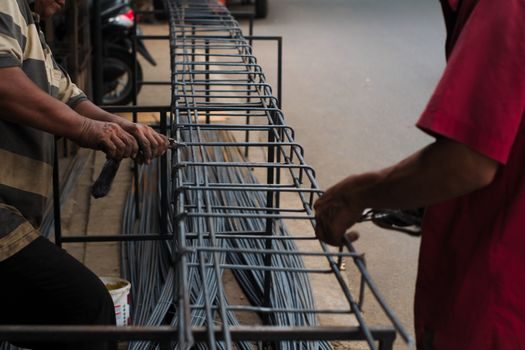
Rebar bender capacity is almost universally expressed in the imperial/imperial-metric shorthand "bar size + grade 60," and the practical ladder seen across the major US catalogs runs #4 (≈13 mm) → #5 (16 mm) → #6 (19 mm) → #7 (22 mm) / 7/8″ → #8 (25 mm) / 1″ → #9 (1-1/8″) → #10 (1-1/4″, 32 mm) / 30M → #11 (1-3/8″, 36 mm) / 45M → #14 bar [S4][S5][S6]. The DBD-25X portable bender, for example, bends rebar up to #7 (7/8″) grade 60 and meets ACI 318-05 specifications on #4, #5 and #6 rebar only — the compliance window is narrower than the maximum capacity [S5].
The class-to-capacity mapping that follows from the catalogs is: portable/light electric class tops out around #5 to #7 (16–22 mm); mid-range electric and table-style hydraulic benders cover #8 to #9 (25–29 mm); heavy electric and shop hydraulic benders cover #10 to #11 (32–36 mm / 30M–45M); and the high-end shop class is reserved for #14 bar and above, where machines like the K Series require a dedicated 220 V supply rather than a 110 V jobsite outlet [S1][S6]. For a buyer cross-checking a single product row, the rebar coupler and rebar threading machine encyclopedia entries sit one click away for the post-bend assembly side of the workflow.
Angle Range, Compliance and the Foot-Pedal Control Convention
Bend angle is the second universal spec after bar size: most portable and shop benders expose a 0–180° range via a lever-type angle selector, and the DBD-25X explicitly advertises that it "can be set to accurately bend any angle from 0-180 degrees" [S5]. On production machines the same selector is upgraded to a programmable angle control — listed as an accessory on the Fascut 800-series line — so the same knob that sets a one-off 90° stirrup bend on site can drive a 135° hook-and-seal bend or a continuous run of identical column ties in a prefab shop [S1].
Compliance with ACI 318-05 is the most-cited US standard reference on portable benders; the DBD-25X manual states the machine "meets ACI 318-05 rebar bending specifications on #4, #5 & #6 rebar only," meaning the rating is intentionally conservative relative to the machine's maximum #7 throughput, and any bar above #6 must be bent on a larger machine if the project spec calls for ACI 318 conformance [S5]. Safety controls cluster around a foot-pedal for hands-free bending, an emergency-stop switch and two lifting handles on the portable units — features that the BN Products HB-16W, DBD-25X and DBD-16X lines all carry as standard rather than optional [S4][S5].
Decision Matrix: Matching Class to Project Size and Bar Diameter
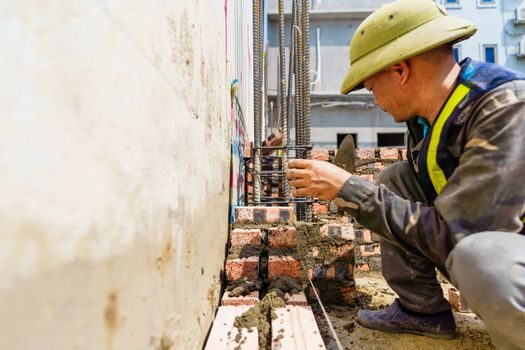
For a small jobsite doing a few dozen #4 or #5 stirrups a day, a manual bender or a 110 V portable electric unit in the DBD-16X class is the cost-effective answer and the operator can carry it to the slab in one trip [S3][S4]. For a medium rebar workshop running continuous #6 to #8 production, the mid-range PF36-N / PF44-N / PF48-N electric benders cover 25M to 30M and run on standard shop power without a dedicated 220 V drop [S6].
For a precast plant producing thousands of identical cage bends per shift, the CNC class with automated angle control is the right call because the programmable head removes the operator as the source of angle variance [S3]. For bridge, pile-cap or heavy-civil work where bar sizes run #10 to #14 and rebar arrives in 12 m lengths, the K & L Series hydraulic benders (1-3/8″ / 45M) are the only off-the-shelf class that holds the capacity, and the site must be provisioned with 220 V three-phase rather than a portable generator [S1][S6]. Buyers who need to bend rebar before threading or coupling should also confirm the rebar straightener workflow sits upstream, because a CNC bender fed by coil rather than straight stock changes the upstream tooling decision.
Limitations, Failure Modes and Sourcing Reality
The hard limit on every class is bar diameter × grade × bend angle: hydraulic units rated to Φ50 mm+ cannot run continuously at that maximum without thermal headroom, and electric units rated to Φ40 mm typically derate sharply when the operator moves from a single 90° bend to a continuous 135° hook bend at the upper end of the capacity range [S3]. Inaccurate bending angles in the field trace back to worn dies or a mis-calibrated angle stopper rather than to the machine class, and metal-debris jamming is the next most common failure — both fixable on site with grease and a die swap rather than a machine replacement [S3].
On sourcing, the US market is anchored by a small set of long-established names — Fascut (manufacturing in the US since 1979), BN Products, and the OEM partners behind the GHM, K & L and PF-series catalog rows — and the units ship as 110 V portable (most #5–#8 portable/table models), 220 V single-phase (the 800-series with the optional 220 V kit), or 220 V three-phase shop supply (K & L Series and the CNC class) [S1][S4][S6]. For a buyer comparing total cost of ownership across the five classes, the lifetime cost driver is die wear and angle-selector recalibration rather than the sticker price, and the truck crane types and classifications working map is a useful cross-reference for the lifting and positioning equipment that feeds coil and straight stock into the bending cell.
Trackable next signals: ACI 318 rebar-bending Annex revisions (any change to the #4–#6 compliance window on portable machines like the DBD-25X), the next 220 V brushless drive refresh on the 800-series rotary bender line, and any 45M / #14 bar CNC cell that bundles a coil payoff, straightener, bender and rebar threading machine into a single production cell.