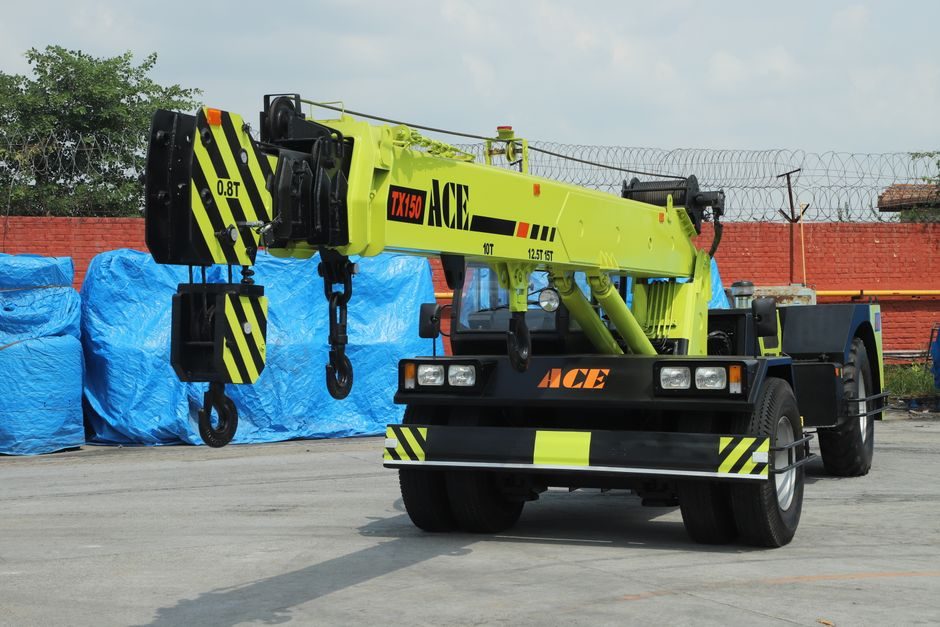
A truck-mounted crane is a carrier-mounted lifting machine with its own engine, hydraulic pump and operator cab, classed by boom type, axle count and load-moment envelope rather than by chassis brand [S6]. The current 2026 product window shows capacity entries from a 14.2 t Hiab X-CLX 1x8 swing-arm loader [S3] to a 50 t Liebherr LTC 1050-3.1E compact 3-axle telescopic unit driving at up to 85 km/h on a 7 t total carrier weight [S2].
The category sits inside the wider truck-mounted crane family and overlaps mechanically with other mobile plant such as concrete mixer truck and dump truck chassis, so boom geometry and outrigger footprint are the real discriminator, not the truck underneath.
Boom Architecture: Telescopic, Swing-Arm and Knuckle
Telescopic truck cranes use nested steel sections extended by a single- or two-stage hydraulic cylinder to reach working heights of 48 m and horizontal radii around 39 m in the Liebherr LTC 1050-3.1E 3-axle package, which carries its 50 t max load on a 7 t carrier with a 243 kW (330 hp) drive engine [S2]. Swing-arm loader cranes, by contrast, fold through multiple articulated joints to a 19.9 m max working height in the Hiab X-CLX 1x8, but the trade-off is a smaller 14,200 kg max load and a 10,100 kg minimum, reflecting the variable-radius geometry the boom geometry demands [S3].
Knuckle / folding-boom trucks are essentially the swing-arm principle scaled up for heavier tonnage; Hiab's X-Duo 178 and X-HiDuo 188 series sit in this mining-applications class with boom-folding articulation rather than straight telescopic extension [S3]. A scrap-yard Turkish-built DISAN unit bridges both worlds, with two boom lengths (7 m and 6 m) fed by a variable-bore axial piston pump at 112 cc/rev, powering a Ø 1140 mm rotary gear and a 0.250 m³ standard polyp grapple at a 45 t load and 45 kW (61.2 hp) crane engine [S1].
Capacity Bands and Axle Count
Truck-crane capacity tracks axle count: a single-axle loader crane covers roughly 1 to 6 tm, two-axle units reach about 10 to 20 tm, three-axle trucks span 25 to 80 tm, four-axle rigs cover 80 to 150 tm, and five-axle machines go beyond 150 tm in published classification tables [S6]. The SQ14SK4Q truck-mounted crane in current 2026 vendor data lifts 14,000 kg at a 35 tm max lift moment from a 32 kW recommended powerpack, with 63 L/min max flow at 26 MPa rated hydraulic pressure and 360° slewing from a 4,800 kg bare crane weight on 1,300 mm of installation space [S7].
Drive-engine power scales non-linearly with capacity: the DISAN scrap unit runs a 45 kW (61.2 hp) engine to deliver 45 t [S1], while the Liebherr LTC 1050-3.1E uses 243 kW (330 hp) to hold its 50 t envelope with full electro-hydraulic backup [S2]. For yard work at low speed, this ratio is irrelevant; for road-to-site transit, it is the deciding factor, because driving speed drops to 85 km/h (52.8 mph) on the compact 3-axle 50 t class [S2].
Drive and Powerpack: Diesel, Electric-Diesel, PTO
The 2026 trend line is the dual-mode compact crane: the Liebherr LTC 1050-3.1E accepts a 125 A site supply for full performance and falls back to 32 A / 63 A reduced-power mode, with conventional external battery packs also supported so crane movements can run zero-emission at the touch of a switch while keeping diesel-hydraulic backup [S2]. Noise emissions drop with the electric motor engaged, which is the real driver on urban "zero emissions" job sites that demand 48 m hook height with no combustion at the hook [S2].
Smaller truck cranes do not need that sophistication. The SQ14SK4Q runs a 120 L oil tank and a proportional hydraulic piston control fed by a 63 L/min pump at 26 MPa, with a 360° full-rotation slewing ring and a 4,800 kg crane weight, illustrating the minimum viable hydraulic envelope for a 14 t truck loader [S7]. The DISAN scrap crane, by contrast, runs a variable-bore axial piston pump at 112 cc/rev, the same family of pump used on full-size mobile cranes, which is why its 45 t capacity is achievable on a comparatively small 45 kW engine [S1].
Use-Case Mapping: Construction, Scrap, Ports, Mining
Construction-site truck cranes favour telescopic booms for reach: the Liebherr LTC 1050-3.1E is explicitly "telescopic / for construction / lifting" with a 39 m horizontal reach that places rebar bundles and formwork panels in a single pick without repositioning the carrier [S2]. Its compact 3-axle envelope keeps the unit inside urban-bridge and plant-room access envelopes, and the 85 km/h road speed lets it self-deploy between sites without a low-loader [S2].
Scrap and waste-handling yards want swing-arm geometry with a heavy grapple at the tip: the DISAN scrap crane's 0.250 m³ polyp, Ø 1140 mm rotary gear, and 6 m / 7 m boom-length options make it a stationary tool on a moving platform, sized for steel-mill and waste-sorting throughput rather than long reach [S1]. Port and harbor handling sit in between, typically on swing-arm harbor rigs such as the Hiab X-HIPRO 232, where a wide working-height window matters more than maximum tonnage [S3]. Mining applications (Hiab X-Duo 178, X-HiDuo 188, X-HiPro 192) push the same folding architecture into heavier-duty cycles, trading boom reach for cycle-time density [S3].
Selection Criteria: Load Moment, Reach, Axle, Drive

The four-criteria decision grid in current 2026 spec sheets lines up as: (1) load-moment envelope in tm, (2) horizontal reach in metres, (3) axle count and total carrier weight, (4) drive mode (diesel-hydraulic vs electro-hydraulic dual). A 14 t, 19.9 m reach Hiab X-CLX 1x8 swing-arm beats a 14 t telescopic on cycle time in tight yards but loses on straight-line reach [S3]. A 50 t, 48 m hook-height Liebherr LTC 1050-3.1E 3-axle 7 t carrier with 125 A electric input beats any 14 t unit on heavy lift, but cannot replicate the swing-arm's below-rubbish-line pick capability that a scrap-yard polyp demands [S2][S1].
For buyers comparing equipment, the same ladder seen in forklift types and classifications applies: start from the load-moment requirement, then the working envelope, then the carrier. Truck crane selection is not a brand-loyalty decision; it is an envelope-and-cycle decision, and the wrong boom type burns hours every shift.
Standards, Safety and Sourcing Notes
European truck-crane builds are pulled toward EN 13000 for crane safety and the Machinery Directive, with electro-hydraulic site-supply units such as the LTC 1050-3.1E explicitly designed to meet "zero emissions" job-site requirements that are increasingly written into public-sector tenders [S2]. Load-moment indication (LMI) and slewing-angle limit switches are standard on units advertising proportional hydraulic-piston control with all-rotation slewing, as on the SQ14SK4Q at 360° and 26 MPa rated pressure [S7].
For US site work, OSHA 1926.1400-1441 governs crane operations on construction, and any 50 t 3-axle unit on a 7 t carrier must be reviewed against the axle-weight and outrigger-pad rules in that standard. Sourcing reality in mid-2026 is a mix: Liebherr (Germany), Hiab (Sweden, Cargotec group) and DISAN (Turkey) hold the main OEM slots [S1][S2][S3], with Chinese-built SQ-series 14 t units filling the lower-capacity procurement band [S7]. Buyers looking at lower tonnages may also cross-reference aerial work truck platforms, since a 19.9 m reach Hiab loader overlaps with smaller AWPs on working height but not on load-moment.
Limitations and Failure Modes
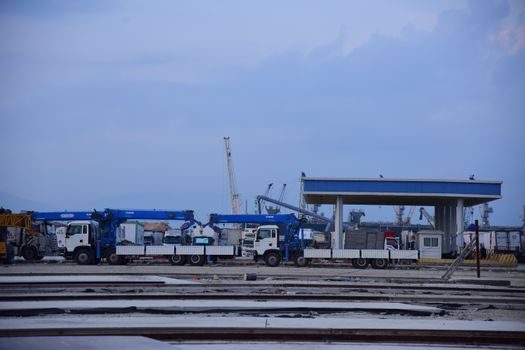
Telescopic truck cranes avoid that penalty but bring a longer stowed envelope that can breach road-height limits; the LTC 1050-3.1E's 48 m working height requires careful route planning on a 7 t carrier at 85 km/h [S2].
Hydraulic heat rejection is the silent failure mode on high-cycle scrap-yard duty, which is why the DISAN unit lists an air-cooled oil-cooling fan as a standard line rather than an option [S1]. Electro-hydraulic dual-mode cranes introduce a second failure surface (the 125 A / 63 A / 32 A site-supply interface), so buyers should pin the supply-amp rating in the contract rather than assume any 50 A site socket will deliver full performance [S2].
Trackable signals over the next quarter: 2026-09-14 IMTS Chicago (Liebherr stand North Level 3, 237044) and 2026-09-22 InnoTrans Berlin (Outdoor Display O/170) for new telescopic and electric-mode announcements [S2]. Watch the Hiab X-CLX 2x8 and X-Duo refresh cycle, and any SQ14-class follow-on lifting the 14,000 kg / 35 tm envelope to a higher-pressure hydraulic system. A swing toward EN 13000-aligned electric-mode truck cranes in European tenders is the clearest procurement signal in the second half of 2026.