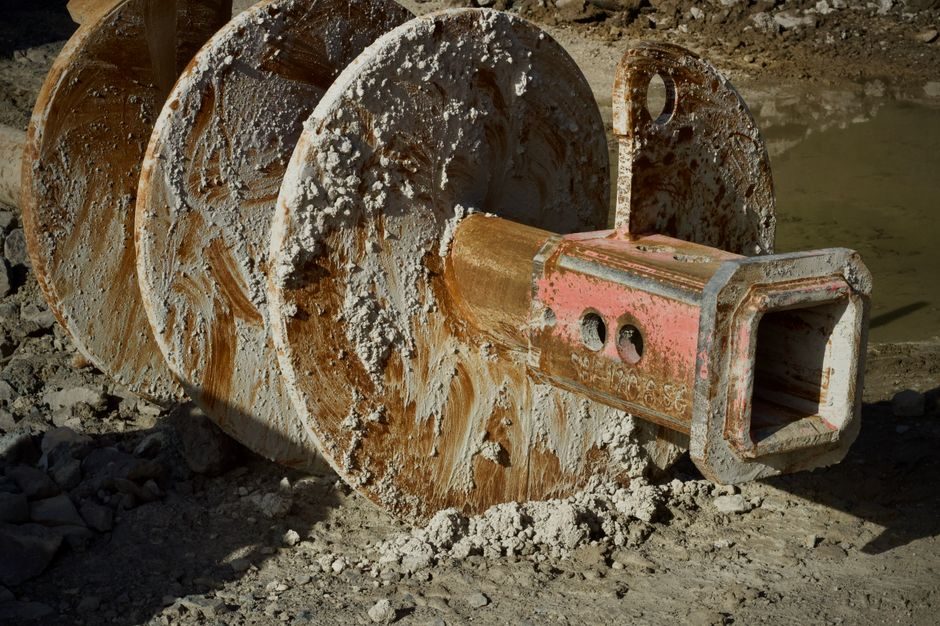
An air pick — sometimes called a pneumatic chipping hammer or pick hammer — converts compressed-air flow into a reciprocating piston stroke that drives a pointed or flat chisel at roughly 600–3,000 blows per minute, with piston strokes typically 25–90 mm and tool shanks in the 14.6 mm (round hex), 17.3 mm, 19 mm hex or 22 mm round patterns [S1].
Realistic per-tool air consumption sits between 600 and 1,500 L/min (≈ 21–53 CFM) at 6.3–6.9 bar (≈ 90–100 psi) working pressure, which means a single pick running flat-out can starve a 7.5 kW (≈ 10 hp) compressor unless the receiver is sized to absorb the pulse load [S1].
Where the air pick beats electric or hydraulic alternatives
Pneumatic power is intrinsically spark-free at the working end because the tool itself contains no electrical windings or hot surfaces, which is why the air pick is still the default chipper in petrochemical shutdowns, LNG carrier tank cleaning and Zone 1 refinery work where an electric hammer would require ATEX certification and a heavier mechanical guard [S1].
Weight-to-energy ratio is the second clear win: a 4–5 kg air pick can deliver 8–15 J per blow, comparable to a 7–9 kg electric rotary hammer, and the operator absorbs less handle-mass fatigue on long shift demolition jobs [S1]. Cold-start behaviour is also better than hydraulics — at –20 °C an air pick will still cycle, while a hydraulic hammer using standard mineral oil will be sluggish until the fluid warms past roughly 0 °C.
The real cost line items a spec engineer has to price
Air picks look cheap on the PO because the tool body is often $200–$500, but the five-year total cost stacks on three things: compressor electricity, hose/treatment upgrades, and consumable steel. Compressor cost dominates: 1,200 L/min at 6.5 bar for 2,000 hours per year at 0.18 USD/kWh against a 7 kW/kW specific power consumption lands near $1,800–$2,400 per tool per year in electricity alone [S1].
The second line item is air prep. A pick will not tolerate wet, oily supply — water in the cylinder washes the lube oil off the piston and scores the bore within 50–100 hours, so spec the upstream chain as a moisture separator + regulator + lubricator with the lubricator set to roughly 1 drop per 50 strokes (manufacturer default for most 4–8 kg picks) [S1]. Hose inner diameter matters: a 10 m run of 8 mm ID hose at 1,200 L/min drops the working pressure to the tool by ~1.0–1.5 bar, which kills impact energy; 12.5 mm (1/2 in) is the practical minimum, 19 mm (3/4 in) preferred above 15 m.
Consumables, vibration and operator-health downsides
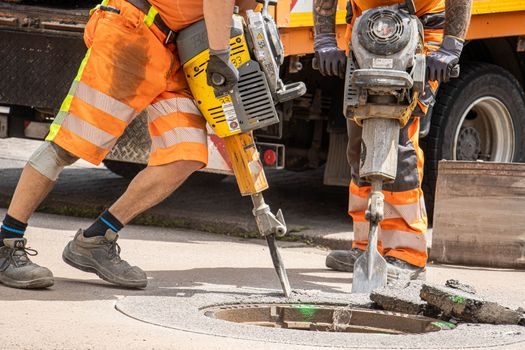
Chisel shank life is short by any measure. A 17.3 mm hex pointed chisel chipping reinforced concrete typically fails by mushrooming, tip fracture or shank breakage at 50–150 hours of continuous work; a flat chisel on boiler descaling fares better at 200–400 hours because the impact load is more axial. Budget $0.50–$2.00 per operating hour in consumable steel on top of the tool price [S1].
Vibration is the second hard limit. Hand-arm vibration (HAV) values for pneumatic picks routinely sit between 12 and 25 m/s² — well above the EU Vibration Directive 2002/44/EC exposure action value of 2.5 m/s² A(8) and the limit value of 5.0 m/s² A(8). A single shift of unpadded grinding with a 20 m/s² tool reaches the limit value in roughly 25 minutes of trigger time, which is why air-impact-style tools share the same PPE and rotation rules discussed for the air impact wrench TCO field.
Selection criteria: which pick for which job
Three decision criteria cover most shop-floor picks. Stroke length picks the application — 25–40 mm strokes suit cleaning and descaling where you want a fast, light cut; 50–70 mm suits general chipping on concrete and weld slag; 80–100 mm strokes are for heavy demolition where each blow must break a piece, not peck at it [S1].
Shank pattern picks the consumable supply. The 14.6 mm round hex (also called "USA hex" or .580 hex) and 17.3 mm hex dominate North American pipeline and refinery work; 19 mm hex is common in European shipyards; the 22 mm round shank appears on heavy demolition picks running above 1,500 BPM. Bore size picks the air class — 19 mm (3/4 in) bore picks land at the 600 L/min / 4–5 kg point, 25 mm (1 in) bore picks at 1,000–1,500 L/min / 5–7 kg, and 32 mm (1¼ in) bore picks above 2,000 L/min / 7–10 kg.
Air-system side effects that bite when you scale up
Receiver sizing is the most undersized part of an air-pick spec. A pick draws air only on the forward stroke, so the instantaneous demand is roughly twice the average figure — a 1,200 L/min average draw becomes a 2,400 L/min pulse. The receiver should be at least 1 L per L/min of pipe-flow (so 1,200 L for the 1,200 L/min pick) to keep pressure drop under 0.5 bar; otherwise impact energy falls off and the operator compensates by pushing harder, breaking chisels and backs.
Noise is the side effect the engineering floor forgets. Free-field sound power of a chipping pick is typically 100–115 dB(A) at the operator, which puts the workspace over the OSHA 90 dB(A) 8-hour PEL and most EU hearing-damage thresholds within minutes; pair the pick with an air quality monitor downstream of the lubricator to catch carryover oil aerosol, and a hearing-protection zone of at least 4 m radius.
Where the air pick is the wrong tool
Avoid the air pick in three cases. First, precision demolition where a hydraulic or electric breaker with chip-control will not spall adjacent concrete — picks do not give controlled breakage. Second, work inside an occupied or food-grade space without a dedicated oil-free compressor, because the lubricator will put a fine oil mist into the air. Third, any application where the work piece is the only load-bearing element (e.g. cutting a tensioned bolt) — the violent impact can shear the bolt explosively and send fragments through the air solenoid valve manifold on nearby equipment. [S1]
For light material handling upstream of the pick, an air impact wrench sized to the bolt class and a properly sized flow meter on the compressor line are the supporting picks of the pneumatic tool ecosystem. Cross-check the air pick types and classifications guide before standardising on a single shank pattern across a multi-site fleet.
Standards and sourcing notes

Industrial pneumatic chipping hammers are not governed by a single ISO performance standard the way torque wrenches are; buyers instead rely on the maker's ISO 9001 quality system, ISO 3741 / ISO 11203 noise declarations and ISO 28927 hammer-vibration test data for HAV reporting under Directive 2002/44/EC [S1]. Compressed-air quality should be specified to ISO 8573-1 Class 1.4.2 (solid ≤0.1 µm, water pressure dew point +3 °C, oil ≤0.1 mg/m³) for picks in continuous service.
Two trackable signals to watch: tighter HAV limits in the EU Vibration Directive 2002/44/EC revision track (currently a few member states pushing the action value toward 1.5 m/s²), and the gradual switch to oil-free diaphragm or water-injected lubricators on plant air for picks used in pharma and food plants. Both would shift the TCO math on air picks versus electric chipping hammers by 15–25% within a five-year fleet cycle.