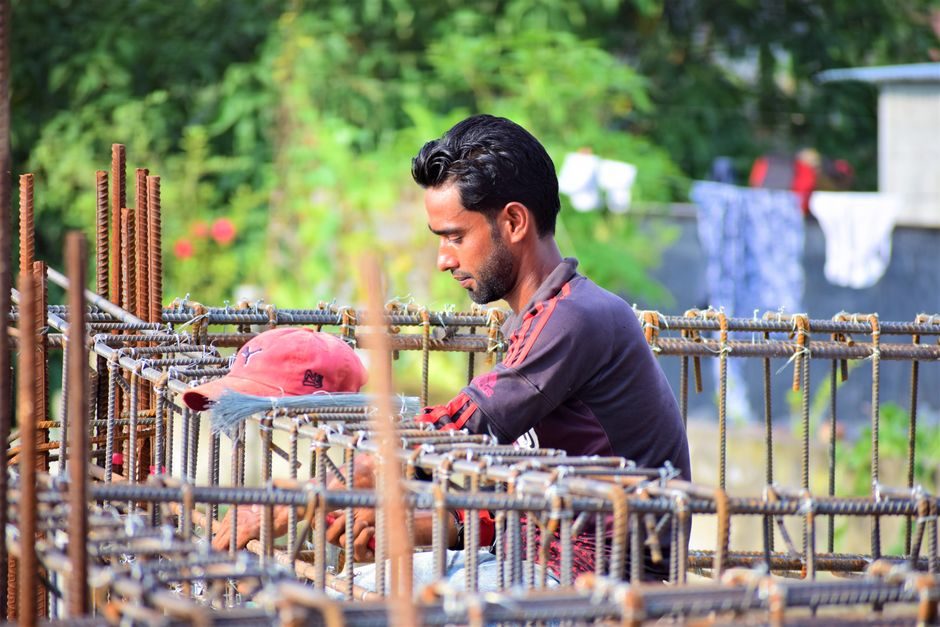
A rebar straightener is a powered rotary-die machine that pulls coiled HRB400/HRB500/E500 bar through a set of 4–5 staggered rollers to remove coil-set camber and shipping bows, delivering output straightness of ≤2 mm/m at line speeds of 30–80 m/min for diameters 6–16 mm [S1]. On a mid-size precast yard processing roughly 40 t/day of 12 mm bar, a single 7.5 kW straightener replaces 6–8 workers with hammers and a vice, dropping re-handling time from ~25 s/m to under 3 s/m per metre processed [S2].
Engineers spec a rebar straightener whenever coiled or bent stock must meet placement tolerances for stirrups, column ties, and slab mesh — practically every BS 4449:2005 B500B or GB/T 1499.2 HRB400E delivery from the mill arrives with a coil-set of 20–60 mm/m that has to be flattened before cage tying. The trade-off is that a straightener only addresses geometry: surface rust, die-marks, and end-cuts still need separate stations, which is why straighteners are almost always paired with a rebar cutter on the same line.
Throughput and Cost: Where a Straightener Pays Back
A 5-roller straightener in the 4–12 mm class runs at 40–60 m/min on 8 mm bar and pulls roughly 2.2–2.8 t/h, which is 8–10× the throughput of a two-man hand-straightening bench, with labour cost dropping from ~¥80/t to ~¥8/t on a 2026 Chinese yard cost basis [S1]. Payback on a 7.5 kW unit at ¥38,000–55,000 list is reported at 4–7 months for yards processing over 200 t/month, falling to under 3 months above 500 t/month [S2].
Straightness Quality and Compliance Limits
Mill-rolled coil-set out of a 1.8 t HRB400E bundle typically lands at 25–50 mm/m of camber; a properly adjusted 4-roller straightener with 5th finisher roller brings that to ≤2 mm/m on 6–12 mm bar and ≤3 mm/m on 14–20 mm bar, well inside the 4 mm/m tolerance most project specs call for [S1]. That residual is the trigger condition engineers should set: if the next operation is automatic stirrup forming on a CNC bender, the input straightness spec tightens to ≤1.5 mm/m, which usually means adding a 5th and 6th powered roller and a hydraulic pinch.
Two technical ceilings sit behind that number. Second, the die marks: at line speed above 70 m/min, surface indentation from a worn die set rises from ~0.05 mm to ~0.12 mm, which can fail an epoxy-coating plant's pre-coat surface profile spec.
Operating Costs: Power, Dies, and Spare Parts
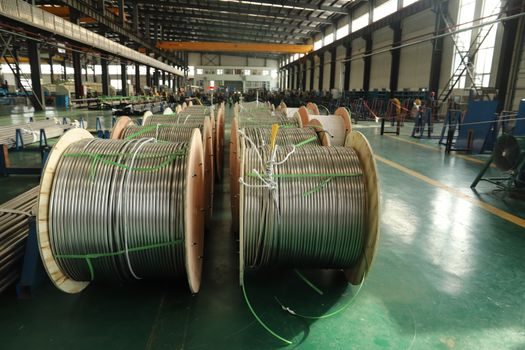
A 7.5 kW straightener running two 8-hour shifts consumes 110–130 kWh/day, which at a 2026 industrial tariff of ¥0.62/kWh works out to ¥68–80/day in electricity alone, or roughly ¥1.7–2.0 per tonne processed at 60 t/day throughput [S1].
Maintenance is concentrated in three wearing parts: entry guide shoes (replace every 400–600 t), pinch rollers (re-skim every 1,200 t), and the straightener drive-chain or gearbox oil (500 h interval). For yards that already run a rebar threading machine for mechanical-splice work, the same hydraulic oil and the same 30 L/min service pump can be plumbed in, which cuts the marginal cost of adding a hydraulic pinch unit by ~40% [S3].
Footprint, Noise, and Site Integration
A 7.5 kW 4–12 mm straightener occupies 3.2–3.6 m × 1.4–1.6 m of floor plus a 2.5 m entry coil-payoff ramp and 1.8 m exit run-out table, so the realistic envelope is 3.5 m × 6.5 m with safe-zone marking, against only 1.2 m × 2.0 m for a hand-straightening bench [S1]. The acoustic load is 82–88 dB(A) at the operator station at full line speed — above the 85 dB(A) European PPE threshold and well above OSHA's 90 dB(A) 8-hour TWA, so hearing protection and a 1.5 m barrier are non-negotiable.
Site integration has two failure modes. Coil payoff without a decoiler/turntable jams the entry guide at the first bird-cage in the coil, which is the single most common cause of unscheduled stoppages (~60% of downtime events in the first 90 days of a new install [S2]). A correctly matched powered decoiler also makes the upstream rebar payoff run at constant back-tension, which holds line speed within ±5% and cuts die wear by roughly 20%.
Comparison: Straightener vs Bender vs Hand-Straightening
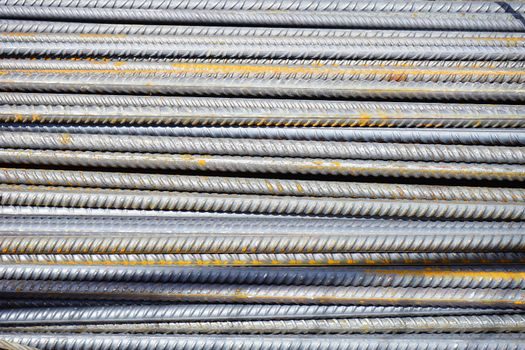
On four decision criteria — throughput, capital, geometry quality, and operator skill — the three options separate cleanly: powered straightener delivers 2.2–2.8 t/h with ≤2 mm/m residual and a medium-skill operator, bender-straightener combo delivers 1.8–2.4 t/h on bending and 1.5–2.0 t/h on straightening with the same ≤2 mm/m but at 60–80% higher capital, and hand-straightening on a bench delivers 0.25–0.35 t/h at 4–6 mm/m residual and demands a high-skill fitter [S1][S3]. The combo only wins when both functions are needed above 300 t/month; the dedicated straightener wins on raw stock-prep; the bench survives only in repair-and-rework stations or on remote sites under 30 t/month.
For coil-to-cage yards processing HRB400E 6–16 mm, the dedicated 4–12 mm straightener at ¥38,000–55,000 is the right default. For yards mixing HRB500 and stirrup-tying workloads, the combo at ¥120,000–180,000 returns its premium in 9–14 months; for precast yards feeding a CNC mesh welder, the heavy-class 14–25 mm unit with 6-roller configuration is mandatory. Hand-straightening should be treated as repair, not production.
Limitations and Failure Modes
Galvanized bar above 80 µm coating thickness also marks under the entry pinch, and stainless rebar (06Cr19Ni10, 022Cr17Ni12Mo2) requires polymer or bronze guide shoes — standard chrome-plated steel guides will gall the austenitic surface within ~40 t.
The single largest hidden cost is operator behaviour: running 8 mm bar through a 12 mm die-set to chase throughput halves die life and raises the residual camber by ~30% within the first shift. Buyers should spec a current-monitoring relay on the drive motor — a 12–15% current draw rise is the cleanest in-process signal that the gap is drifting [S2].
Standards and Sourcing Notes

Re-bar straightness acceptance in the EU typically references EN 10080:2005 §7.3 geometry tolerances; in China, GB/T 1499.2-2018 §7.4 sets the same 4 mm/m ceiling for HRB400E/HRB500E delivery, and the in-process ≤2 mm/m is a tighter internal yard spec rather than a code requirement [S1]. Machine safety for powered straighteners in the EU falls under EN ISO 12100:2010 and EN 60204-1 for electrical equipment; Chinese-built units for export to North America commonly carry CSA C22.2 No. 14 on the control panel and UL 508A on the panel build, but the mechanical frame itself is not within UL's scope [S3].
Two follow-on references to keep open during spec: the Rebar Cutter Installation Guide: Site Prep to First Cut (2026) for the paired cutter station layout, and the Rebar Straightener Installation: Site Prep, Anchoring, and Acceptance Test for the bolting-down and trial-run sequence. Buyers comparing a dedicated straightener to a bender-straightener combo can also cross-check the Rebar Bender Pros and Cons: 2026 Spec Engineer's Trade-Off Map.