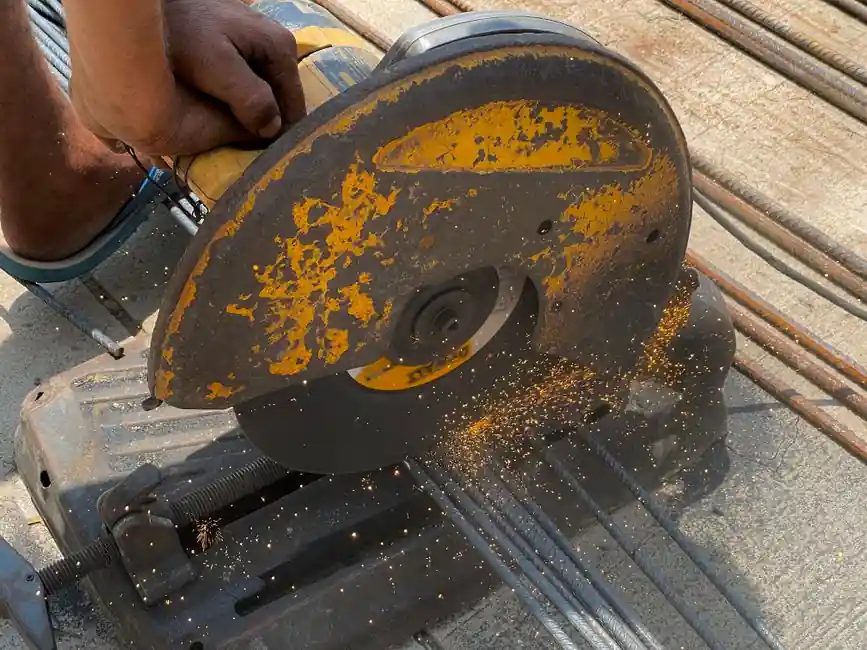
For interior finishing work, a rebar threading machine rated 3-6 kW at 380 V with a 100-1000 kg frame is the practical envelope cited by current Indian and Chinese OEM catalogues [S1][S2].
Interior finishing rarely demands the heaviest rebar diameters seen in main structural pours, so the spec map narrows to machines that cut or roll ISO metric parallel threads on 12-25 mm rebar cleanly inside a finished floor footprint, with a matching rebar coupler lineup from 40Cr or 45# carbon steel.
Machine Class: Roll vs Cut for Interior Finishing
Two architectures dominate the OEM lists, and the choice is governed by thread length, not by bar diameter alone [S1][S2][S3]. A rebar thread rolling machine displaces material cold to form the thread, with one Chinese maker publishing 100-300 mm workable thread length in the rolling class and another listing throughput-style "high speed easy operation" units aimed at repetitive splicing [S2].
A rebar thread cutting machine uses tangential chasers or single-point tooling to remove stock, and is the architecture behind National Cutting Tools' steel bar threading line, which shares the same 3-6 kW, 380 V, 100-1000 kg chassis as their hydraulic pipe threading range [S1]. For interior finishing where lap splices are restricted by cover depth, the rolling-end thread typically matches standard rebar couplers in 40Cr or 45# carbon steel without the swarf a cutter leaves inside the thread [S2].
For comparison on four decision criteria relevant to interior finishing crews:
Thread rolling machine: cold-formed thread, no swarf, slower per bar, requires matched 40Cr/45# coupler; thread length 100-300 mm per published spec; power draw 3-6 kW at 380 V; frame 100-1000 kg [S1][S2].
Thread cutting machine: cut thread, swarf to clear, faster per bar, accepts a wider coupler material mix including 20# and 16Mn cold-pressed sleeves; same 3-6 kW and 100-1000 kg envelope; chaser geometry is the wear item [S1][S2][S3].
Upsetting + thread combination: an upset bar end is mandatory where the rolling machine cannot develop full thread length on small-diameter bars; BARTECH sells an auto rebar end upsetter matched to its rolling machine line, and the upset-end coupler is its own product family [S2].
Power, Voltage, and Frame Spec Gates
The 3-6 kW window at 380 V three-phase is the working point both for the Indian rebar threading machine SKU and the Chinese rebar thread rolling machine family published in 2026 [S1][S2]. Single-phase 220 V variants exist for site work but are not the dominant SKU in either catalogue [S1].
Frame weight 100-1000 kg is published as a band rather than a single figure, which tells the spec-writer the machine class spans portable bench units up to floor-standing production units, with the heavier end of the band reserved for the rebar bender and threading combinations sold to precast yards [S1]. CE certification is shown on the National Cutting Tools rebar threading machine SKU, which is the cleanest compliance marker for European interior fit-out work [S1].
Production capacity on the Made-in-China rolling-dies listing is 500 sets per month from a 2003-founded Shanghai workshop, with wood-case export packaging and L/C or T/T terms; this is a useful throughput benchmark when sizing a finishing contractor's rebar splicing line [S3].
Coupler and Thread Compatibility
Thread length on the rebar threading machine must match the coupler make, not the bar diameter, and three coupler families are in current production [S2]. Standard and positional rebar couplers in 40Cr and 45# carbon steel accept the rolling-end thread form; the upset-end parallel thread coupler family is sized for the upset-then-roll workflow and is the one to pick when the bar diameter is at the lower end of the machine's range [S2].
Cold-pressed pressing sleeves in 20# or 16Mn raw material are a separate machine path, served by a manual coupler pressing machine that does not thread the bar at all; this is the lowest-capex route when interior finishing rebar is small-diameter and the splice is non-critical structurally [S2]. Plastic thread covers and a dedicated rebar coupler wrench are stocked as accessories, and the wrench torque is the field variable that decides whether the splice meets the coupler's published strength [S2].
Selection Criteria for Interior Finishing Crews
Interior finishing work typically means slab thickenings, stair wells, lift cores, plant rooms, and retrofit openings, where rebar diameters cluster in the 12-25 mm band and the finishing material schedule is tight on laydown space. For that scope, a 3-6 kW floor-standing thread rolling machine in the 200-400 kg frame range, paired with 40Cr standard couplers, covers most splicing tasks without the cutter's swarf control problem [S1][S2].
For crews that move between floor pours, a thread cutting machine on the same 3-6 kW chassis is the more flexible pick because one set of tangential chasers can serve multiple bar diameters, with the trade-off of needing a swarf vacuum or blow-off before coupler make-up [S1][S3]. The rebar cutter is a separate machine class and should not be substituted for the thread rolling or thread cutting unit; cutting machines shear the bar, they do not form or cut threads [S1].
For precast interior panels where the rebar is pre-positioned before pour, the upset-then-roll combination removes the need for a thread length longer than the coupler body, which is the cleanest fit when cover depth is the binding constraint [S2]. Cross-spec the rebar threading machine thread length against the coupler catalogue before purchase, not after.
Field Constraints and Failure Modes
Three failure modes show up in interior finishing threading work. First, thread length shorter than the coupler engagement length causes bar slip under load and is the most common field rejection cause; the 100-300 mm thread length window on current rolling machine SKUs exists because the standard couplers in 40Cr and 45# carbon steel need that engagement to develop full bar strength [S2].
Second, swarf left inside a cut thread blocks full coupler engagement; this is why interior finishing crews on tight schedules should bias toward rolling, even at the cost of per-bar cycle time [S1][S2]. Third, mismatched raw material between the bar and the coupler, for example a 20# cold-pressed sleeve on a high-grade rebar, drops the splice below the bar's yield and is the spec error that does not show up until the slab is loaded [S2].
Sourcing Notes and Standards
Both Indian and Chinese OEM catalogues publish CE marking on the rebar threading machine SKU, and the National Cutting Tools product page lists CE certification explicitly for its 3-6 kW, 380 V rebar threading line [S1].
For interior finishing work in EU jurisdictions, the practical compliance chain is CE on the machine plus project-specific structural approval on the coupler splice, and the coupler's published raw material (40Cr, 45#, 20#, or 16Mn) is the traceability document the structural engineer will ask for [S1][S2]. Related reading on this scope is available in the Rebar Threading Machine Selection for Concrete Work spec map and in the Rebar Threading Machine Selection for Steel Construction spec map, which cover heavier structural envelopes. For thinner-scope repair work, the road maintenance and bridge-deck repair selection note documents smaller frame sizes and field-portable kits in the same 3-6 kW class.
Trackable signals for the next 6 months: any new coupler SKUs in 40Cr or 45# carbon steel with published thread length below 100 mm for thin-slab interior work, and any CE-marked single-phase 220 V rebar threading machines under 100 kg frame weight, which would open interior finishing work in retrofit residential scopes.