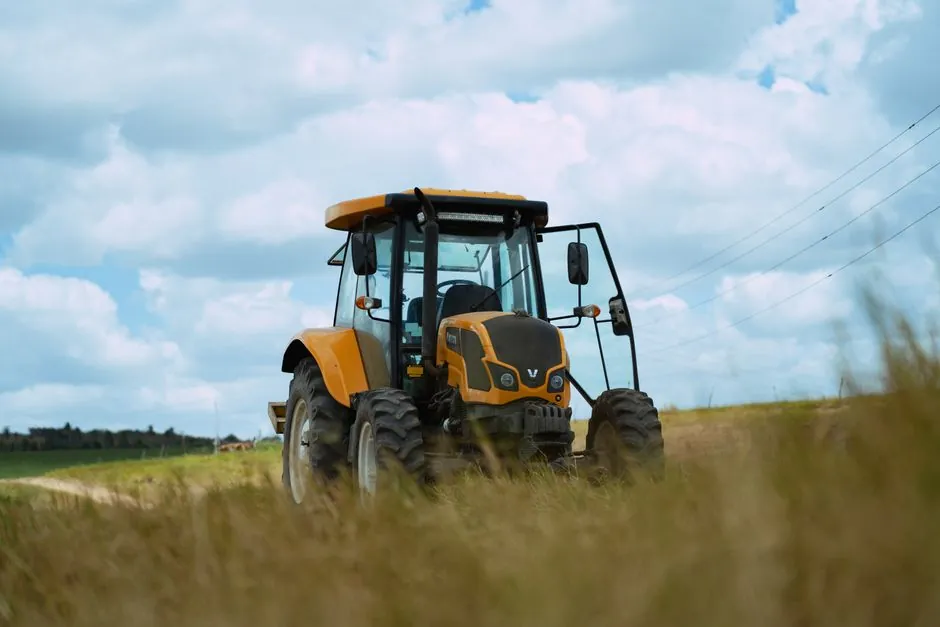
Resin sand molding lines are the dominant process for medium to large iron castings used in agricultural machinery, with production ranges suited to gearbox housings, hydraulic components, and structural brackets weighing from roughly 20 kg up to 500 kg or more per piece [S2].
Compared with green sand automatic lines, which typically hold ISO 8062 CT9 to CT11 and surface roughness Ra 12.5 to 25 micrometers, resin bonded systems tighten dimensional tolerance to CT7 to CT9 and push finish down to Ra 3.2 to 12.5 micrometers, a meaningful step for parts that feed straight into CNC machining cells [S3]. For foundries serving both automotive Tier 1 and farm equipment OEMs, a similar resin sand line spec map for automotive parts shows the same selection logic, batch size and tolerance first, alloy second.
Why Agriculture Machinery Fits the Resin Sand Process
Agricultural iron castings, including transmission housings, sprockets, pulleys, agricultural gearboxes, and hydraulic valve bodies, demand vibration damping, wear resistance, and batch-to-batch consistency, properties that gray iron and ductile iron deliver reliably when poured into rigid resin bonded molds [S2]. Resin sand casting is explicitly called out as suitable for medium to large iron castings with high accuracy and complex shapes, exactly the envelope that farm equipment draws from [S2].
The agricultural sector also tends to run medium batch sizes, often 500 to 5,000 pieces per part number per year, which sits in the sweet spot for resin sand: too large for manual floor molding, but not large enough to justify the cycle time of high-pressure green sand flask lines that can push up to roughly 20 tons of castings per day on automotive programs [S1]. For foundries already running multiple alloys, the synthetic resin binder system used in these lines accepts gray iron, ductile iron, and alloy iron without re-tooling the sand loop, an important point when batch mixes shift with planting and harvest seasonality.
Selection Criteria: Box Size, Sand Reclamation, Curing Method
Three engineering parameters drive 80 percent of the selection decision on a resin sand line: molding box dimensions, sand reclamation rate, and binder chemistry. Box size must clear the largest part plus 100 to 150 mm of sand padding on every face; for a 500 kg gearbox housing, a 1,200 mm by 1,200 mm flask is the practical minimum, and most suppliers size up to 1,500 mm by 1,500 mm or 1,800 mm by 1,800 mm for headroom. [S1]
Sand reclamation rate matters more than throughput on most agricultural projects. Modern attrition reclamation units recover 90 to 95 percent of used sand, and thermal reclamation pushes that to 95 to 98 percent, which keeps the binder cost per ton of casting at a competitive level against green sand operations running on bentonite-water systems [S1][S3]. Curing method is the third gate: furan resin plus acid catalyst (no-bake) is the default for heavy iron castings because it gives a rigid mold that holds shape during pour, while phenolic urethane (Pepset) is preferred when faster strip times are needed on higher batch counts [S1].
Process Comparison: Resin Sand vs Green Sand vs Shell Molding
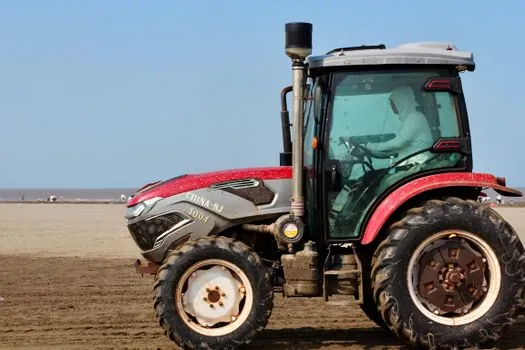
The decision matrix for an agriculture machinery foundry is narrower than it looks. Green sand wins on tooling cost and per-unit cost for simple shapes in high volume, but it bottoms out at roughly 5 mm minimum wall thickness and struggles with parts over 1,000 lb (about 450 kg), which rules it out for many heavy-duty gearbox and axle housings [S1]. Standard investment casting delivers ISO 8062 CT4 to CT6 and Ra 1.6 to 6.3 micrometers, but the per-unit cost is the highest of the three, and it cannot economically hit the volume bands that farm equipment demands [S3].
Resin sand molding lines sit in the middle on cost and on tolerance, at ISO 8062 CT7 to CT9 and Ra 3.2 to 12.5 micrometers, which is enough to drop finish machining allowances by 1 to 2 mm on most iron castings and shorten CNC cycle time measurably [S3]. For foundries that also serve pump and valve OEMs, the shell molding machine selection logic for pump and valve work follows a similar criteria-based pattern, though shell molding trades higher pattern cost for tighter finish and thinner walls, typically 3 to 6 mm. On the molding line type choice, the rule of thumb is: green sand for prototyping and high-volume simple parts, resin sand for medium-volume complex iron castings, shell mold for tight-tolerance thinner-wall parts where the pattern cost amortizes.
Standards, Materials, and Inspection Anchors
Dimensional references on a resin sand line should be quoted to ISO 8062 CT grade, with CT8 to CT9 being the practical baseline for agricultural castings that still go through finish machining on bearing bores and seal grooves. Material grades typically reference ASTM A48 for gray iron, ASTM A536 for ductile iron, with the option of DIN 1691 and JIS G5501 cross-references for export programs; the supplier should hold batch-traceable chemistry records against these standards, with spectrometer checks per heat [S2].
Mechanical property targets are part-dependent. Gray iron gearbox housings usually land at tensile strength 200 to 300 MPa, while ductile iron structural brackets target 350 to 500 MPa with elongation 7 to 12 percent for impact resistance. For ductile iron going into corrosive or slurry-exposed applications, NACE MR0175 compliance on the casting itself is rarely the issue, but foundries supplying sour-service components still need to track Y-block Charpy results and provide ferrite count where specified.
Where Resin Sand Lines Fall Short
Resin sand is not a universal answer. Cycle time per mold is longer than green sand, typically 8 to 15 minutes including stripping, sand mixing, and mold assembly, so a single-station resin line will not match the throughput of an automated green sand flask line for simple brackets below 10 kg. Per-ton binder cost is also higher than bentonite-water systems, which means resin sand is uneconomic for parts where dimensional tolerance and surface finish are not driving value, e.g. counterweights and simple wear plates. [S3]
Environmental control is another constraint. Furan-acid systems emit SO2 and formaldehyde during pouring and shakeout, and most jurisdictions now require scrubber-equipped pouring lines plus binder handling under LEV. A newer automatic molding line retrofit with closed-loop sand and binder dosing will cut VOC per ton of casting by 20 to 30 percent, but it raises the capex line by 10 to 15 percent compared with a basic manually-fed resin line.
Sourcing and Supplier Vetting
When evaluating a resin sand line supplier, the audit checklist should include: in-house pattern shop with lifetime pattern warranty, vertically integrated heat treatment (anneal or normalize), CNC machining capacity for at least 60 percent of the part envelope, and dimensional inspection to ISO 8062 with a documented CT grade capability study on at least three representative parts [S2][S3]. Foundry location also matters for agricultural customers, since most farm equipment OEMs concentrate sourcing in regions with strong iron casting density, and lead times from those clusters typically run 30 to 45 days for finished machined parts versus 60 to 90 days from low-density regions.
Trackable signals for the next sourcing cycle include resin binder price index moves (furan acid systems are tied to furfuryl alcohol, which has been volatile), updates to ISO 8062 CT grade tables, and the rollout of low-formaldehyde binder systems that several large foundries are piloting through 2026.