
NIOSH recognizes two top-level respirator families, air-purifying respirators (APR) and atmosphere-supplying respirators (ASR), and assigns a numeric Assigned Protection Factor (APF) to every sub-type, ranging from 5 for a filtering facepiece to 10,000 for a positive-pressure full-facepiece SCBA [S1][S3].
Millions of U.S. workers in healthcare, construction, mining, public safety, and emergency response rely on NIOSH-approved respirators as the last administrative line in the hierarchy of controls, with selection driven by the contaminant, its airborne concentration, and the oxygen fraction of the work environment [S1].
Two families, five APR sub-types, three ASR sub-types
NIOSH groups the air-purifying branch into filtering facepiece respirators (FFR, disposable), elastomeric quarter-facepiece, elastomeric half-facepiece, elastomeric full-facepiece, and powered air-purifying respirators (PAPR), each a tight-fitting or loose-fitting tight-fitting device that relies on filters, cartridges, or canisters to strip particulates, gases, or vapors from ambient air [S1][S2].
The atmosphere-supplying branch groups into supplied-air respirators (SAR, hose-fed from a Grade-D air source), self-contained breathing apparatus (SCBA) in open-circuit (typical for fire service) and closed-circuit form (rebreather / SCSR used for mine escape), and combination SAR/SCBA units that fall back to cylinder air if the airline fails [S1][S3]. ASRs are the only branch that can legally be used in oxygen-deficient atmospheres below 19.5% O2, because APRs do not supply oxygen and must never be deployed where oxygen is displaced [S3].
Assigned Protection Factor is the deciding number
The APF is the airborne contaminant concentration multiplier a respirator is expected to handle under a compliant fit-test program, with OSHA 29 CFR 1910.134 Table 1 setting 5 for a disposable FFR, 10 for a half-mask APR, 50 for a full-facepiece APR, 1,000 for a tight-fitting PAPR, and 10,000 for a positive-pressure full-facepiece SCBA [S3][S5].
For PAPRs, NIOSH's filter class framework provides nine negative-pressure particulate filter categories plus a dedicated PAPR particulate category, giving roughly ten NIOSH filter classes for powered and non-powered respirators combined [S4]. Selection therefore reduces to dividing the measured hazard concentration by the chosen APF, then verifying the filter class (P100 / HE for particulates, plus an organic vapor or acid gas cartridge for chemical hazards) is rated for that specific contaminant [S4][S8].
Filter class mechanics: N, P, R, HE and the 95/99/100 tier
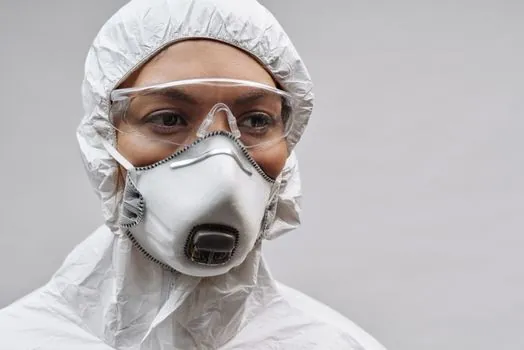
NIOSH-approved particulate filters are graded by degradation letter, N (not oil-resistant), R (somewhat oil-resistant), P (oil-resistant / P100 is the HE equivalent), and by efficiency, 95 (≥95% filter efficiency), 99, and 100 (≥99.97% HE), so a P100 filter is the minimum specified for many CBRN and radiological APR tasks [S2][S3].
FFRs such as the N95 and elastomeric half-mask respirators (EHMR) equipped with P-series filters both deliver a minimum 95% filtration efficiency at the most-permeable particle size, but elastomerics are reusable, swappable on cartridges, and the only class that can be economically deployed for routine gas and vapor exposure where disposable FFRs offer zero protection [S2][S8]. EHMRs and EQMRs seal around the nose and mouth, must be quantitative or qualitative fit-tested, and require a written respiratory protection program under OSHA 29 CFR 1910.134 [S1][S2].
Tight-fitting vs loose-fitting inlets change everything
APRs and SCBAs are almost always tight-fitting, requiring shave policy, qualitative or quantitative fit testing, and a user seal check before every donning, while PAPRs can be tight-fitting or loose-fitting hood/head-cover designs, which sidestep fit testing entirely and are commonly used in healthcare, pharmaceutical aseptic suites, and welding hoods [S1][S3][S5].
The trade-off is blower battery weight, hose snag, and reduced APF (a loose-fitting PAPR hood typically carries APF 25 to 1,000 depending on face seal vs hood) compared to a tight-fitting half-mask APR at APF 10, so specifiers should match the inlet geometry to the wearer's beard, prescription eyewear, and movement pattern, not the other way around [S3][S5]. For broader PPE selection logic in a fixed facility, the same spec-driven approach used for eye wash station compatibility with ANSI and OSHA availability rules carries over to breathing-air systems, since both hinge on hazard mapping plus standard-driven minimum performance.
International and specialty respirators: KN95, KF94, FFP2, CBRN, SCBA Escape
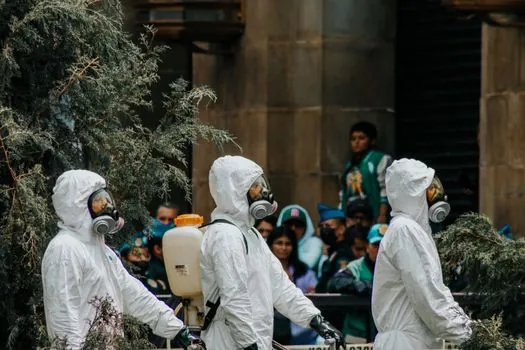
International filtering facepiece respirators such as KN95, KF94, and FFP2 are particulate-only devices that meet foreign certification schemes rather than the NIOSH approval label, and most do not carry the NIOSH filter-efficiency grading, so they are typically restricted to non-regulated occupational use and a small set of crisis-authorized scenarios [S2].
For higher-tier work, NIOSH CBRN APRs (full-facepiece elastomeric with CBRN canisters) and CBRN PAPRs are specified for first responders, while closed-circuit SCBA rebreathers known as self-contained self-rescuers (SCSR) provide roughly 30 to 60 minutes of oxygen for mine escape, and open-circuit SCBA delivers 30 to 60 minutes at 4500 psig cylinder pressure for fire service entry [S1][S3]. Where respirators sit inside a wider PPE matrix, the warning sign selection rules under OSHA 1910.145 and ANSI Z535.2 govern the visible enforcement around them, and the fire extinguisher class and rating logic mirrors it: class by hazard, numeric rating by severity.
Selection decision tree: hazard, concentration, oxygen, fit
Step one is hazard identification: particulate (dust, fume, mist, radionuclide), gas/vapor (organic vapor, acid gas, ammonia, mercury), or both, which maps to filter media plus a NIOSH-certified cartridge color code, with combination cartridges for mixed atmospheres [S4][S8].
Step two is concentration check, dividing the measured airborne concentration by the respirator's APF gives the maximum use concentration, and any oxygen reading below 19.5% automatically routes the selection to an ASR (SAR or SCBA) because APRs do not supply oxygen [S3][S5]. Step three is fit: a clean-shaven user with no facial hair can use any tight-fitting class; workers with beards, prescription glasses, or facial scarring should be routed to a loose-fitting PAPR hood or a full-facepiece with spectacle inserts, never forced into a half-mask. Step four is program: OSHA 29 CFR 1910.134 requires medical evaluation, written program, training, fit testing, and recordkeeping, and the NIOSH Certified Equipment List (CEL) is the authoritative check for an approved model number before purchase [S1][S4].
Limitations, failure modes, and what respirators cannot do
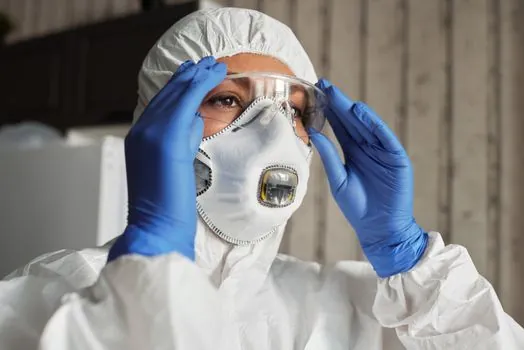
APRs cannot be used in oxygen-deficient atmospheres, cannot be used above the filter's stated maximum use concentration, and rely on a maintained face seal, so a single broken strap, missed user seal check, or 1-day stubble drops effective protection below the rated APF [S3][S5].
SARs require a Grade-D breathing air source (CGA G-7.1) and an intact supply hose, and they fail if the compressor ingests CO from a gasoline engine or the hose is run through a pinch point, so end-to-end air quality testing is part of the program, not optional [S1]. PAPRs add blower failure risk, battery runtime limits, and high up-front cost, so redundancy plans and battery management must be written into the program, mirroring the kind of pre-deploy checks described in concrete pump truck cooling water loop certification where the supporting system is as regulated as the primary machine.
The next trackable signal is the NIOSH Certified Equipment List (CEL) revision cadence, which is updated as new CBRN canisters, PAPR hoods, and elastomeric respirators receive approval, and any plant or facility specifying respiratory PPE should confirm the chosen model number, filter class, and APF against the CEL entry before purchase, with respirator selection re-validated whenever the OSHA Respiratory Protection standard Table 1, NIOSH filter class scheme, or ANSI Z88.2 is revised.
Detailed specification references: respirator, construction machinery and equipment, and lamps and light fittings.