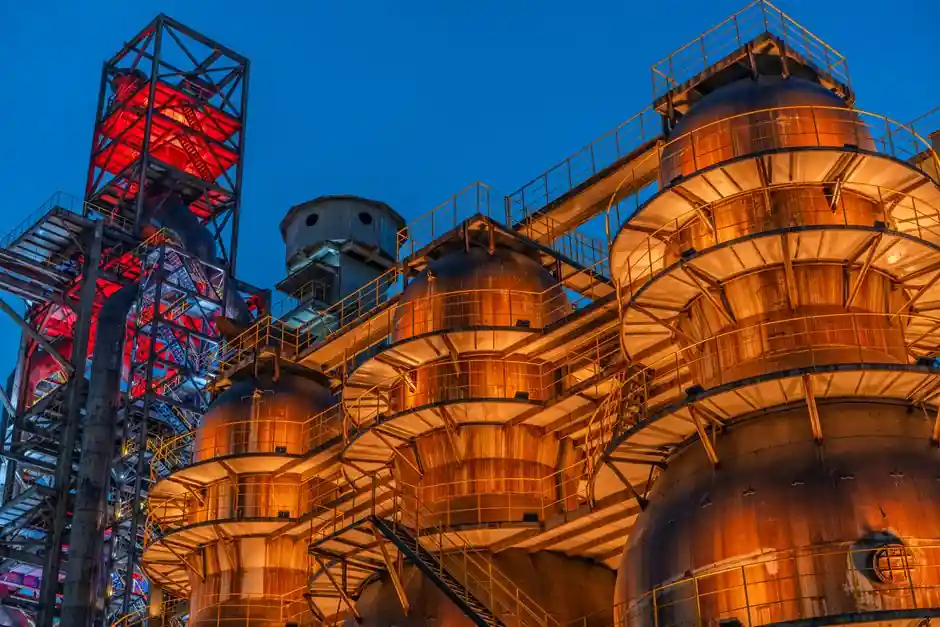
Explosion-proof lighting on a classified process skid is specified as a complete protection package, not a lamp purchase: zone or division, gas/dust group, temperature class, enclosure type, IP rating, ambient temperature, and certification body must all appear on the RFQ line, or vendors will return with the lowest-cost, often wrong, fit [S1][S2].
GUANMN (ZheJiang Guanmn Photoelectric Technology) publishes an LED explosion-proof catalog covering floodlights, sight-glass lights, roadway lamps, aviation obstacle beacons, and aluminum lamp brackets for petroleum and chemical service, while Shanghai Xinliming manufactures lights, electricals, pipe fittings, and blowers to GB3836-2000 with national production license and ISO 9001 certification [S1][S2].
Zone classification, gas group, and temperature class on the RFQ line
The single most common RFQ mistake is writing "Ex-proof light, Zone 1" and stopping there: a usable line must also state the gas group (IIA, IIB, or IIC for hydrogen-family) and the temperature class (T1 through T6, with T6 capped at 85 °C surface), because the same LED fixture can carry T4, T5, or T6 ratings depending on the driver and housing thermal path [S2].
For a process skid in petroleum, chemical, military, aerospace, or pharmaceutical service, Xinliming markets its portfolio as "widely used" across those industries, and its lighting products are built to GB3836-2000 "Electrical Equipment for Explosive Gas Atmospheres" plus related Chinese Ex standards, then type-tested and licensed by Chinese Ex inspection bodies with quality underwritten by China People's Insurance Company [S2].
Where the skid sits in a NEC/CEC environment rather than ATEX, the parallel language is Class I Div 1 / Div 2 with the same gas group and T-class logic; the buyer should write both pairs on the RFQ when the skid may ship to either jurisdiction, otherwise the same fixture may be requoted.
Protection concept: Ex d, Ex e, Ex tD, and Ex nR compared
Ex d (flameproof) contains any internal explosion and is the default for Zone 1 lamp housings on a process skid; Ex e (increased safety) is restricted to terminal/junction areas where no arc or hotspot is normal; Ex tD (dust by enclosure) replaces the older DIP A21/A22 logic for Zone 21/22 dust atmospheres and is mandatory when the skid handles powders, catalysts, or polymer dust [S1].
Selection turns on four decision criteria that an experienced buyer lines up before the RFQ is sent:
1. Zone versus enclosure: Ex d for Zone 1 lamp body, Ex e only for the wiring compartment, Ex tD mandatory in Zone 21/22 dust. Picking Ex e for the lamp head is a classic non-conformance.<br/>2. Temperature class versus LED drive: 150 W floodlights run hotter than 18 W roadway lamps, so a 150 W Ex d unit is commonly T4 while a small-pipe Ex e unit can be T6 at the same ambient [S1].<br/>3. Material versus corrosion: copper-free aluminum alloy is the default for onshore chemical service; SS304 or SS316 is required for chloride or offshore marine atmospheres.<br/>4. IP versus cleaning: IP66 is the floor for washdown skids, IP65 for shaded indoor cabinets, IP67 where temporary water immersion is possible during site washdown.
Ex nR (restricted breathing) is the right call only for Zone 2 enclosed-break luminaires with certified gaskets; it should not be specified for Zone 1 lamp heads even when vendors offer it, because the protection concept is too weak for continuous Grade 1 release sources.
Wattage, lumen output, color temperature, and optics on the RFQ
RFQ wattage must be paired with delivered lumens, not just a "150 W" callout: a 150 W Ex d LED floodlight commonly delivers 18,000-22,500 lm at 5000-6500 K, while a 150 W metal-halide equivalent in the same Ex d housing delivers about 12,000-15,000 lm with shorter service life and a hot restrike limit, which matters during a black-start [S1].
For sight-glass and small-vessel lighting, GUANMN publishes a dedicated Ex d sight-glass LED line with narrow-beam optics to avoid glare into the operator's eye through the glass; for roadway and walkway service the 18 W Ex d roadway lamp is the typical 1500-2000 lm package at IP66 with a 5000 K LED engine [S1].
Aviation obstacle lights (low, medium, or high intensity) are a separate RFQ line and should never be bundled with the general Ex lighting package, because the certification scope, photometric standard (ICAO Annex 14 or FAA AC 150/5345-43), and the flash/ steady logic are governed by different documents, even when the housing itself is Ex d.
Enclosure material, IP rating, ambient, and cable entry
The three RFQ lines that cause the most requote cycles are cable entry, ambient temperature, and mounting interface, because vendors carry different default thread forms (M20, M25, NPT 1/2", NPT 3/4", G1/2") and the wrong default inflates lead time by 2-6 weeks.
For a chemical process skid the default enclosure is copper-free aluminum alloy with epoxy powder coat, tempered-glass diffuser, and stainless steel external hardware; SS316 is the right call where chloride pitting is a known risk, and SS304 is acceptable indoors away from washdown [S1][S2].
Ambient temperature should be written as a range with the worst-case site value, not a single number, because Ex d LED drivers derate from 40 °C to 55 °C and some Ex e terminal boxes are limited to 40 °C; a -20 °C to +55 °C callout forces the vendor to confirm driver selection and eliminates the "ambient not specified" requote [S2].
Cable entry is best written as a thread form plus quantity plus direction (e.g. "2 x M25, bottom entry, one plugged"); omitting the plug position is the single most common reason a buyer receives a top-entry unit that cannot be rotated on the skid frame without breaching the Ex d flame path.
Voltage, control, emergency, and emergency battery logic
Rated voltage must be written with tolerance and frequency (e.g. "220-240 V AC, 50/60 Hz" or "24 V DC ±10%"), because some Chinese Ex d luminaires ship with driver boards only rated for 50 Hz, which is a hidden requote when the skid is destined for a 60 Hz Gulf or Americas site [S2].
For emergency egress on the skid, specify maintained or non-maintained operation, the battery technology (Ni-Cd, LiFePO4, or supercapacitor), and the 90-minute or 180-minute duration; LiFePO4 is now the safer chemistry in Ex enclosures because it does not vent hydrogen on abuse, but it still needs a certified battery compartment, not a shared lamp cavity.
DALI, 0-10 V, or simple on/off control should be specified as a separate RFQ line, because adding DALI after the quote stage typically forces a driver swap and a new EMC test, which adds cost without changing the Ex enclosure itself.
Documentation and certification deliverables to demand with the RFQ
Every Ex d or Ex tD quote should travel with the certificate (ATEX, IECEx, or Chinese Ex), the IECEx Test Report, the operating instructions in the destination language, and a nameplate drawing that matches the exact model ordered, not a generic family drawing [S2].
Xinliming explicitly states that its products are "designed and manufactured in strictly accordance with GB3836-2000 and other related standards," and that the line holds national production license for Ex products plus ISO 9001 quality system certification, with all units Ex-certified by Chinese Ex inspection bodies [S2].
For an international skid shipment, ask for the IECEx Certificate of Conformity (CoC) and the IECEx Test and Assessment Report (ExTR) up front; without the ExTR, a third-party certification body in the destination country will often refuse to issue the local Ex certificate without retesting, which is the most expensive line item on a retrofitted skid.
Track two signals on the next sourcing cycle: (a) the IECEx CoC revision status of any dual-certified Ex d / Ex tD LED floodlight you carry, because it is the single document that lets the same fixture cover Zone 1 gas and Zone 21 dust on a single RFQ line; (b) the lead-time spread between aluminum and SS316 enclosures from the same vendor, because a 6-10 week swing between the two is typical and should be locked into the project schedule, not negotiated at PO stage.
For related process-skid spec work, see this LNG process control spec guide for the 2026 capacity wave and this stainless steel pipe versus expansion joint gate review; lighting tied to the same skid, an explosion-proof light reference helps when writing the photometric line, while explosion-proof electrical and explosion-proof distribution cover the upstream enclosure and feeder choices that surround the luminaire RFQ.