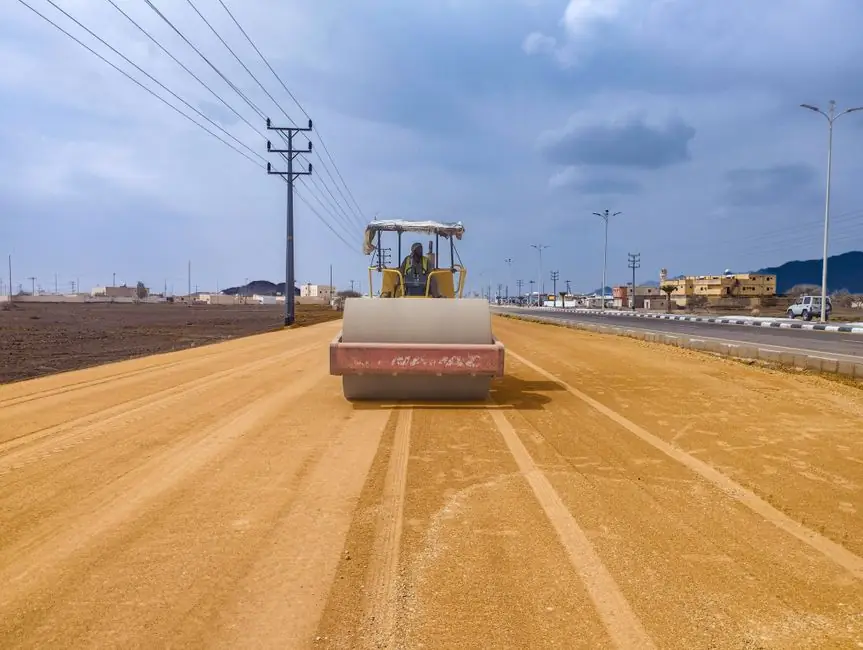
Road roller safety is governed by a small set of hard numbers, not by slogans: slope ≤30% longitudinal / ≤10% transverse, travel speed ≤6 km/h in vibration mode and ≤10 km/h static with turns limited to 2–3 km/h, minimum 1.5 m stand-off from unsupported edges, and 3 m spacing between co-working rollers [S4]. These thresholds reappear across OEM and contractor safety briefs because they map directly to the documented incident patterns of rollovers, blind-spot strikes, and uncontrolled downhill runs [S4][S5].
The hazard profile is a function of the machine itself: high static mass, limited maneuverability, and continuous exposure of the drum to uneven, sometimes soft, ground. Smooth drum and sheepsfoot rollers each add their own failure mode, with sheepsfoot units prone to sudden balance shifts on initial compaction passes [S5]. Cab access adds a second, often underestimated hazard layer, since dust, asphalt residue, and moisture on steps and handholds produce documented slip-and-fall injuries during repeated entry and exit [S5].
Operator Qualification and PPE Baseline
Operators must hold a special-equipment operation certificate and must not be rotated through shifts exceeding 4 hours of continuous work, per current OEM safety guidance [S4]. The PPE baseline is concrete: hard hat, safety goggles, gloves, steel-toed boots, and a high-visibility reflective vest, with no loose clothing that can be drawn into rotating components [S1][S4].
Visibility gear is a separate engineering control, not a courtesy item. Bright reflective vests are specified because they remain readable in low-light and high-dust paving environments, which directly reduces on-site collision risk with haul trucks, pavers, and other rollers [S1]. For asphalt work, the PPE list expands to heat-resistant gloves rated for material at or above 120 °C, plus release agent on the drum to prevent asphalt pickup [S4].
Pre-Operation Inspection: What to Verify Before the Key Turns
A consistent pre-use inspection is the single most cited control across safety briefs, and the items checked are highly specific [S2][S5]. Operators must verify drum condition and pad integrity on sheepsfoot drums, absence of cracks or excessive wear, function of vibration system, steering, service and emergency brakes, and emergency stop; steps, ladders, handrails, and cab flooring are inspected for contamination, damage, and loose components; seat belts, mirrors, cameras, and audible warning devices must be functional and properly adjusted; and manufacturer load limits, vibration settings, and slope ratings must be reviewed before travel [S5].
Fluid-side checks matter equally: leaks of fuel, hydraulic oil, or coolant must be ruled out, tires or steel wheels must be crack-free, and the vibration bearing housing should show no grease purge or play [S4]. The daily schedule continues into scheduled servicing, with hydraulic filters replaced every 250 hours and vibration bearings inspected every 500 hours, the kind of intervals that prevent the gradual drift toward a brake or steering failure [S4].
Slope, Speed, and Edge Limits: The Hard Numbers

Slope operation is the highest-energy hazard category, and the controls are numerical. Longitudinal grade is capped at ≤30% and transverse grade at ≤10%; above these, anti-slip measures such as tracked machines or modified work patterns are required [S4]. The slope rules interact with the transmission rules: coasting downhill in neutral is prohibited, low gear must be used for engine braking, and on a transverse slope the center of gravity must be kept uphill by working along the contour rather than across it [S4].
Speed limits layer onto the same logic. Travel is limited to ≤6 km/h with vibration on, ≤10 km/h without vibration, and reduced to 2–3 km/h during turns to prevent the dynamic rollover moment from exceeding the track width [S4]. Edge work is the third leg of the same control set: maintain ≥1.5 m stand-off from trenches and cliff edges, use warning stakes where the edge is not visually obvious, and always compact parallel to drop-offs rather than turning sharply at them [S4][S5]. A useful related read on compaction physics is the road roller working principle guide, which explains why these speed and slope numbers track the eccentric-shaft excitation limits rather than being arbitrary.
Multi-Machine Spacing, Vibration Trigger, and Brake Test
When more than one roller is working the same lift, the minimum spacing is 3 m, which prevents both collision and mutual steering interference caused by one drum pushing the other's travel line [S4][S6]. The vibration system is a discrete hazard: it must only be engaged or disengaged when the roller is stationary, because activating it in motion creates surface waves and destabilizes the mat, and operators must confirm the area is clear before starting vibration [S4].
Before any forward or reverse travel, the foot brake must be tested for responsiveness, with the pedal pressed deliberately rather than slammed, so a soft caliper or air leak is caught before the machine is committed to a crewed work zone [S3].
Material-Specific Hazards: Asphalt, Clay, and Vibration Bearings
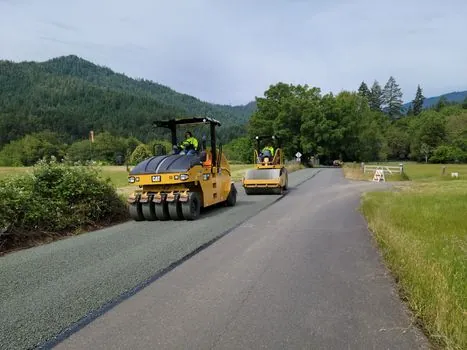
Asphalt work adds thermal and adhesion hazards: material at ≥120 °C requires heat-resistant gloves, release agent on the drum, and an immediate halt to placement if rain begins, because water causes rapid cooling and segregation of the mat [S4]. Clay or cohesive soils introduce a separate failure mode, the "springy soil" condition, where excess moisture makes the layer rebound under the drum; the correct response is to pause and let the lift dry or be reworked, not to add more compaction passes [S4].
Vibration bearings are the wear part that ties all of the above together. They are inspected every 500 hours and are the usual culprit when an operator reports unusual machine bounce, steering resistance, or noise during compaction, all of which are grounds to stop work and reassess [S4][S5]. The general envelope of these machines, including drum types and compaction categories, is documented in the road roller product reference.
Comparison: Walk-Behind vs Ride-On Roller Safety Posture
Walk-behind rollers shift the hazard mix toward operator exposure and manual handling, while ride-on rollers shift it toward blind spots, rollover energy, and cab-access falls, so the PPE list and the inspection depth differ even where the slope and edge numbers stay constant [S1][S5].
The comparison matters for procurement, not just operations: a buyer selecting a walk-behind unit for trench work is buying a different PPE and training burden than a buyer selecting a 12-ton tandem for highway paving, and the safety documentation that ships with the machine should match the hazard profile above. For broader machinery context, the construction machinery and equipment reference frames these machines against adjacent categories such as pavers and compactors.
Emergency, Shutdown, and Adverse-Weather Rules
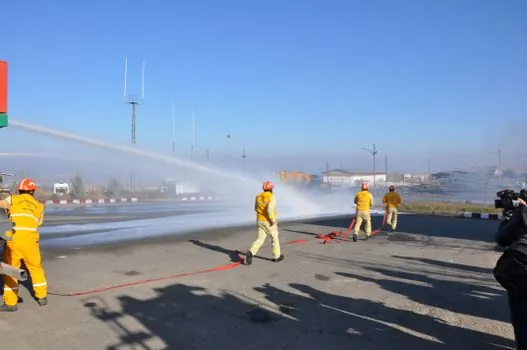
Emergency response is procedural, not improvised: on any malfunction, vibration is shut off immediately and the engine stopped before inspection, and high-pressure hydraulic leaks must never be blocked by hand because the oil jet can penetrate skin [S4]. If the roller begins to lose stability, the correct steering input is opposite to the tilt direction, with no sudden brake application, which would convert a recoverable lean into a rollover [S4].
Shutdown protocol is equally specific. Park on level ground, deploy the safety stand, and use wheel chocks on any slope, with drum buildup cleaned only with tools and never with bare hands [S4]. Weather adds its own layer: stop asphalt work in rain, activate warning lights and halt if visibility drops below 50 m, and enforce a 2-hour hydration cycle in heatwaves to prevent operator heatstroke [S4].
The underlying component specifications are covered under lamps and light fittings.