
A modern road roller densifies soil, gravel, concrete, or asphalt by combining the static weight of its steel drum with a high-frequency centrifugal force generated by an internal eccentric shaft, typically running at 30-70 Hz and adding 100-300 kN of impact energy per drum per cycle [S3].
Effectiveness scales with mass: today’s diesel-powered machines span roughly 1-20 tonnes, replacing the horse-drawn and steam rollers that dominated the field until the mid-19th century [S1][S5]. Most units on site are now self-propelled tandem or single-drum compactors, and the job is the same as it was 200 years ago: drive air out of the lift so the finished layer carries traffic without rutting [S3].
Static compaction: dead weight as a linear load
Static linear load is the spec number that actually predicts compaction output, and it is calculated by dividing roller mass by total loaded drum width [S3]. A 12-tonne tandem with two 2.1 m drums delivers roughly 28.6 kg/cm of drum width, or about 28 kN/m and 58.8 kN per drum, which by itself rearranges aggregate and squeezes out air without any vibration at all [S3].
Static rollers rely entirely on this dead-weight contribution and are best matched to surface finishing and tightly graded stone fills where particle re-arrangement, not deep energy, is required [S6]. Because the only force is gravity, output scales linearly with added ballast, which is why operators still load water or sand into drum shells to bump linear load on the same machine.
Vibratory compaction: eccentric shaft, centrifugal force, and depth
A vibratory roller adds dynamic energy on top of its static weight by spinning an eccentric mass inside the drum at 30-70 Hz, throwing a calibrated mass off-centre to produce 100-300 kN of centrifugal force per drum per cycle [S3]. The drum effectively hammers the surface thousands of times per minute while rolling forward, and that hammering is what drives air voids out of the deeper portion of the lift rather than just the top skin.
Drum diameter sets the contact patch length, and that geometry is more decisive than engine power: a 1.5 m diameter drum on a 60 mm SMA lift gives a contact patch around 380 mm, while a 1.0 m drum drops the patch to roughly 310 mm and pushes the mat instead of compacting it [S3]. As a working rule, vibratory rollers compact effectively to about 1.5x the drum diameter on granular soil and roughly 1.0-1.5x the lift thickness on asphalt, and going thicker leaves a soft layer that ruts under traffic within the first winter [S3].
Drum types and where each one earns its keep
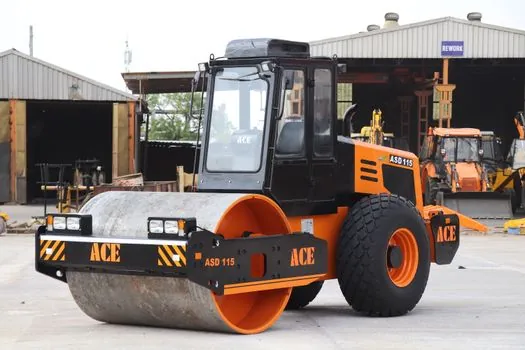
Single-drum rollers carry one large steel drum at the front and pneumatic drive tyres at the rear, which gives them mobility and traction on soil and sub-base work and makes them a natural choice for highway and residential road prep [S4][S5]. Double-drum (tandem) rollers put a drum at both ends and are the standard for asphalt wearing courses, where a typical 12-tonne tandem hits 92-94% of maximum theoretical density on a hot SMA wearing course in 4-6 passes [S3].
Padfoot, or “sheep’s-foot,” drums use protruding pads with less contact area to generate higher compaction density on cohesive soils and are used for initial substrate compaction before paving; on large freeways, a four-wheel padfoot compactor with a dozer blade such as the Caterpillar 815/825 series is the typical choice for its high weight, speed, and material-spreading push force [S1]. Rubber-tyred and pneumatic rollers, with multiple rows of staggered pneumatic tyres covering about 80% of the rolling width, are preferred for sealing bitumen surfaces, smoothing cold-laid pavements, and finishing work where a steel drum would crush the aggregate [S4].
Operating window, pass count, and the two real failure modes
Asphalt compaction is temperature-bound: for a typical 60 mm SMA wearing course, breakdown rolling must finish above 130 °C and final rolling above 90 °C, otherwise the binder stiffens, the aggregate locks, and additional passes will not recover target density [S3]. Crews that over-roll cold mat cause aggregate fracture and surface checking, while vibrating on a thin lift over a hard base reflects energy back into the drum and risks drum-bearing damage [S3].
Typical operating speed sits in a narrow 4-6 km/h band for self-propelled vibratory rollers, fast enough to keep the mat hot and the cycle rate high, slow enough to let each impact settle the lift instead of shoving it [S3]. Padfoot drums, vibrating motors, eccentric shafts, and the bearings that carry them share a family of components with general roller bearing duty cycles, which is one reason maintenance intervals on rollers are typically pegged to hours of vibration rather than kilometres travelled. For adjacent site machinery, the same motor grader inspection discipline used to walk a 4-zone pre-shift check on graders transfers cleanly to a roller pre-shift, and the cut-off machine working principle breakdown is a useful contrast on how different compactor-class machines apply force.
Selection map: matching roller type to the lift
Four criteria drive a defensible selection: lift material, lift thickness, target density, and tolerance for surface crushing [S3][S6]. On granular sub-base with lifts above 200 mm, a padfoot or single-drum vibratory roller with a 1.5 m diameter drum is the standard pick because the larger diameter reaches the bottom of the lift [S3].
On asphalt wearing courses 40-60 mm thick, a 12-tonne class tandem with two vibratory drums at 30-70 Hz is the workhorse, and a static tandem is reserved for the final kneading pass once the mat has dropped below 90 °C [S3][S6]. For bitumen sealing and cold-mix finishes, a pneumatic-tyred roller delivers a uniform contact pressure across roughly 80% of the tyre face without the risk of aggregate fracture that a steel drum introduces [S4].
Standards, sourcing, and what to verify before purchase
Roller selection is dominated by mass, drum geometry, and amplitude/frequency pairing, not by engine horsepower, and the relevant OEM literature frames output in kg/cm of static linear load and kN of centrifugal force rather than kW [S3][S6]. Sourcing from Chinese OEM lines remains common, and the same sourcing spec-first discipline used for SCADA applies: require stamped drum diameter, eccentric-shaft frequency range, and static linear load at working mass, not brochure horsepower.
Track next: a published eccentric-shaft service-life benchmark (hours to first re-bearing) per ISO 1940-1 balance grade, and a vendor-side amplitude/frequency pairing chart for the 30-70 Hz operating band. Either signal would let buyers compare vibratory rollers on output rather than on drum diameter alone.
Spec-level background on the components involved: road roller, and roller chain.