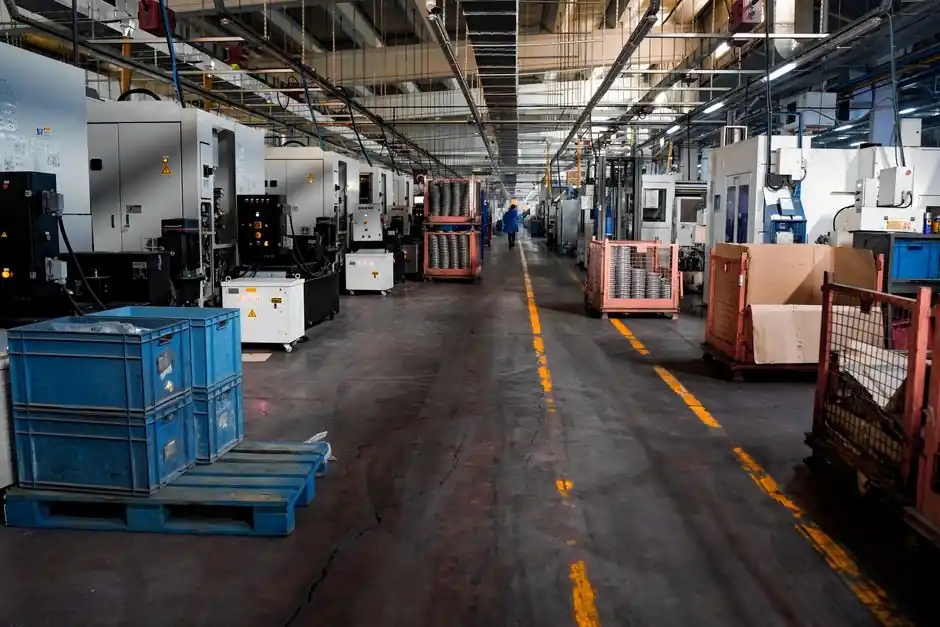
Packaging-line bearing selection in 2026 is driven by three operating variables: shaft speed (typically 200-3000 rpm on form/seal/carton stations), radial load (light on idlers, heavy on nip and feed rolls), and the wash-down, chemical-exposure, or low-noise requirement of the cell [S3].
Standard cylindrical roller bearing lineups cover inside diameters from 25 mm to 150 mm and outside diameters from 47 mm to 320 mm in metric chrome steel (GCr15 / DIN 100Cr6), with cage options in pressed steel, machined brass, and polyamide, and ABEC-1 / ABEC-3 / ABEC-5 precision grades commonly offered [S3].
Map the bearing family to the packaging-line station
On a typical horizontal form-fill-seal or cartoner, the support and idler rolls are best served by deep-groove ball bearings, while the heat-seal jaws, draw rolls, and film-tracking nip rolls need cylindrical roller bearings for the higher radial load capacity at line speed [S1][S3].
For shafts that carry combined radial and thrust loads (label drums, die-cut cylinders, vertical-form-fill film tracks), a tapered roller bearing pair is the usual 2026 specification, taking advantage of the line's typical 300-1800 rpm operating window and the bearing's ability to be preloaded to a defined axial play [S2].
Deep-groove ball vs cylindrical roller vs tapered: decision criteria
Three criteria decide it on most packaging cells: radial load capacity per line speed, misalignment tolerance, and axial-load handling. Deep-groove ball bearings run quietly and tolerate minor misalignment, but cap out at moderate radial load. Cylindrical roller bearings (NU, NJ, NUP, N, NF single-row; NNU, NN double-row) handle roughly two to three times the radial load of a same-bore deep-groove ball and reach higher limiting speeds, but require tighter alignment and have limited thrust capacity [S3]. Tapered roller bearings handle combined radial+thrust in a paired, preloaded arrangement, with single-row, double-row, and four-row configurations available for heavier combined-load stations [S1][S2].
For changeover-heavy lines where sanitation crews wash down daily, 2RS or 2RZ sealed deep-groove ball bearings with nitrile or silicone contact seals are the default; for dry film and paper lines, open cylindrical roller bearings with a felt or labyrinth seal and a centralized grease manifold keep the lube inside the housing without raising operating temperature [S3]. A general-purpose roller bearing reference for adjacent plant applications can be cross-checked against the same selection logic.
Material, cage, and precision choices for 2026 specs
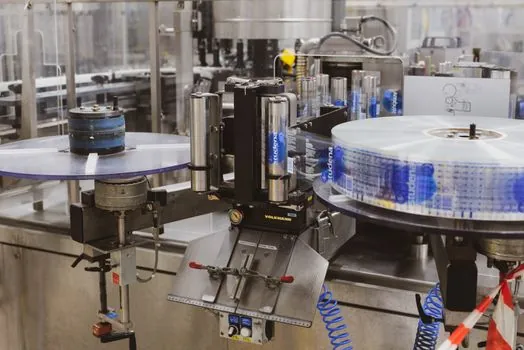
GCr15 / DIN 100Cr6 chrome steel remains the default bearing material in the 2026 packaging supply chain, with case-hardened variants in 52100 for higher-load stations [S3]. Cage material selection is the most underrated spec: pressed steel is the cheapest and runs at lower speeds, machined brass is preferred for sustained high-speed cylindrical roller bearing operation above roughly 3000 rpm, and glass-filled polyamide 66 cages are now standard for noise-sensitive packaging cells where Z1, Z2, Z3, Z4 noise-level classes are specified [S3].
Precision grades typically called out on packaging-line POs in 2026 are P0 (ABEC-1) for general conveyor and idler service, P6 (ABEC-3) for form-seal and carton stations, and P5 (ABEC-5) reserved for die-cut, labelling, and print-registration rolls where runout must stay under a few microns [S3]. Vibration classes V1, V2, V3, V4 are still used to grade electrically noisy motors, and are typically requested as V3 or V4 on VFFS film-tracking stations where encoder resolution and servo-loop stability are sensitive to bearing-induced micro-vibration [S3].
Where to use the four-row and sealed variants
Four-row cylindrical roller bearings (for example, 48FC33220BW in steel-mill catalogues) carry very high radial load in a single package, but on packaging lines they are only seen on heavy corrugated-board feed-in rolls and large-format palletizer turntables; here a slewing ring or a four-row cylindrical setup is more common than a deep-groove ball [S2][S1].
For packaging machines running three-shift, 24/7, the 2026 best practice is to standardize on sealed, greased-for-life deep-groove ball bearings (2RS) on idlers and on open cylindrical roller bearings with relubrication fittings on the high-radial-load stations, replacing them on a 20,000-30,000 hour interval rather than waiting for failure. Cylindrical roller bearing cages in machined brass or polyamide extend that interval meaningfully compared with pressed steel at sustained line speed [S3].
Standards, documentation, and supplier red flags
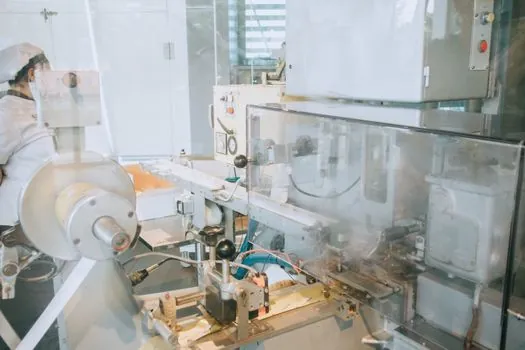
The minimum documentation set a 2026 packaging-line buyer should require on a bearing PO is: dimensional conformity to ISO 15 (radial bearings) or ISO 355 (tapered), material certificate to DIN 100Cr6 / GCr15, precision grade (P0, P6, P5) and vibration class (V1-V4) both explicitly stated on the test sheet, and a serial-numbered lot for full traceability [S3].
Two supplier red flags on packaging-line bearing POs in 2026: sellers that cannot state the cage material in writing, and sellers that ship "P0" bearings labelled only as "high quality" without ABEC-1 reference on the test sheet. Both are linked to early cage failure and premature noise drift on form-seal and label stations in documented line audits [S3]. Buyers consolidating 2026 packaging-line spares can reuse the same PO template across deep-groove ball, cylindrical roller, and tapered roller lines, which keeps MRO inventory under tighter control on packaging material cells.
Limitations and failure modes specific to packaging lines
Three failure modes dominate packaging-line bearing returns: lubricant washout from daily wash-down, false brinelling on idle conveyors that see micro-vibration, and cage cracking on polyamide cages exposed to sustained 90 deg C plus bearing housings in heat-seal zones. Sealed 2RS deep-groove ball bearings solve the first, monthly re-greasing solves the second, and switching to machined-brass cages in those seal zones solves the third [S3].
For vacuum and modified-atmosphere packaging cells, the bearing housing must be specified for the vacuum cycle, not just the ambient cell; this is also why selection of the vacuum packaging machine chamber pump train interacts with the chamber's door-hinge bearings, and a related decision is the line-side selection guide for ball bearings in textile mills, which shares the same wash-down logic. For heavier radial-load stations on palletizer heads, the selection logic is closer to steel-mill roller bearing specification than to general packaging-line practice.
Trackable signals for the next 90 days: ISO 4406 cleanliness codes starting to appear on packaging-line bearing POs (a real shift from 2024-2025 practice), and 2026 supplier data sheets for cylindrical roller bearings moving from 25-150 mm bore to a 20-160 mm range to cover the new compact VFFS footprint.