
Urban infrastructure work sorts truck cranes into two practical bands by lift class: 16-25 t telescopic units (e.g. the XCMG XCT25L5_Y 5-section model [S2]) for streetscape, utility, and precast panel work, and 30-60 t telescopic units (XCT60_Y and similar 60 t classes [S2]) for bridge girder, overpass deck, and metro-station steel erection. Below 16 t the chassis payload envelope of a standard 6x4 truck runs out of headroom; above 60 t the machine crosses into all-terrain crane territory with multi-axle booms, so the working envelope for city projects stays inside that 16-60 t window.
The lift class is the first gate, not the last. The four hard constraints that decide fit on an urban site are: (1) capacity at the required radius under the configured outrigger spread, (2) retracted boom length relative to bridge underpasses and tree canopies, (3) tail-swing radius against sidewalks and traffic lanes, and (4) carrier axle load against any route that crosses a posted bridge or culvert. Get any one of these wrong and the crane either cannot set up, cannot travel to the site, or cannot lift the load it was bought for.
Capacity vs. radius: the load chart is the spec, not the nameplate
Nameplate rating is the maximum lift at minimum radius with full counterweight and outriggers fully extended on firm ground. On a city street the outrigger spread is often pinned by the curb, and the load typically sits 8-14 m out, which is well past the strongest part of the chart [S1][S2]. A 25 t crane such as the XCT25L5_Y will show roughly 7-9 t at 12 m main-boom radius with short jib, while a 60 t XCT60_Y holds around 14-18 t at the same radius with a longer main boom and counterweight package [S2].
Rule of thumb for spec sheets: divide the published nameplate by 3 to get the working capacity at typical urban radii with a 75% outrigger spread. If that working number still beats the heaviest pick (panel, beam, HVAC module, generator) with a 1.25 safety factor, the unit is sized correctly. Below 1.25, step up one class.
Boom configuration: telescopic vs. knuckle, and what fits the street
Telescopic boom truck cranes dominate the urban infrastructure market because the boom telescopes under load, gives the best radius-vs.-stowed-length ratio, and the operator can reeve and lift without a second person on the hook. The published range on the Chinese export channel covers 2-section up to 6-section main booms, with 4-section booms the most common in the 16-25 t class and 5-6 section booms standard from 30 t upward [S2].
Knuckle-boom (folding) cranes from makers like HYVA and Ferrari are common on smaller carriers where the priority is a tight tail swing and a low stowed envelope rather than raw reach [S5]. A knuckle unit typically stows inside a 9 m envelope and parks inside a 2.5 m lane-width envelope, but radius drops to 14-18 m, which limits it to ducting, signage, and small precast. Where reach matters more than footprint, a truck-mounted crane with telescopic boom is the correct family.
Tail swing, outrigger spread, and the curb-to-curb envelope
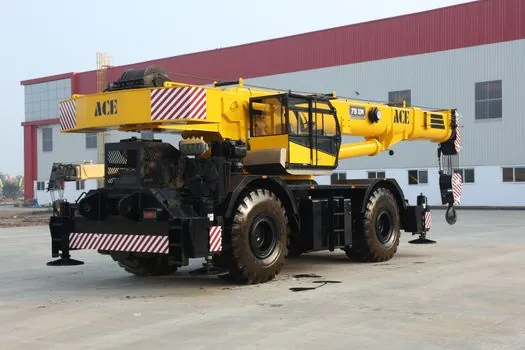
Tail swing is the single most under-checked number on an urban job. A 5-section 60 m boom on a 60 t class crane carries a tail swing of roughly 3.8-4.2 m, which on a 3.5 m lane means the rear of the machine overruns the opposite sidewalk. The practical fix on tight sites is a shorter counterweight pack and a knuckle jib, or a step down to a 30 t class with a 3.2-3.5 m tail swing [S1][S5].
Outrigger spread is the second footprint gate. Full spread is the only configuration the load chart is valid for; half-spread and retracted modes are derated, typically to 50-70% of the full-spread capacity. On a one-lane closure with pedestrian traffic on the other side, a half-spread setup may be the only legal option, and the load chart must be re-read for that case before the lift is committed [S1].
Carrier, axle load, and route legality
Most 16-30 t truck cranes ride on 4x2 or 6x4 carriers with GVW in the 25-33 t band, which keeps them inside the standard highway bridge posting on most municipal routes. A 60 t class machine jumps to 6x6 or 8x4 carriers with GVW of 38-44 t, and many older city bridges have a 32 t posted limit. Routing software, not the salesperson, is the answer here: confirm the heaviest axle plus the GVW against the route's weakest posting before mobilizing. [S2]
Engine and emissions matter for low-emission zones (LEZ) in cities that operate them. Export listings on the Machmall catalog show XCMG units offered in both Stage III and Stage IV emission configurations across the 25-60 t range [S2], so specifiers in LEZ-controlled cities should pin the emission tier in the purchase order, not assume the default build meets local rules.
Standards, documentation, and what the package must include
Beyond the machine itself, a procurement-ready urban truck crane package includes: load chart book, operator manual, CE/ANSI compliance files, third-party load-test certificate (typically dated within 12 months of delivery), and the maintenance log template. North American deliveries typically list to ANSI B30.5 (mobile and locomotive cranes), while EU deliveries list to EN 13000 (cranes - mobile cranes) and carry CE marking under the Machinery Directive. Buyers should pin the standard on the order rather than assume it. [S2]
For comparison, a specifier weighing 25 t telescopic against 30 t knuckle on a streetscape job runs four criteria: capacity at 10 m (7-9 t vs. 4-6 t), stowed length (10-11 m vs. 7-8 m), tail swing (3.3 m vs. 2.4 m), and carrier GVW (24-28 t vs. 18-22 t). The telescopic wins on lift, the knuckle wins on footprint. The right answer is the load chart.
Selection gates summary
Pass these four gates in order and the urban spec writes itself: (1) required capacity x 1.25 at working radius with realistic outrigger spread, (2) retracted boom length under the lowest overhead on the route and the site, (3) tail swing plus outrigger pads inside the curb-to-curb envelope, (4) GVW and axle load under every bridge posting on the haul route. If any gate fails, the next step is either a different class of crane or a different routing plan, not a different salesperson. [S2]
Trackable signals for the next 6 months: emission-tier default changes on Chinese export 25-60 t units as LEZ rules tighten in target cities, and knuckle-boom offerings from HYVA / Ferrari extending into the 20-30 t class to bridge the gap between light utility cranes and telescopic 30 t units [S5]. Both shifts will reshape the truck crane shortlist on streetscape work without changing the four-gate logic above.
Detailed specification references: dump truck, and reach truck.
See also our earlier report, Pallet rack selection for e-commerce fulfillment: type, capacity, and code gates.