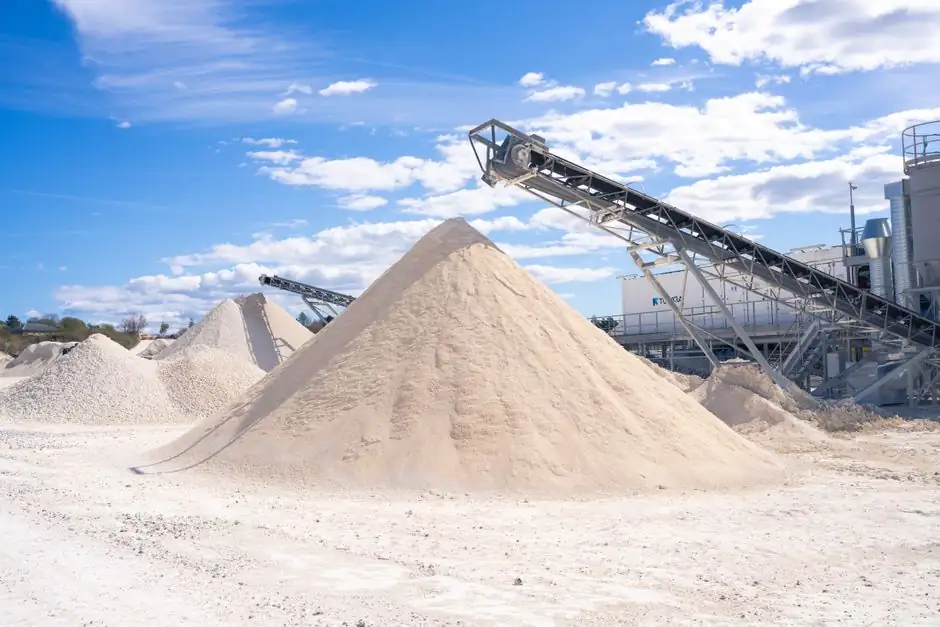
Spherical roller bearings and tapered roller bearings carry the bulk of hauler, conveyor, crusher, and mill-trunnion loads in mineral operations, with dynamic load rating, sealing class, and roller-profile modification the three spec gates that determine service life in 2026 [S1][S2][S3][S4].
Crossed-roller variants, where cylindrical rollers alternate at 90° between inner and outer rings, are the second-tier choice where combined axial, radial, and moment loads must be handled in a compact envelope, for example slewing rings, rotary tables, and precision gearboxes on mobile mining equipment [S1].
Where each roller-bearing type fits in a mining plant
Spherical roller bearings accommodate misalignment of 0.5° to 2° typical for conveyor pulleys, vibrating screens, and crusher shafts, while self-aligning ball bearings cover lighter-duty, higher-speed nodes such as fan and pump shafts in the same plant [S3][S4].
Tapered roller bearings are the default for wheel ends, gearboxes, and pinion stands on haul trucks and underground loaders because paired cup-and-cone assemblies handle combined radial and thrust loads, and the separable design supports field adjustment of endplay, which is a maintenance advantage on remote mine sites [S3][S4].
For slewing booms on mining excavators and for the trunnions of large ball mills, a four-point contact ball slewing bearing or a crossed-roller slewing bearing is the standard product class, with both types accepting simultaneous axial, radial, and overturning moment loads, an advantage documented across current OEM offerings for heavy-duty cranes, excavators, and material-handling equipment [S1].
A detailed reference for the broader roller bearing family sits in the encyclopedia; the tapered roller bearing entry gives the cup-and-cone geometry and the paired-mounting rules that matter for wheel-end duty.
The three spec gates: dynamic load, sealing, and roller profile
Dynamic load rating C is the first gate: a mining conveyor pulley bearing is typically sized so the equivalent dynamic load P sits at 0.1C to 0.15C for an L10 life target of 100,000 h, while crusher bearings are commonly run closer to 0.2C because the impact loading shortens effective life [S2].
Contamination control is the second gate. Mining environments carry abrasive dust, water spray, and process slurry, so 2RS or 2RS1 rubber seals on both faces are the typical minimum, with sealed-on-both-side XSU-series crossed-roller units used where wash-down or fine-particle ingress would otherwise destroy the raceway finish in months [S1][S3].
Roller-profile modification is the third gate. Logarithmic, crowned, and hollow-roller profiles reduce edge stress concentration under offset loading, with research published on this topic showing measurable shifts in load distribution between crowned, logarithmic, and unmodified rollers under both upright and offset bearing loading [S2].
Criteria-based comparison of the four mining-relevant types
Spherical roller bearings win on misalignment tolerance (typical 0.5° to 2°) and radial load capacity but lose on speed limit, generally capped well below cylindrical-roller equivalents, and on cost per kN of load [S3][S4].
Tapered roller bearings win on combined radial-plus-thrust capacity and on field serviceability, since the separable cone allows endplay adjustment without bearing replacement, but they require precise alignment during mounting and are sensitive to inadequate lubrication, with failure modes dominated by spalling at the rib-roller contact [S3][S4].
Crossed-roller bearings win on rigidity and on combined-load capacity in a small envelope, with the 90° roller crossover delivering high axial and moment stiffness in a fraction of the space of a separate thrust bearing, but they are more sensitive to mounting surface flatness and cost more per unit, which is why they are specified on slewing rings and precision rotary tables rather than on bulk conveyor pulleys [S1].
Needle roller bearings, with their full-complement or caged cylindrical-needle rolling elements, are used in mining equipment where radial space is constrained, for example in pinion shafts, planet-carrier pins, and certain hydraulic-pump drives, accepting moderate radial load at higher speed and lower friction than an equivalent ball bearing [S3].
For road roller and compactor fleets that share components with mining haul roads, the same tapered- versus spherical-roller decision logic applies, with the compactor drum bearing typically a spherical or toroidal roller type that handles the dynamic misalignment of the oscillating drum.
Mining use cases, mounted and running
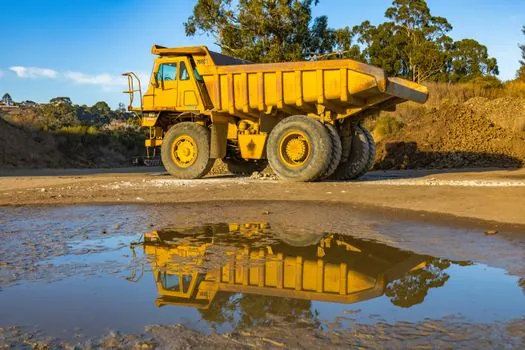
On a 100 t to 400 t mining dump truck, the wheel-ends, final-drive planet-pinions, and the retarder-axle supports all run on large-bore tapered roller bearings, with the planetary gearset needle bearings on the planet pins and carrier journals [S3].
On SAG and ball mills, the trunnion bearings are typically spherical or hydrostatic pad-type, while the pinion stands run paired tapered roller bearings in an O-arrangement to carry the pinion bending moment and the thrust from the girth gear [S3][S4].
On vibrating screens, dewatering screens, and pan feeders, the eccentric-shaft bearings are usually spherical roller bearings, chosen specifically because the screen frame vibration forces cyclic misalignment that a cylindrical or tapered design cannot absorb without premature failure [S3][S4].
For a related cross-industry view, the mining dump truck encyclopedia entry maps the driveline layout, and the supplier market for off-highway haul-truck bearings overlaps with the truck crane selection for mining operations supplier map, both of which sit in the same Chinese industrial-belt manufacturing cluster.
Lubrication, contamination, and failure modes
Grease lubrication is the mining default, with re-lube intervals of 1,000 to 4,000 operating hours typical for sealed 2RS spherical units on conveyor pulleys, while oil-mist or oil-bath lubrication is reserved for high-speed nodes such as crusher gearboxes and mill pinion stands [S3][S4].
Premature failure in mining bearings is dominated by contamination-induced spalling, followed by inadequate lubrication, misalignment, and overload impact, with the 2RS seal a critical and cost-effective mitigation; unsealed or single-shielded (Z) bearings are rarely acceptable in any dust-laden location [S1][S3].
Hybrid ceramic bearing variants, with silicon-nitride rolling elements and steel rings, are a 2026 supplier option for applications where electrical-erosion pitting or very high speed is a concern, though cost remains roughly 2× to 3× a comparable all-steel unit, which keeps them in niche roles such as spindle and high-speed gearboxes rather than on bulk conveyor or crusher shafts [S3].
Material, standards, and what to verify on a 2026 datasheet
Through-hardening chrome steel remains the workhorse material for rings and rollers, with case-carburized variants used where shock loads are high; vacuum-degassed steel is the supplier baseline for any mining-grade bearing, and the datasheet should confirm cleanliness per the relevant metallurgical standard rather than only generic ISO tolerance class [S3][S4].
For any mining bearing on equipment destined for underground coal, oil and gas, or potentially explosive dust atmospheres, ATEX 2014/34/EU and IECEx certification of the bearing housings and any integrated sensors, rather than the bearing itself, is the spec to check, because certification sits at the equipment-assembly level [S1][S3].
For slewing-bearing orders, verify the static axial load rating Ca, the static moment rating Ckm, and the gear specification (if the unit is geared), since these three numbers define whether a four-point-contact or a crossed-roller slewing ring is the right choice for a given mining crane, excavator, or mill-trunnion application [S1].
2026 supplier map and what each cluster does best
Luoyang (Henan) remains the Chinese cluster for slewing bearings, thin-section bearings, and precision crossed-roller units, with custom-engineering capability for non-standard diameters and integrated gear teeth, a useful route when an OEM needs a one-off slewing ring for a mining crane or mill trunnion [S1].
Xi'an (Shaanxi) houses needle-roller, rod-end, spherical-plain, and one-way-clutch bearing production, a cluster that supplies both aftermarket spares and OEM volumes for the off-highway mining and construction-equipment market, and is the natural source for planet-pin needle bearings and clutch-brake elements used in haul-truck powertrains [S3].
The broader Wenzhou and Shandong cluster covers general spherical, tapered, cylindrical, and self-aligning ball bearings, with 10-year-plus OEM track records supplying mining, mineral-processing, and cement-plant operators, making these the default source for conveyor, crusher, and screen bearings at standard ISO 15-series dimensions [S4].
For a related cross-industry perspective, the ball bearing selection for wind power article maps a different operating envelope, high speed, low load, strict cleanliness, that informs which bearing suppliers also serve mining winders and hoists, where similar reliability and cleanliness expectations apply.
Selection checklist for a 2026 mining bearing order
Match the bearing type to the load vector first: spherical for misalignment, tapered for combined radial-thrust, crossed-roller for compact combined loading, needle for space-constrained radial loads; then size the dynamic load C so that P/C sits in the 0.1 to 0.2 band appropriate to the duty cycle [S2][S3][S4].
Specify sealing (2RS minimum for any dust-exposed location), lubrication interval, and mounting accuracy, because in mining more bearings fail from contamination and misalignment than from being undersized, and a 5° mounting error can cut L10 life by more than half [S1][S2][S3].
Request the supplier's material certificates, ISO tolerance class, and any ATEX or IECEx certification relevant to the host equipment, and confirm lead time against the planned mine shutdown window, because 8 to 12 weeks is typical for non-stock large-bore spherical or slewing units, and longer for custom crossed-roller designs [S1][S3][S4].