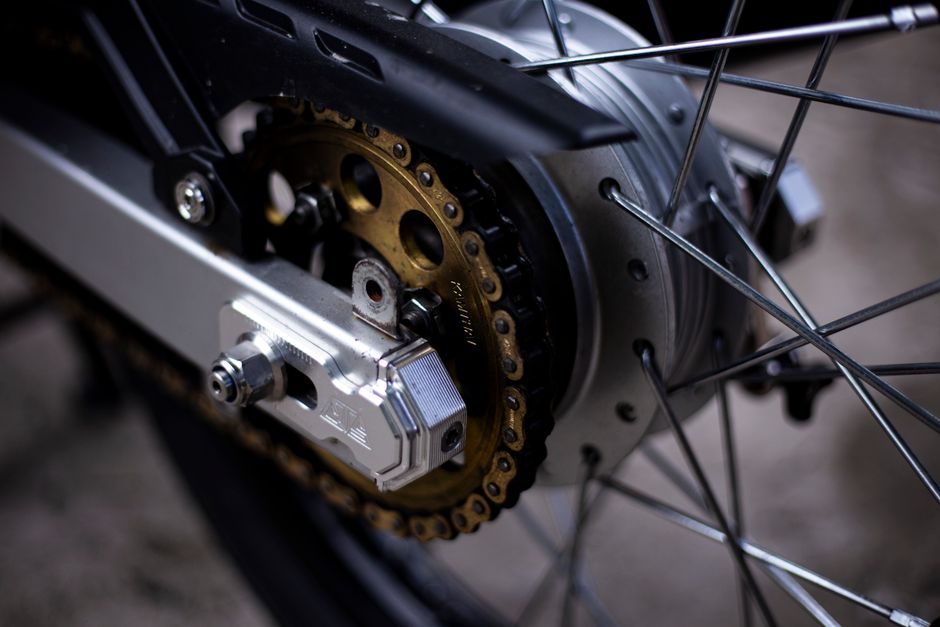
ANSI roller chain drives from #40 (8B) through #240 pitch fail in service for the same handful of root causes: over-tensioned spans, misaligned sprockets, and mismatched pitch between the chain and the driven sprockets [S1][S2].
On industrial conveyor and power-transmission skids built in 2025–2026, the same four acceptance checks govern every install: shaft parallelism, mid-span sag, sprocket tooth-count match, and pre-load lubrication. Get any of these wrong and the roller chain loses 30%–60% of its rated fatigue life before the first re-lube interval [S2].
Shaft Parallelism and Angular Misalignment Limits
Parallelism between driver and driven shafts must hold within 0.5°–1.0° angular misalignment for standard single-strand ANSI chain, and within 0.2°–0.5° for high-speed drives above 1,000 rpm, per general mechanical-drive practice [S1]. Industrial couplings built on duplex roller chain — the LRC series at 162 Nm to 18,040 Nm and 50–5,000 rpm — rely on the same alignment discipline, since angular misalignment beyond tolerance loads the chain's pins unevenly and accelerates elongation past 3% (the discard limit) [S1].
Acceptance test: lay a straightedge across both sprocket faces; the gap between straightedge and sprocket face should not exceed 0.5% of the shaft-center distance, and the gap at the two shaft ends should be within 1 mm of each other on spans under 1 m. Exceed this and the chain will climb the sprocket teeth — a symptom known as "chain whip" — and jump teeth within the first 100 hours of duty. On chain conveyor lines running 24/7, a 1 mm parallelism offset typically costs 1,500–2,000 hours of chain life per year of operation.
Mid-Span Sag: The 2% Rule for Static Tension
Static mid-span sag of 2%–3% of the center distance is the industry-standard target for new installations, with 4% accepted only on slow-speed, lightly-loaded drives under 50 rpm and 1 kW [S2]. The C-channel agricultural chain sold at $0.5–$0.9 per meter, and ANSI #40–#120 single-strand chain sold at $2–$15 per meter depending on pitch and material, both rely on controlled slack to absorb shock load and accommodate thermal growth [S2][S4].
Acceptance test: with the drive stopped and the slack strand hanging free, measure the perpendicular distance from a straight line between sprocket centers to the lowest point of the chain. For a 1,000 mm center distance, that distance should read 20–30 mm. A taut chain (less than 1% sag) will run hot — typically 30°C–40°C above ambient at the pin/bushing interface — and will stretch past 3% elongation within 500 hours. A chain that sags more than 5% on the slack side will jump teeth under transient load spikes above 1.5× rated torque.
Sprocket Tooth Count and Speed Ratio
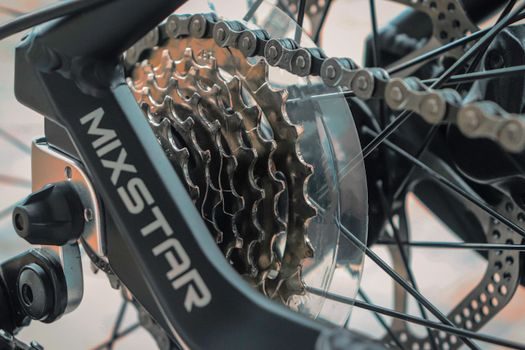
The driven sprocket tooth count is fixed by the speed ratio, but the minimum tooth count on the small sprocket is set by chain pitch and speed — not by the ratio alone. For ANSI #40 chain (12.7 mm pitch) at 1,000 rpm, the minimum recommended small-sprocket tooth count is 17T; for #60 chain (19.05 mm pitch) at the same speed, 19T; and for #80 chain (25.4 mm pitch), 21T, per general chain-drive derating practice [S1][S2].
Going below these minimums causes the chain to wrap the sprocket through too few teeth, multiplies the polygonal-action shock load, and forces premature wear on the conveyor chain pin joints. The CG-CC series roller chain couplings, rated 10–7,154 Nm at 80–700 rpm, use a duplex roller chain between two platewheels specifically to increase the tooth-wrap angle and cut polygon-action shock — the same engineering logic that drives minimum tooth count in standalone drives [S1].
Pre-Load Tension and Take-Up Allowance
Pre-load on a new chain install is set by the mid-span sag, not by a torque wrench — the chain has no torque spec, only a sag spec [S2]. Take-up travel on the driven shaft should reserve 1.5–2 link pitches of adjustment for every 1 m of center distance, so a 2 m drive needs 3–4 pitches (roughly 75–100 mm on #60 chain) of take-up. The Cottered Roller Chain and Heavy Roller Chain (ANSI Heavy Duty) variants sold through US industrial channels at $5–$30 per foot in 2025–2026 are designed for fixed-pin drives where take-up is built into the chain length itself via an offset link [S2].
Do not tension by pulling the chain taut against the slack side and locking the adjuster. The chain must be free to find its own line through the sprockets; over-tension loads every pin and bushing to its static yield and cuts fatigue life by 50%–80%. On long-span conveyor chain drives above 5 m, install a hydraulic or spring-loaded gravity tensioner rated for 1%–2% of chain weight, not a manual screw adjust.
Lubrication at Installation and Re-Lube Intervals

Initial lubrication at install must reach the pin/bushing interface, not just coat the outer plates — and the standard practice is to soak a new chain in 80°C–100°C oil bath for 10–15 minutes before mounting, then wipe dry and re-lube the pins with a high-pressure chain grease [S2]. Re-lube interval on a properly aligned drive is 500 operating hours for petroleum-chain oil, 250 hours for dusty or washdown environments, and 1,000 hours for sealed/o-ring chain like the HKK Aqua-Series or the DUROCHAIN premium line [S2].
Acceptance test after the first 8 hours of break-in: walk the slack strand and confirm every link rotates freely on its pin by hand. Stiff links are the first sign of misalignment or under-lubrication, and they will wear 3×–5× faster than the rest of the chain. Replace, do not repair — a single stiff link on a roller chain drive above 5 kW will fail within 200 hours and take the sprocket teeth with it.
Common Failure Modes and When to Replace, Not Repair
Three symptoms trigger chain replacement rather than adjustment: (1) elongation past 3% of original pitch — measure over 10 pitches and compare to spec; (2) stiff links that will not free up after re-lubrication, indicating corrosion between pin and bushing; (3) sprocket tooth profile worn to a hook shape, which forces the new chain to skip teeth regardless of tension [S2].
Replace, do not repair, when any of the following is true: chain is within 10% of the 3% elongation limit and the application is a high-speed conveyor above 500 rpm; the drive has experienced a single shock overload above 2× rated working load (typical shock absorber practice parallels this — once-overload events collapse fatigue life by an order of magnitude); or the chain is on a CE-marked machine in a region where ATEX 2014/34/EU and ISO 13849 govern the safety envelope and any field repair voids the certification. For standard industrial drives under 5 kW, a single mid-life repair (replacing one master link and flipping the chain end-for-end) is acceptable; beyond that, full chain replacement is the cost-effective path. When in doubt, source replacement chain to ANSI B29.1 dimensions and confirm lot-traceable certification from the manufacturer's quality system documentation.
Track two signals on the next maintenance walk-around: chain elongation measured over 10 pitches with a vernier (target under 1.5% on a new install, 1.5%–2.5% in service, scrap above 3%), and slack-strand temperature at the pin/bushing interface using an IR thermometer (target within 15°C of ambient at 30 minutes into the run). Either reading out of band points to an installation error that no amount of re-lubrication will fix.