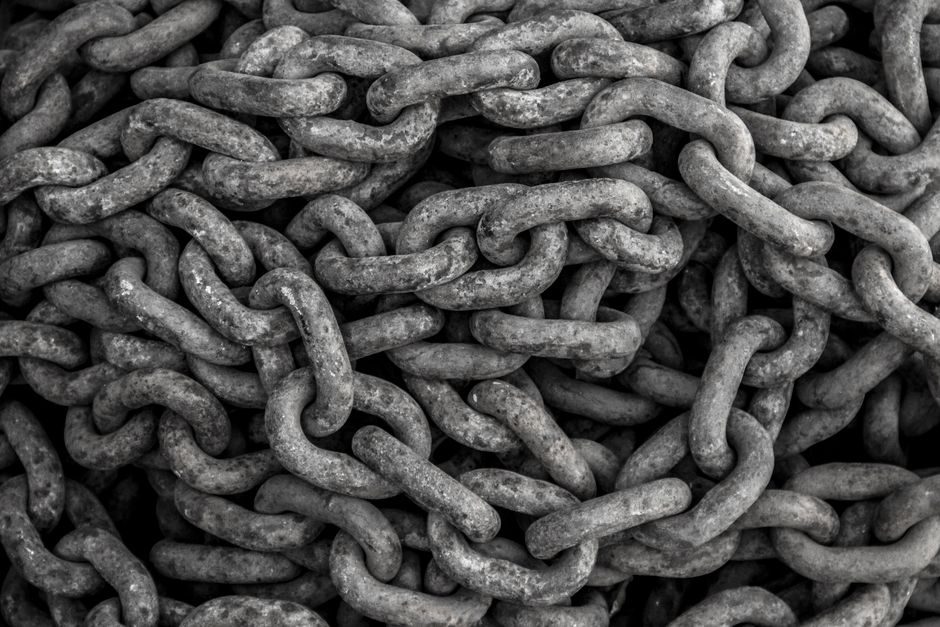
Roller chain selection runs on three orthogonal axes — dimensional standard (ANSI B29.1, ISO 606 / DIN 8187 / BS 228, GB/T 1243), duty class (standard short-pitch, heavy/extra-heavy series, double-pitch), and environmental treatment (stainless, nickel/zinc/Dacromet-coated, sealed O-ring/X-ring) — and getting any one of them wrong shows up as accelerated wear, elongation past the 3% discard limit, or premature pin fracture [S2][S3].
Power transmission buyers in 2026 still see ANSI #40 through #120 as the volume workhorses for general industrial drives, while ISO 06B–24B, 08B–24B, and 10B–24B anchor the metric/British-standard side, and 04B–24B plus 08A–32A dominate the GB/T 1243 build [S2][S3].
Standards Stack: ANSI B29.1, ISO 606, BS 228, GB/T 1243
ANSI B29.1 governs the inch-series short-pitch transmission roller chain used across North American drives, with the #25–#240 numbering ladder covering pitches from 6.35 mm to 76.20 mm; this is the size grid USA Roller Chain stocks for general industrial MRO [S3]. ISO 606 is the international counterpart and runs the A-series (08A–40A, ANSI-compatible) and B-series (04B–24B, metric), which underpins DIN 8187, BS 228, and the Chinese GB/T 1243 family used by Hengjiu, Huagang, Wanlong and HZ-Chain [S2][S3][S4][S5][S9].
Manufacturers explicitly market to all four standards as parallel offerings — Hengjiu Group states its short-pitch roller chain "dimensions fully comply with ANSI, ISO, and BS standards" and is shot-peened plus pre-drawn to control elongation rate [S2]; USA Roller Chain stocks a "British Standard Metric Roller Chain" line alongside the American Standard line, confirming the practical interchangeability in the field [S3].
The key spec-to-spec point: a European 08B-1 chain (12.7 mm pitch) is dimensionally interchangeable with ANSI #40 — sprockets, connecting links, and offsets are shared — but an 08A-1 (also 12.7 mm) has a thicker side-plate and higher tensile rating, so the sprocket profile and horsepower curve differ [S2][S3].
Duty Class Map: Standard, Heavy, Extra-Heavy, Double-Pitch
Standard short-pitch (single-strand A/K/SA/SK/M/D attachments) is the baseline for drives under roughly 50 kW at moderate speed where shock load is controlled; this is the bulk of what distributors like USA Roller Chain ship as "#40 single strand" [S2][S3]. Heavy-duty and extra-heavy-duty chains (often called "Engineer Class" or "Super Roller") use thicker side-plates, larger-diameter pins, and deeper case hardening to absorb shock loading from stamping presses, bucket elevators, and oilfield pumping units — both USA Roller Chain and Wanlong Machinery call out heavy/oilfield variants as a distinct SKU class [S3][S9].
For buyers writing a submittal, a clean criteria table looks like: standard short-pitch (≤50 kW, ≤1500 RPM, clean) vs heavy/extra-heavy (50–250 kW, shock loads, mining/oilfield) vs double-pitch (low speed, long centres, conveyor duty) — and the same chain size in double-pitch form typically drops allowable horsepower by roughly 40% but doubles allowable centre distance [S2][S3].
Construction Variants: Attachments, Hollow Pin, Cotter, Side-Bow, O-Ring
Chains with attachments (A, K, SA, SK, M, D) extend the side-plate with a bent tab or K-style lug every few pitches; these are the building blocks for chain conveyor flights, pusher dogs, and timing fixtures, and are dimensioned to ISO 606 Annex B-style attachment spacing [S2]. Hollow-pin chains use a sleeve in place of a solid pin so hydraulic or electrical lines can be run through the chain, which is the common fix for low-current signal routing on automated lines [S2][S3].
Cottered roller chain (vs the standard spring-clip or cotter-pin retained chain) trades assembly time for higher retention force on heavy-shock drives, and is sold as its own line item by both Hangzhou Wanlong and the US distributor [S3][S9]. Side-bow chains accept a small lateral deflection (typically up to 15° flex over short spans) and are used on spiral or curved conveyors — the roller conveyor market for distribution-centre curves still relies on this geometry [S2][S3].
Sealed chains (O-ring and X-ring) fit a nitrile seal between the pin and bushing to retain factory grease and exclude contamination; USA Roller Chain markets a "Long-Lasting O-Ring" SKU separately from the unsealed "Standard" line, and Hengjiu calls out "O-ring & X-ring Roller Chains" as a distinct construction family [S2][S3]. In washdown or outdoor service, the X-ring (four-lip) geometry retains grease measurably longer than a two-lip O-ring and is the common choice once ambient temperature crosses 60°C or the duty cycle exceeds 16 hours/day.
Surface Treatments and Stainless: Where the Chain Goes to Die
Corrosion is the #1 killer of roller chain in food, marine, and outdoor service, and the supplier response is a tiered coating stack: zinc plated (entry-level, indoor, mild humidity), nickel plated (smoother, harder, mild chemical resistance), Dacromet / zinc-flake (sacrificial + barrier, ~500 hr salt spray), chrome plated, phosphate, super zinc, and full stainless (AISI 304 for general food, AISI 316 for chloride exposure) [S2][S3]. Hengjiu publishes this exact ladder — "Galvanized / Nickel / Chrome / Dacromet / Phosphate / Super Zinc / Stainless" — as parallel build options on the same chain size [S2].
USA Roller Chain breaks the corrosion-resistant category into "Stainless Steel," "Coated," "Nickel Plated," and "Zinc Plated" SKUs, with the HKK Aqua-Series (MAXCO Perfect Coat Plus) as a higher-end coated option aimed at bottling and washdown [S3]. The decision rule is straightforward: indoor dry → standard carbon steel; outdoor / humid → zinc or nickel; food contact or chemical splash → stainless 304 minimum; salt or chloride → stainless 316 or Dacromet-coated carbon [S2][S3].
For foundries, rolling mills, and similar high-temperature process lines, the adjacent forging press and press-line selection map and the steel plant instrumentation and cable spec guide document the same heat-zone, lube-grade trade-offs the chain sits inside, which is why elevated-temperature chain service typically pairs an O-ring seal with a high-temperature NLGI #2 grease rather than a food-grade grease.
Specialty Families: Oilfield, Agricultural, Conveyor, Self-Lube
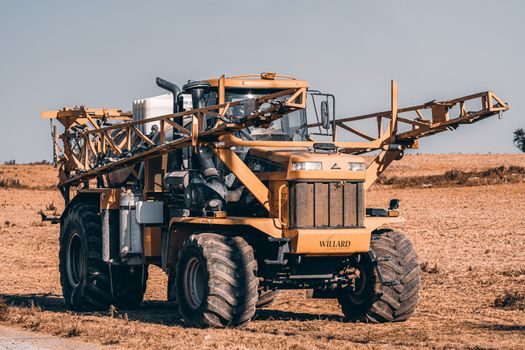
Oilfield chain (sucker-rod guide, pumping-unit, rod-lifter) is engineered for slow-speed high-shock service, often 80–160 pitch, with through-hardened pins and shot-peened links — Hangzhou Wanlong lists "oil field chains" as a separate main product and USA Roller Chain carries "Oilfield Roller Chain" as its own SKU [S3][S9]. Agricultural chain (C-type steel with attachments, CA-series, pintle) shares geometry with double-pitch but uses hook-and-eye or cotter-pin links for easy field repair; Hangzhou Perpetual Machinery lists C-type agricultural chain at FOB US $0.90/m with 100 m MOQ, which is the price band for the segment [S3][S10].
Conveyor chain sits in its own geometry class: larger pins, often straight-sidebar (no roller), and a conveyor chain configuration engineered for tension rather than mesh with sprocket teeth. Hollow-pin conveyor chain, stainless conveyor chain, and tabletop base roller chains all live in this family and are cross-listed on roller-chain distributor sites because the sprocket pitch is shared [S3]. For buyers, the rule is: if the load is carried on flights attached to the chain pins, you are in conveyor chain territory, not transmission chain territory.
Self-lubricating / lube-free chain (sintered-bushing or polymer-bushed) and plastic roller chain are niche SKUs that exist for cleanroom, painting-line, and food applications where oil drip is unacceptable; these are sold as "Lube Free" and "Plastic Roller Chain" line items, not as substitutes for a sealed O-ring chain in normal service [S3].
Selection Workflow and Sourcing Map
Write the spec in this order: (1) pitch and series — match to the driven and driver sprockets already on the machine (08B-1, #40, 50-2, etc.); (2) strand count — single, double, triple (a -2/-3 suffix multiplies the allowable torque roughly 1.7×/2.5×, not 2×/3×, because load distribution is imperfect); (3) duty class — standard, heavy, extra-heavy, double-pitch; (4) environment — sealed, coated, stainless; (5) attachments — A/K/SA/SK/D if the chain is also a flight carrier [S2][S3].
Mainland China remains the dominant manufacturing node: Zhejiang Huagang Chain Drive (founded 1995, Zhuji, Shaoxing) [S5], Hangzhou Wanlong Machinery (founded 1997, West Lake industrial cluster, 30 minutes from Hangzhou International Airport) [S9], Hengjiu Group [S2], Hangzhou Perpetual Machinery (ISO 9001 / ISO 14001 / IATF 16949 certified) [S10], and Hongkong Huaze Chain (three factories, exports to Asia, USA, Middle East, South America, Europe) [S4] are the typical B2B nodes for OEM and after-market volumes. Taiwan-origin supply surfaces through CENS-listed suppliers such as Yung Fang Steel Chains & Hardwares Works [S1][S8]. US distribution and custom assembly (HKK, Daido, DUROCHAIN) is anchored by USA Roller Chain with a $300 web order minimum and 45-year-old parallel stockist Darbar Company carrying bearings, industrial timing belts, and chain [S3][S6].
For broader mechanical-spec context — quality standards, instrumentation layers, and what is actually shipping in 2026 — the steel manufacturing quality standards reference and the shock absorber classification map sit on the same spec-driven axis as this chain guide, and the encyclopedia entry on roller chain anchors the basic geometry and history. The decision tree converges fast: pick the standard your sprockets are cut to, escalate duty class to heavy or extra-heavy only when shock load or contamination justifies it, and only then add a coating or seal.