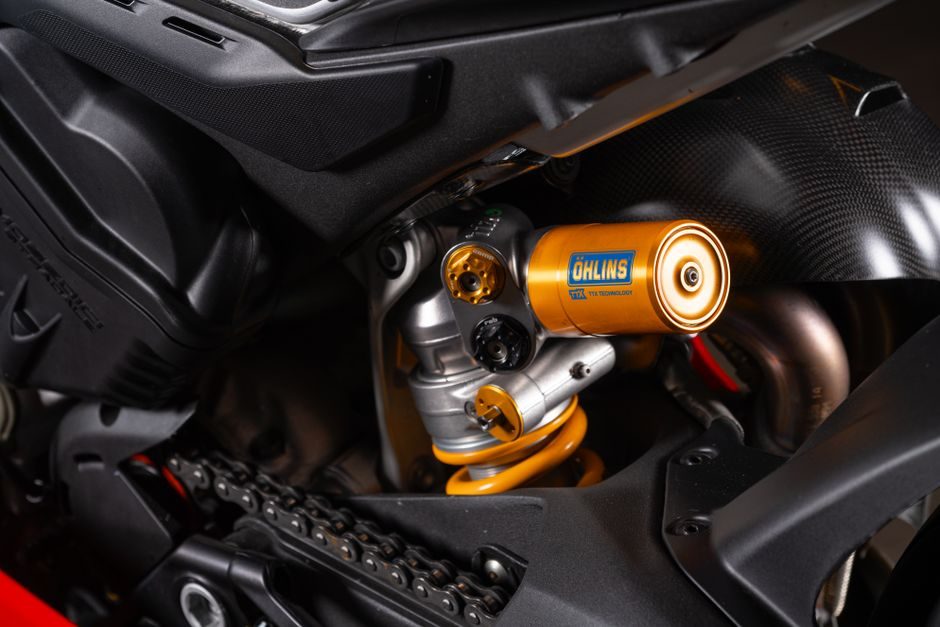
Industrial shock absorbers divide into four functional families — hydraulic, pneumatic (air-oil), elastomeric, and adjustable damping — selected by energy-per-cycle, peak reactive force, stroke, and ambient temperature [S3][S8].
Catalog coverage runs from OE-equivalent automotive struts to 20-level adjustable dampers, military truck units, and 8,000+ model libraries serving 200,000-piece monthly production, indicating the breadth of the global supply base [S3][S8].
Hydraulic Twin-Tube and Mono-Tube Dampers
Hydraulic units are the workhorse of automotive and light-industrial suspension, with catalogue references to OE-spec manufacture and 12-level damping adjustment on premium lines [S3][S4]. SAJIN's programmable line offers 20-level damping adjustment in a patented cartridge that fits the original assembly hardware, signalling a clear path from passive OE replacement to electronically tunable dampers [S3].
Hydraulic dampers dissipate kinetic energy by forcing oil through orifices; the working fluid is described as a highly resistant hydraulic blending oil in current product literature, a phrasing that maps to ISO VG 32–68 viscosity grades typical for mobile hydraulics [S3]. For selection, the relevant inputs are damping coefficient (N·s/m), maximum rod velocity (m/s), and energy per cycle (J) — values that are stamped on a unit's data plate rather than estimated from the housing diameter alone. Industrial twin-tube units are typically rated for lower peak force but higher continuous dissipation than equivalent mono-tube designs because the reservoir volume buffers aeration.
Pneumatic and Air-Oil Dampers
Pneumatic (air-oil) dampers use a compressible nitrogen charge behind a floating piston to provide a progressive, velocity-squared force curve; they are specified where the duty cycle includes long dwell times and where cavitation in pure hydraulic units would limit life [S3]. In factory automation, these units often share the same NC (national coarse) mounting footprints as hydraulic cylinders, simplifying retrofit.
Selection between hydraulic and pneumatic hinges on three numbers: (1) energy per cycle, where pneumatic wins above roughly 5,000 J per stroke for end-of-line machinery cushioning; (2) cycle rate, where hydraulic tolerates higher Hz because gas-piston units need recovery time; (3) temperature band, since pneumatic units compensate for viscosity drift better than mineral-oil hydraulics. Where adjustable damping is required, the SAJIN 20-level architecture demonstrates that hydraulic cartridges can also be tuned to mimic a progressive curve, narrowing the functional gap [S3].
Elastomeric and Rubber Buffers
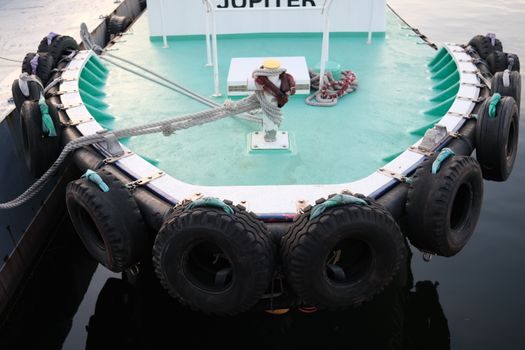
Elastomeric shock absorbers — solid rubber or polyurethane buffers — convert kinetic energy into heat through viscoelastic deformation rather than fluid flow [S1]. They are the default for low-energy, high-cycle applications such as conveyor end stops, cabinet door closers, and small-fixture bumpers, where a hydraulic unit would be over-specified and prone to seal failure.
Key spec inputs are durometer (Shore A 30–90 covers most industrial buffers), deflection at rated load (typically 20–40 % of free height), and peak force at maximum compression. Temperature limits for natural rubber sit near −40 °C to +70 °C, while polyurethane extends the upper bound to roughly +80 °C and offers better cut-growth resistance, which is why polyurethane buffers dominate modern industrial catalogues. For environment-resistant specifications, stainless hardware and FDA-grade elastomers are commonly offered as options, though these must be confirmed on the supplier data sheet rather than assumed from catalogue tier.
Adjustable and Application-Tuned Dampers
Adjustable dampers split into two practical sub-classes: externally-rebound adjustable (knob on the shaft) and electronically controlled (solenoid or proportional valve). SAJIN's 12- and 20-level product lines are OE-pattern, fit-for-original-assembly replacements, with a dedicated Hi-Low-Kit damping adjustable damper for lifted suspensions [S3]. FST's Taiwan-built line is documented to follow KYB OE specifications, an indication that aftermarket adjustable units are validated against the same damping curves as the OE hardware they replace [S4].
For machinery builders sourcing vibration isolation, an adjustable damper is rarely the cheapest path; the case for it is duty variability — a single line running both light containers and dense steel coils cannot be optimally damped by a fixed-orifice unit. Where a pressure sensor or flow meter already feeds a PLC on the line, integrating an electronically adjustable damper is straightforward: a 4–20 mA or 0–10 V setpoint closes the loop and the same controller can log cycle counts for predictive maintenance.
Automotive vs Industrial Use Boundary
Automotive and industrial shock absorbers share the same governing physics but differ on cycle life, contamination tolerance, and certification burden. The SAJIN catalogue explicitly carves out four application tracks: all-types OE replacement, tuning/Hi-Low-Kit, military and heavy-duty truck, and four-wheel-drive off-road — each with distinct bore sizes, shaft diameters, and seal stacks [S3].
Industrial users, by contrast, usually specify by absorbed energy per hour (kJ/h) and maximum reactive force (kN) rather than by vehicle application. The boundary cases are common: a packaging line that drops 25 kg cases onto a deceleration conveyor is mechanically closer to a vehicle suspension problem than to a precision instrument mount, so the automotive catalogue is often a faster and cheaper starting point than a generic industrial catalogue. Conversely, a cleanroom or food-grade installation needs stainless hardware and food-grade oil, neither of which appears in OE automotive SKUs.
Failure Modes and Selection Limits
Hydraulic units fail most often from seal wear and oil aeration; symptoms are a rising damping coefficient at low velocity and a foamy reservoir. Elastomeric units fail by compression set, where the buffer no longer returns to free height after sustained load — a permanent-thickness loss rather than a softening. Adjustable units add a third mode: damping-valve clogging in dirty environments, which presents as a single-direction lock. [S3]
Jiangsu Huanyu (SEFFE) markets 8,000+ model coverage on a 10,000 m² plant footprint with 200,000-piece monthly output, a capacity figure that places the supplier in the tier typically serving Tier-1 automotive aftermarket rather than niche industrial OEM [S8]. For high-cycle industrial duty, confirm with the supplier whether the unit's published life figure is cycles-to-failure or kilometres-driven, as these are not interchangeable.
Standards, Sourcing, and Verification
Shock absorber specifications are governed by a patchwork of OEM-specific standards and a smaller set of general industrial references; in mobile hydraulics, ISO 6020-2 governs cylinder mounting dimensions that many damper bodies inherit, while vibration isolation in fixed machinery typically references ISO 10816 for evaluation of machine vibration [S8].
Sourcing is concentrated in three regions: Taiwanese aftermarket and OEM-replacement manufacturers (SAJIN, FST), mainland Chinese volume producers (Jiangsu Huanyu/SEFFE, 200,000-piece monthly capacity, 8,000+ model library), and Japanese OE-grade suppliers (Panasonic's industrial line covering multifunctional shock absorbers for factory automation) [S1][S3][S4][S8]. For verification, request the unit's damping curve (force vs. velocity at a stated oil temperature), the SAE or metric mounting standard, and the published cycle life at the rated energy input — these three documents separate a real specification from a marketing sheet.
Two signals to watch: (1) a shift of adjustable-damper offerings from external knob to CAN-controlled proportional valves, which lets the same unit serve both OE aftermarket and electrified suspension retrofits; (2) capacity expansion announcements from mainland Chinese suppliers, where monthly output crossing 200,000 pieces is now the baseline for Tier-1 competitive supply [S8].
Background reading: Linear Encoder Buying Guide 2026: Specs, Types, and Sourcing Map.