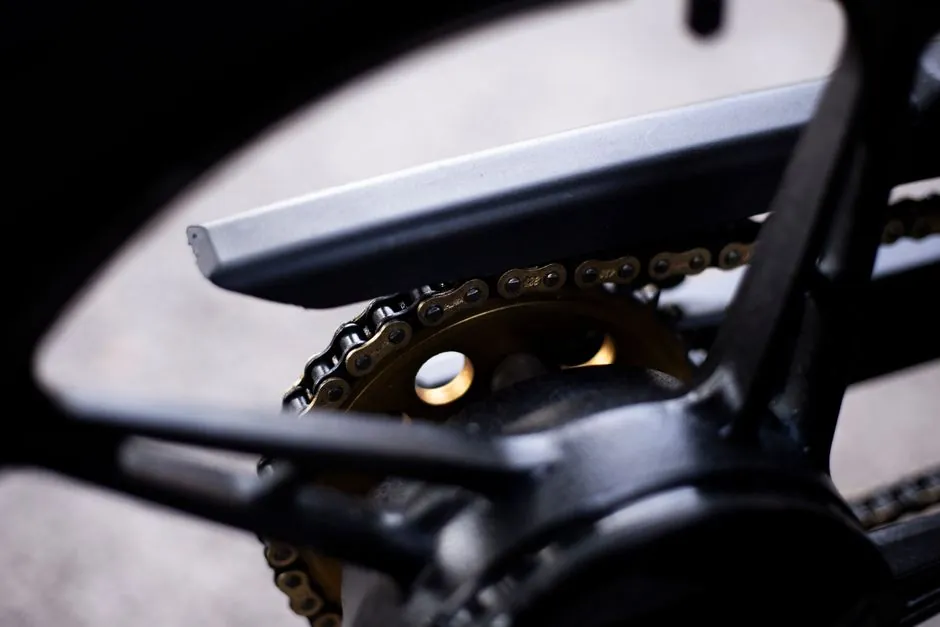
Automotive assembly and component plants specify roller chain through a fixed 9-step flow: classify the driven load, apply a service factor of 1.0-1.7, compute design HP, select pitch from a quick-selector chart, then validate the small-sprocket tooth count against the chain's HP table rating [S1][S7].
For paint, wash, and e-coat cells, the same flow applies, but with corrosion-resistant chain variants: stainless steel, zinc-plated, or nickel-plated, sized against the same ANSI B29.1 / ISO 606 envelope used for mechanical drives [S3][S4]. Roller chain remains the workhorse positive-drive medium because it transmits power without slip, holds a fixed speed ratio, and tolerates the long shaft centres typical of conveyor and skid lines [S2][S9].
Drive classification and service factor before any pitch call
Engineers must first lock down five inputs before touching a chain catalogue: input power type (electric motor vs. internal combustion engine with mechanical or hydraulic drive), driven equipment, transmitted HP, fastest-shaft RPM, and the desired slow-shaft speed [S1]. Driven loads fall into three classes: uniform, moderate, or heavy shock, and each class carries a different service factor in the standard 1.0-1.7 range that the designer multiplies by nameplate HP to obtain design HP [S1]. For example, a uniform load driven by an electric motor takes a 1.0 factor, while a heavy-shock mechanical ICE drive takes 1.7, a 70% margin swing on the same motor [S1].
Design HP = nameplate HP x service factor, and that product, not raw motor HP, is the value plotted on the chain-selection quick-selector chart [S1][S7]. Variable-speed lines must be evaluated at every speed step, not just at the nominal point, because a chain rated for 5 kW at 600 rpm can be undersized at 200 rpm on the same curve [S1].
Pitch, strands, and small-sprocket tooth count
Pitch selection is a two-axis lookup: design HP on the vertical axis, small-sprocket RPM on the horizontal axis, with the intersection landing inside the recommended pitch area (single-strand first, then double or triple-strand) [S1][S7]. Common ANSI sizes in automotive plants are 40B, 50B, 60B, 80B, and 100B for conveyor drives, with 06B-12B British/ISO sizes for compact transfer and indexing stations [S3][S7]. Double-pitch roller chain is the lighter, more economical option for low-speed, long-centre conveyors typical of body-in-white skid handling, because the longer links reduce weight per metre while keeping the same roller diameter family [S8].
Small-sprocket tooth count is not a free choice. The minimum is read off the chain's HP-rating table once the HP Table Rating (Design HP / Multiple Strand Factor) is calculated, and going below that minimum drives polygon-ing, chain whip, and premature roller/pin wear [S1][S7]. On reversing drives the two sprockets must be mirror-image matched, and the wrap angle on the smallest sprocket should not drop below 120° (90° only with verified chain tension) [S5].
Materials, attachments, and corrosion resistance for paint / wash cells
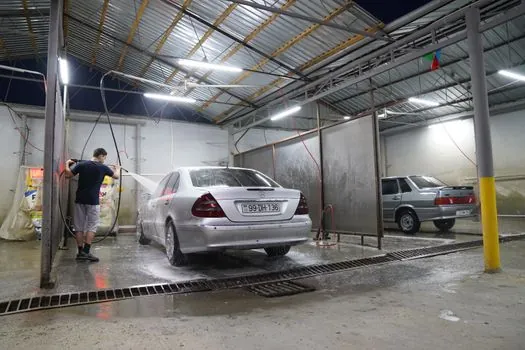
Standard roller chain uses case-hardened carbon-steel pins, bushings, and rollers, and is the right call for dry mechanical-drive zones such as press shops and engine assembly [S4]. Paint-shop pretreatment, e-coat, and wash-down zones need corrosion-resistant chain: stainless steel for full chemical resistance, zinc-plated for mild humidity, nickel-plated for higher temperature and longer cosmetic life, with ProCoat-style coatings used where the line cannot tolerate a full stainless price step [S3][S4].
Conveyor chain drives in automotive plants accept hundreds of attachment geometries (K-type, M-type, extended pins, bent attachments) to carry fixtures, skids, and tops, and these attachments must be specified to the same ANSI/ISO standard as the base chain so pitch and roller diameter remain interchangeable across the line [S2][S3]. Conveyor chain drives cover packaging, automotive, food and beverage, pharma, and textile cells, with low-friction, anti-static, magnetic, and high-temperature variants available as catalogue options rather than specials [S2].
Comparison: standard vs. double-pitch vs. stainless vs. industrial drive chain
The four common options line up against the criteria that matter on an automotive RFQ: cost per metre, maximum continuous load, corrosion resistance, and rated speed envelope. Standard ANSI single-strand roller chain (40-100) is the lowest cost and the highest rated speed per tooth, but is plain carbon steel and needs lubrication. Double-pitch chain (C2040-C2100) is lighter and cheaper per metre for the same tensile class, runs at lower speed, and is widely used on long conveyor runs. Stainless-steel chain (304/316) trades two to four times the unit cost for full wash-down capability and food-grade compatibility. Industrial drive chain per ISO 606 / ANSI B29.1 heavy series is the choice when shock loading, tighter pitch tolerance, or extended lubrication intervals are specified [S3][S4][S7].
The decision rule is straightforward: use standard single-strand for dry mechanical drives, double-pitch for low-speed long-centre conveyors, stainless for chemical-exposure zones, and industrial heavy series for high-shock or high-precision synchronised lines [S3][S4][S9].
Sprocket pairing, wrap angle, and centre distance

Chain and sprocket are a system: a chain's HP rating only holds if the small sprocket has the minimum teeth the table specifies, and the wrap angle on that sprocket stays at 120° or above (90° only with verified tensioning) [S1][S5][S7]. Sprocket material is typically hardened steel, with sprocket selection on agriculture-machinery lines a useful parallel reference for the same pitch/hub/steel logic applied to industrial conveyor drives.
Centre distance in chain pitches is the second geometric lever: too short increases articulation angle and wear, too long increases catenary and whip. Adjustable centres should be designed with the documented take-up range so chain elongation over the lubrication interval can be taken up without re-tensioning [S1][S7]. On reversing drives, both halves of the loop should be mirror-image matched, and the chain tensioner must be symmetric, otherwise slack will alternate between strands and accelerate fatigue on the loaded side [S5].
Limitations, failure modes, and what not to use a roller chain for
Roller chain is not the right call where absolute cleanliness, zero lubricant, or silent operation is mandatory: those cells need silent (inverted-tooth) chain, poly-chain, or timing-belt drives instead [S4][S9]. It also does not tolerate misaligned sprocket shafts beyond a fraction of the pitch, and a misaligned drive will show up as accelerated side-plate wear on one flank long before chain breakage [S7][S9].
Common failure modes in service are elongation from pin/bushing wear (signalled by the chain riding out on the sprocket tooth tips), roller fracture under shock load, and side-plate cracking from fatigue at the link-plate holes. All three accelerate if the service factor was set as 1.0 on a drive that turned out to be moderate or heavy shock in production [S1][S7]. Drives with more than two sprockets, idlers, abrasive or corrosive environments, widely fluctuating loads, or frequent start/stop cycles must be flagged for engineering review, not run off the standard 9-step flow [S1].
Lubrication, inspection, and standards anchoring
Standard, double-pitch, and industrial drive chains all need regular lubrication with the correct chain oil (not generic grease), correct tension, and periodic wear measurement with a go/no-go gauge over the sprocket tooth [S4][S7]. For automotive plants, the relevant standards anchors are ANSI B29.1 (US roller chain dimensions and HP ratings) and ISO 606 (metric / British standard short-pitch transmission chain), with DIN 8187 / DIN 8188 covering the German/European subset of ISO 606 sizes [S3][S4][S7]. A drive that meets the right standard, with the right service factor, the right minimum tooth count, and the right wrap angle will normally run the full lubrication interval without elongation issues; one that skips any of these steps shows up in the maintenance log within months [S1][S7].
Track the following two signals over the next planning cycle: (1) confirm whether any new automotive line in your plant is variable-speed, because that re-opens the HP curve at every speed step rather than just at nominal, and (2) audit existing drives for wrap angle on the smallest sprocket, since 90° retrofits are a common source of unexplained elongation on long-centre conveyors [S1][S5]. For related selection logic on adjacent components, shaft encoder vs rotary encoder selection is a useful cross-reference for the synchronised drives that share the same line.
Spec-level background on the components involved: road roller.