
Automotive assembly and component plants run on synchronous drives, and a correctly specced timing belt plus matched timing pulley is the lowest-risk way to keep camshaft, transfer, indexing, and conveyor sub-systems phase-locked without slip.
The decision sits inside a tight engineering envelope: ISO 9010 / ISO 9011 define ZA and ZB tooth profiles for automotive service [S7]; curvilinear HTD and Gates GT2/GT3 profiles carry 20 to 40% more torque than trapezoidal MXL/XL/L/H at the same pitch and width [S3]; chloroprene rubber with steel-wire or glass-fibre tension members survives -20 to +80 C ambient swings at up to 98% transmission efficiency and 50 m/s linear belt speed [S4].
Automotive vs. industrial tooth profiles: pick the right standard
Automotive engine timing belts run the ZA and ZB profiles formalised under ISO 9010 and ISO 9011, the international designations that fix tooth geometry, pitch, and dimensional tolerances for crank-cam service [S7]. Industrial synchronous belts, by contrast, follow the ANSI / ISO trapezoidal MXL, XL, L, and H series (0.080 in, 0.200 in, 0.375 in, and 0.500 in / 2.032 mm, 5.08 mm, 9.525 mm, 12.7 mm pitches) or the metric 8M and 14M HTD pitches used on transfer and indexing lines [S3].
Substituting an XL trapezoidal belt into a ZA-belt automotive service envelope is a common mis-spec: the tooth root on the trapezoidal section concentrates stress under high cam torque, which is why HTD/GT2/GT3 curvilinear profiles have become the default for new high-torque drive designs [S3]. For legacy engine assemblies, ZA/ZB remains the only correct choice, and any pulley swap must match ISO 9010 / ISO 9011 geometry exactly [S7].
Selection criteria ranked for automotive-plant drives
Five parameters decide the part number, and they should be locked down in this order. First, drive load: calculate peak, not average, because a one-second torque spike kills belts that look fine on the nameplate [S1][S2]. Second, pitch and profile: the load dictates whether MXL (less than 0.5 kW), XL (0.5 to 3 kW), L, or H is the right ANSI series, or whether a metric 8M / 14M HTD pitch is required for higher kW transfer lines [S3].
Third, environment: chloroprene rubber with steel or glass-fibre tension cord holds -20 to +80 C with oil and ozone resistance, and is the default cover compound for general plant areas; polyurethane is preferred in clean rooms and paint shops where particulate shedding must be minimised [S1][S2][S4]. Fourth, pulley condition and alignment: the belt cannot compensate for a worn or misaligned timing pulley; a 0.5 mm parallel misalignment shortens life by a measurable margin on a 5.08 mm pitch XL drive [S1]. Fifth, tensioning: a fixed-center drive needs a belt tensioner with enough idler travel to absorb belt stretch over the maintenance interval, otherwise the drive walks toward the slack side as the cord creeps [S1][S8].
Material and construction options side by side

Three material families cover almost every automotive-plant drive, and the choice is dictated by the surrounding environment rather than the load. Chloroprene rubber (neoprene) over steel or fibreglass tensile cord: standard workhorse, -20 to +80 C, oil- and abrasion-resistant, transmission efficiency up to 98% [S4]. Polyurethane (PU) over steel cord: clean-room compatible, low particulate, hydrolysis-resistant grades available for wash-down zones, but limited high-temperature ceiling relative to chloroprene [S1][S4].
Polyurethane over aramid (Kevlar) cord: used where the drive is exposed to repeated shock loading, such as cam-actuated test rigs, because aramid absorbs impact better than steel or glass fibre [S2]. Double-sided timing belts, with teeth on both faces, are the right answer where one belt must drive two driven shafts from opposite sides of the motor, a layout common in automotive transfer and lift stations [S1]. For drives that need to transmit power between parallel shafts over a longer span, a chain belt hybrid is occasionally evaluated, but the synchronous-belt approach remains lower-noise and maintenance-free in most plant cells [S2].
Matching belt series to power and speed on a plant line
The standard ANSI and HTD series bracket the power ranges an automotive plant actually uses. MXL (2.032 mm pitch) handles under 0.5 kW, fits miniature actuators and instrumentation, and is normally built in aluminium or plastic pulleys [S3]. XL (5.08 mm pitch) covers 0.5 to 3 kW and is the most common series in light transfer and indexing stations, including those driven by NEMA 23 or NEMA 34 stepper motors [S3][S5]. L (9.525 mm) and H (12.7 mm) take the higher-torque drives in body-shop skirt conveyors and engine assembly transfer lines [S3].
For higher kW transfer conveyors in body-in-white and paint, HTD 8M and 14M (8 mm and 14 mm pitches) and the equivalent Gates GT2 / GT3 metric series are the current engineering default, with the curvilinear tooth shape delivering the 20 to 40% torque gain over a trapezoidal profile at the same width [S3]. A standard two-pulley reduction of 1:1 to 1:6 covers most motor-to-load gearings; a 120-tooth XL pulley measures roughly 7.6 in (193 mm) in pitch diameter, useful as a sanity check when laying out a station [S5]. A similar sizing logic drives belt conveyor lines where a synchronous belt replaces a chain to cut noise and lubricant demand.
Installation, tensioning, and life expectancy
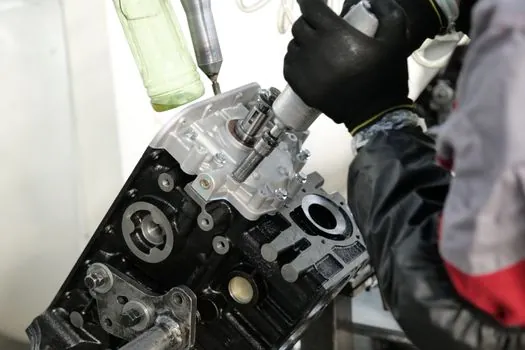
Correct installation is half the selection. A timing belt is sold as an endless loop cut to a specific tooth count, so the centre distance and the two pulley tooth counts must be chosen to match a standard catalog length, not the other way around [S5][S6]. Hub and shaft interfaces are usually plain bore with set screws, or D-bore for light press-fit onto a motor shaft; a keyed bore is the right call for any drive above 1 kW where shock reversal can walk a set screw loose [S5].
Tension must be set to manufacturer specifications at install and re-checked after the first 100 hours of run-in, because new chloroprene belts relax as the cords seat; an automatic belt tensioner is worth specifying on any drive where the line cannot tolerate a planned stop [S1][S8]. With load, environment, alignment, and tension all correctly set, timing belts in industrial service are commonly rated for 15,000 to 30,000 operating hours before the tooth-shear or cord-fatigue limit is reached [S1]. A related deep-dive on pulp-and-paper drives, where humidity and temperature are harsher than in a paint shop, is covered in Timing belt selection for pulp and paper drives.
Who this is for, and where the standard profile fails
Synchronous timing drives are the right answer for any automotive-plant cell that needs phase-locked motion without slip: cam-indexing tables, robotic transfer rails, synchronous conveyors running alongside an assembly line, paint-shop skew-roller drives, and engine sub-assembly stations where a ZA or ZB belt is mandated [S1][S2][S7]. They are the wrong answer for very high shock loads, where a roller chain survives impact better; for drives exposed to abrasive dust, where a polyurethane flat belt with a scraper is more economical; and for any application that demands a 1:30 or higher reduction in a single stage, where a gear reducer plus a short belt is the cleaner architecture [S2][S5].
A common failure mode is specifying a trapezoidal XL belt where an HTD 8M or 14M is needed for the kW and torque, then watching tooth-root cracks appear at 4,000 to 6,000 hours instead of the expected 20,000 [S3]. A second failure mode is to forget the belt tensioner on a long-centre transfer drive, after which the cord creeps and the belt walks off the pulley flange within one shift [S1][S8]. Sizing logic that maps cleanly onto a different power-transmission problem is detailed in Roller Chain Selection for Agriculture Machinery: Pitch, Duty Class, and Drive Fit, useful as a contrast for when a chain drive actually beats a belt.
Verifiable next nodes: confirm the OEM publish date of the current ISO 9010 / ISO 9011 amendment before locking a ZA or ZB tooling order [S7]; and request a matched timing pulley drawing from the belt vendor, with bore, keyway, and tooth-count tolerances called out to ISO 5294, so the pulley does not become the weak link in the drive [S3][S8].