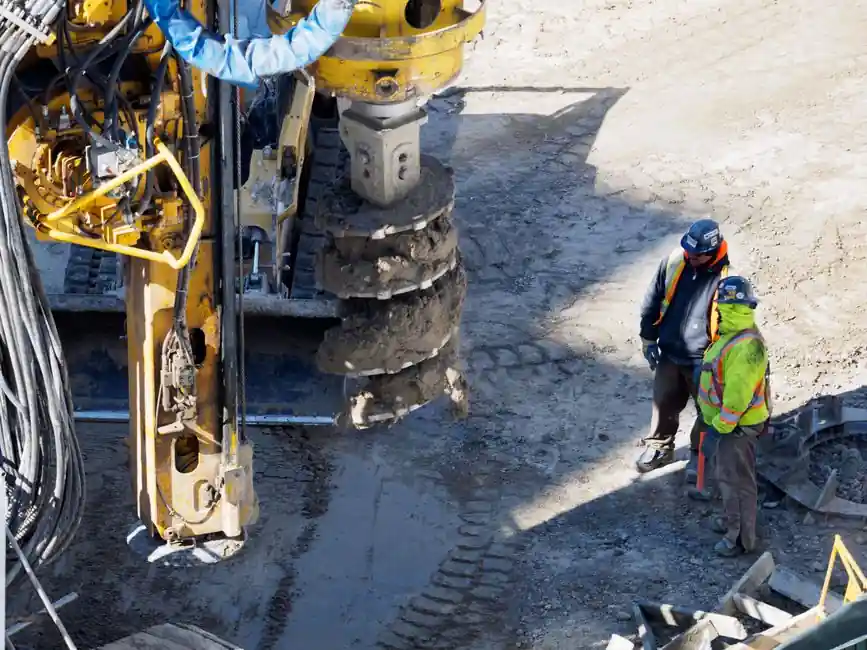
For road and bridge foundation piling, specify rotary drilling rigs with rated power of 125-450 kW, output torque of 120-400 kN·m, maximum hole diameter of 1.5-4 m, and maximum hole depth of 60-90 m, the working envelope that covers the majority of highway, interchange, and overpass pile programs [S1].
Within that envelope the equipment splits into three operating classes used on road jobs: small rigs (≈100 kN·m torque, 170 kW, 500-1,000 mm diameter, ≈40 m depth, ≈40 t) for slope-protection and urban piles; medium rigs (≈180 kN·m, 200 kW, 800-1,800 mm, ≈60 m, ≈65 t) for bridge piers and viaduct footings; and large rigs (≈240 kN·m, 300 kW, 1,000-2,500 mm, ≈80 m, over 100 t) for highway mainline, rail-bridge, and heavy harbor foundations [S4].
Spec envelope and what each number controls on a road site
Torque governs the ability to rotate the auger or bucket through dense overburden, soft rock, and embedded obstructions; the SWRDR125C delivers 125 kN·m at 1,500 mm diameter and 37 m depth, the SWRDR220C delivers 220 kN·m at 2,000 mm and 51 m depth, and the SWRDR285C delivers 285 kN·m at 2,000 mm and 54 m depth on a 85 t chassis [S1]. Rated engine power drives the hydraulic load-sense system that feeds both the rotary head and the main/auxiliary winches, and the 125-450 kW band is the practical range where crawler telescopic chassis, foldable self-erecting masts, and telescopic drill pipes stay within transport and permit limits [S1].
Maximum drilling depth is set by Kelly-bar length plus crowd-cylinder stroke, while hole verticality is held by the automatic detection and adjustment system on modern hydraulic units, with a target deviation of 1% or less during casing installation [S7]. For deep bridge foundations, casing is welded in multiple sections: 4-6 mm wall thickness for casing lengths up to 4 m, 6-8 mm for lengths beyond 4 m, again with verticality held within 1% during the weld-up sequence [S7].
Class-by-class fit for road, bridge, and interchange work
On a road project the class decision is driven first by pile diameter and depth. Small rigs handle urban renewal piles inside 1 m diameter, slope-protection piling, and light building footings adjacent to the right-of-way; medium rigs handle bridge pile construction for transport infrastructure, harbor terminals, and city viaducts up to 1.8 m diameter; large rigs handle highway and railway mainline bridge piles, large-diameter load-bearing foundations, and special-structure footings beyond 2 m diameter [S4].
Real procurement patterns follow that split: for a 15 m maximum-depth and ≤1 m diameter job a compact rig is normally sufficient, and weight stays under 25 t so it can be hauled on a standard lowboy without special permits [S6]. For interchange ramps with 28-37 m piles the SWRDR90A/SWRDR125A class (90-125 kN·m, 1,500 mm, 24-35 t) is the common pick, and for mainline bridges with 51-54 m, 2,000 mm piles the SWRDR220C/SWRDR285C class (64-85 t) is the working point [S1]. A practical spec-driven selection for forestry and remote sites is laid out separately in this rotary rig selection map.
Side-by-side comparison on four decision criteria
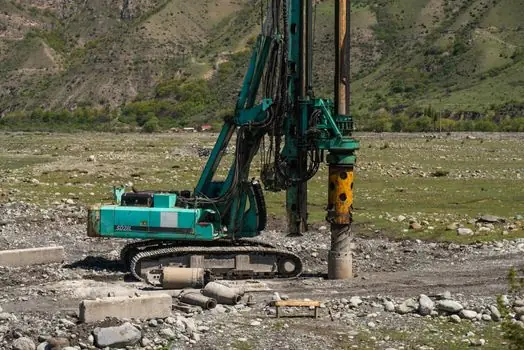
The three operating classes line up against road-job criteria as follows. Torque runs ≈100 kN·m (small), ≈180 kN·m (medium), and ≈240-285 kN·m (large) [S4][S1]. Engine power runs 170 kW, 200 kW, and 300 kW for the same three classes [S4]. Maximum hole diameter runs 500-1,000 mm, 800-1,800 mm, and 1,000-2,500 mm [S4], and operating weight runs ≈40 t, ≈65 t, and 100 t or more [S4], which directly controls the haul configuration and any escort or permit cost on the road haul route.
For the high end, a 285 kN·m rig at 300 kW and 2,000 mm diameter is roughly the same power-to-torque density as a 220 kN·m unit at the same 2,000 mm diameter but with a 51 m depth envelope instead of 54 m, a useful trade when borehole stability rather than raw torque is the limiting factor on a deep bridge pier [S1]. The road-site earthworks and compaction side of the job is covered by road roller types and classifications, and the broader machine park by construction machinery and equipment.
Drilling tools, mast features, and on-rig control
Modern hydraulic rotary rigs for road work run a hydraulic pilot control with load sensing, a hydraulic crawler telescopic chassis, a self-lifting foldable mast, telescopic drill pipe, automatic verticality detection and digital hole-depth display; the main and auxiliary hoists cover casing handling, rebar cage lift, and tremie pipe work without a separate service crane on site [S1]. Tooling is swapped for the ground condition: short spiral for dry cohesive soil, rotary bucket for wet silty soil, and core drill for rock, with options to fit long spiral, diaphragm-wall grab, and vibratory pile hammer for the cut-off and sheet-pile phases of an interchange [S1].
For geotechnical and environmental investigation that runs alongside a new road corridor, dual-mode direct-push and rotary rigs convert from mud rotary or air rotary to hollow-stem auger without breaking the drill string, a configuration that keeps a single rig productive across the soft-soil, fill, and weathered-rock layers typical of a road alignment [S5]. The wider rig family, including percussive variants for rock excavation, is covered in rotary hammer and rotary drilling rig.
Limitations, constraints, and failure modes to plan around
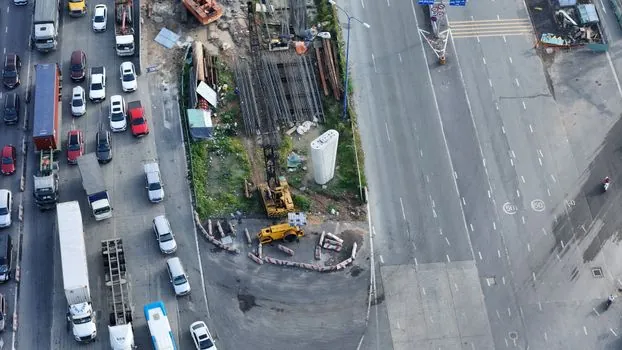
Outside the working envelope above, the rig class is the wrong tool: petroleum-class land rigs handle 8,000-15,000 ft (≈2,400-4,570 m) wells and water-well truck rigs handle 300-3,000 ft (≈90-900 m), depth ranges that are two to three orders of magnitude above the 60-90 m road-pile envelope, so any spec sheet that quotes those numbers on a road tender is a category error [S2]. Inside the road envelope, the binding constraints are ground bearing pressure for the crawler, transport weight and width for road haul, verticality tolerance for casing, and torque margin for tool stalls in cobble layers.
Casing deviation beyond 1% during multi-section weld-up propagates into pile eccentricity and rebar-cage clearance loss, and is the most common cause of rejection on a 2,000 mm bridge pier, so the casing thickness rule (4-6 mm for ≤4 m, 6-8 mm for >4 m) is treated as a hard floor rather than a recommendation [S7]. Tooling also drives the spec: a small rig with the right rock auger can outperform a medium rig with the wrong bucket in weathered rock, which is why procurement tends to be written around torque and tool compatibility, not just engine power.
Specifications table by model (verified from manufacturer data)
The following model line is published by a Shanghai-based OEM and is representative of the 60-285 kN·m road-class envelope: SWRDR60A at 60 kN·m, 1,200 mm, 20 m, 20 t; SWRDR90A and SWRDR90C at 90 kN·m, 1,200 mm, 28 m, 24-28 t; SWRDR125A and SWRDR125C at 125 kN·m, 1,500 mm, 37 m, 35 t; SWRDR150A and SWRDR150C at 150 kN·m, 1,500 mm, 42 m, 38-40 t; SWRDR150M at 150 kN·m but 700 mm and 16 m on a 37 t chassis for restricted-access urban work; SWRDR220M at 220 kN·m, 800 mm, 20 m, 60 t; SWRDR220C at 220 kN·m, 2,000 mm, 51 m, 64 t; and SWRDR285C at 285 kN·m, 2,000 mm, 54 m, 85 t [S1].
Drill string and downhole assembly remain the same component vocabulary across road and heavy-foundation work: drill pipe, drill collars, Kelly bar, drill bit, and rotary head, with the rotary table or top drive as the rotation source depending on the rig generation [S3][S8]. For a road-construction yard that needs lifting capacity to handle casing and rebar cages alongside the rig, single girder crane spec maps for road construction yards give the matching lifting spec.
How to spec a road-job rig without oversizing
Start from pile diameter and depth, then torque, then engine power, then weight and transport: for 1,000 mm / 40 m piles in urban renewal, stay in the ≈100 kN·m / 170 kW / 40 t class; for 1,500 mm / 37 m bridge piers, move to the 125-150 kN·m / 35-40 t class such as SWRDR125C or SWRDR150A; for 2,000 mm / 51-54 m mainline bridge piers, specify the 220-285 kN·m / 64-85 t class such as SWRDR220C or SWRDR285C [S1][S4].
Trackable signals to confirm a correct road-class spec on the next tender: the OEM torque and diameter table above for the candidate chassis; a 1% verticality tolerance on the casing plan with the 4-6 mm / 6-8 mm wall-thickness callout for ≤4 m and >4 m sections [S7]; and confirmation that the rig is offered as a hydraulic crawler with self-erecting mast and load-sense pilot control, the configuration that covers the dry, wet, and rock tool change-outs on a single road-site mobilization [S1]. Compaction and finish work after the pile cap is poured falls to road roller selection, which is a separate spec pass.