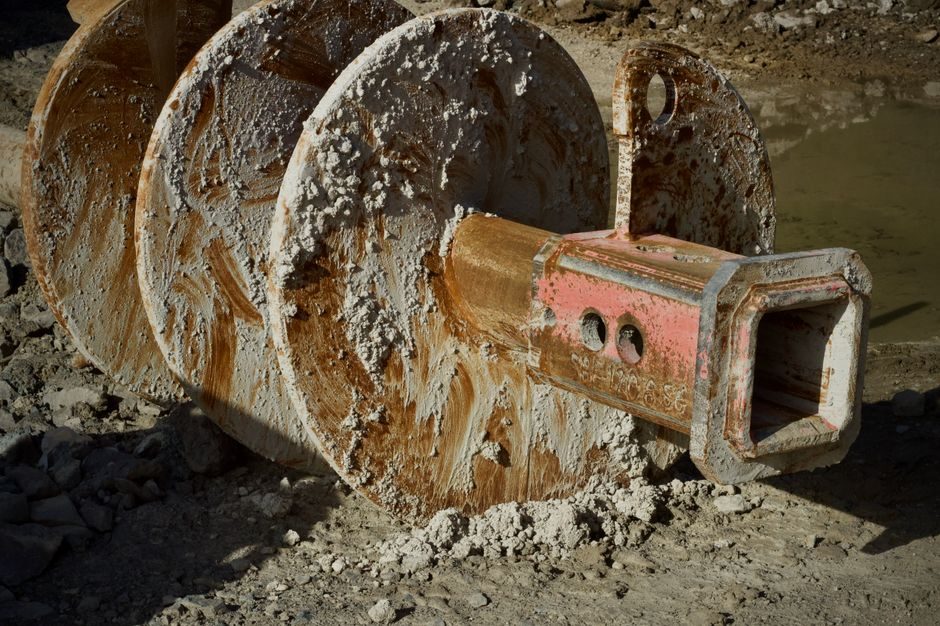
Three equipment classes dominate the 2026 rotary drilling rig market: down-the-hole (DTH) blasting rigs sized for 95–152 mm holes, piling crawler rigs engineered for 2,200–2,500 mm diameter bored piles to 100 m depth, and self-erecting compact units like the TR60 platform built for transport-complete deployment [S1][S2][S3].
China's national standard GB/T 21682-2019 remains the binding classification reference, segregating rigs by torque, engine power, hole diameter, hole depth, and overall machine mass [S8]. Suppliers range from dedicated OEM SANY and RTDrill to multi-line builders such as Zhengzhou Dafang Bridge-Machine, which lists rotary drilling rigs alongside gantry cranes and hydraulic trailers in its 2026 supplier index [S4].
Down-the-hole (DTH) rotary blasting rigs: 95–152 mm class
RTDrill's RTD28 DTH rig drills 95–152 mm (3.7–6 in) holes at 20.6 m³/min (727 CFM) air volume and 23 bar (333 PSI) working pressure, with a CAT C13 engine offered in Tier III, Tier IVf, and Tier V configurations at 287–309 kW (385–416 HP) @ 1,800 rpm [S1]. The drill tube accepts 76–114 mm (3–4.5 in) tooling, and the unit ships at 24,500 kg (54,013 lbs) operating weight, fitting the lower-mass tier of GB/T 21682-2019's torque/power classification matrix [S1][S8].
DTH rigs rely on a pneumatic hammer behind the bit to break rock while the rotary head turns the string — a hybrid method used in mining and quarry blast-hole drilling where hole straightness and per-metre penetration rate outweigh the larger diameters a piling rig can reach. The 23 bar / 333 PSI pressure class and 727 CFM air demand place the RTD28 squarely in mid-production blasthole duty, with a sister RTD32 / RTD45 / RTD55 / RTD70 / RTD75 lineup covering smaller to larger hole envelopes from the same manufacturer [S1].
Piling crawler rigs: 2,200–2,500 mm diameter, 65–100 m depth
SANY's SR365R-W10 piling crawler rig delivers 2,200 mm and 2,500 mm (87 in, 98 in) hole diameters at 65 m and 100 m drilling depths respectively, with a remote-controlled crawler platform targeting construction-sector foundation work [S2]. SANY positions the rig on "large core parameters such as high torque and crowd force" and a fast main-rope line speed, the two specifications that govern whether a piling rig can cut clean hole walls in stiff clay or weathered rock without deflection [S2].
For engineers evaluating piling rigs, the four numbers that matter are maximum hole diameter, maximum depth, rotary head torque, and crowd (down-thrust) force — the same parameters GB/T 21682-2019 uses to tier piling-class machines [S8]. A 100 m, 2,500 mm piling rig is fundamentally a different machine from a 30 m, 1,200 mm utility rig, not just a longer boom. Crawler mobility plus remote control, as on the SR365R-W10, also distinguishes the piling class from truck- or trailer-mounted DTH units, since the rig must reposition around a foundation grid without dismantling [S2]. A related comparison of rotary drilling rig classes and their selection criteria shows torque envelopes scaling non-linearly with hole diameter, which is why mid-sized piling work increasingly specifies 360 kN·m-plus rotary heads.
Compact self-erecting rigs: TR60 class and transport-complete design
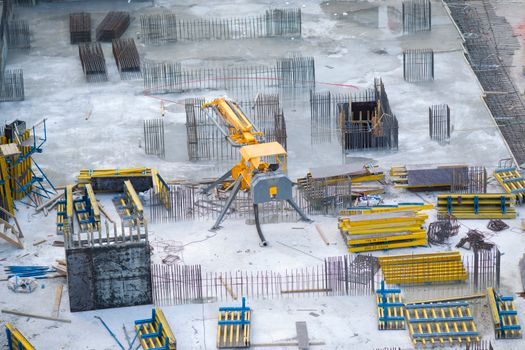
TR60-class rigs adopt "advanced hydraulic loading back technology" and electronic control integration, with a rotary head spin-off speed up to 80 r/min that solves the soil-off problem on small-diameter pile holes [S3]. Main and auxiliary winches mount on the back of the mast — improving rope-direction visibility, mast stability, and construction safety versus legacy front-mounted winch layouts [S3].
The TR60 driveline is a Cummins QSB3.9-C130-31 meeting State III emissions, with the hydraulic system built around import-brand main pump, rotary head motor, main valve, service valve, travelling system, rotary system, and joystick, plus Rexroth motor and balance valve on the main winch [S3]. EPEC (Finland) displays, controllers, and inclination sensors run through aviation-grade connectors in the electrical system, and the Kelly bar is telescopic friction or interlocking depending on application [S3]. The headline logistics claim is transport-complete: the drill pipe does not have to be removed before transit, which is a real differentiator for urban foundation work with night-transport and daytime-pour schedules [S3].
GB/T 21682-2019 classification axes: torque, power, diameter, depth, mass
GB/T 21682-2019 — the current Chinese national standard for rotary drilling rigs — defines the machine as a rig using a rotary bucket, short auger, or other working attachment for dry or wet drilling with cyclic rotary extraction, and classifies units by torque, engine power, hole diameter, hole depth, and overall mass [S8]. A 100 kN·m torque figure appears as one of the class boundaries in the standard's tiering, separating small/utility rigs from mid- and large-piling machines [S8].
GB/T 21682-2019 also partitions rigs functionally into single-mode rotary bucket rigs and multi-function rotary rigs, the latter accepting interchangeable tooling for CFA, casing, and DTH work in a single platform [S8]. A practical reading of the standard, cross-checked against the 2026 OEM catalog, is that a "small" rig typically tops out near 100 kN·m torque and roughly 1,500–2,000 mm hole diameter, a "medium" rig covers 150–250 kN·m and 2,000–2,500 mm diameters, and a "large" rig runs 300 kN·m-plus with diameters above 2,500 mm and depths past 60 m [S8][S2][S3]. These boundaries are not arbitrary: torque scales with the cross-sectional area of cut, and crowd force scales with required penetration in dense soil or weak rock — the two numbers together predict whether a rig can hold a clean hole at its rated diameter without stalling.
Engine emissions, hydraulic architecture, and component sourcing
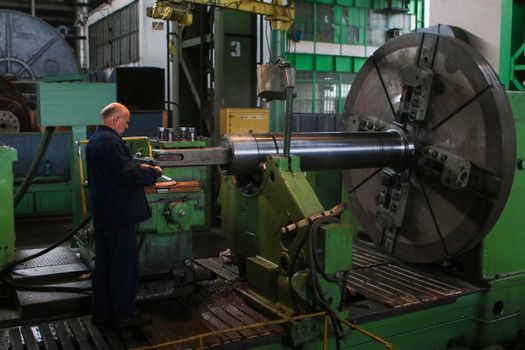
2026-class OEM rigs converge on a small set of emissions platforms: CAT C13 across Tier III / Tier IVf / Tier V (RTD28) and Cummins QSB3.9-C130-31 to State III (TR60) [S1][S3]. Tier IVf and Tier V are the EU and US non-road diesel benchmarks for 130–560 kW machines, while China State III is roughly equivalent to EU Stage IIIA; site specifications in 2026 increasingly demand Tier IVf / Stage IV or better for tenders in regulated jurisdictions [S1][S3].
On hydraulics, the TR60 specifies load-sensitive auxiliary valves for on-demand flow distribution, with Rexroth motors and balance valves on the main winch and EPEC (Finland) controllers and inclination sensors throughout the electrical architecture [S3]. The RTD28 instead uses a pneumatic-DTH architecture — 20.6 m³/min (727 CFM) at 23 bar (333 PSI) — with a 76–114 mm drill tube envelope and a CAT C13 diesel-electric driveline rather than an open-loop hydraulic pile-drilling circuit [S1]. The component-sourcing pattern (Rexroth + EPEC for Chinese-built piling rigs, CAT or Cummins for the prime mover, Finnish or German electronics) has been stable across multiple 2025–2026 supplier releases, including the Zhengzhou Dafang Bridge-Machine 2026 supplier index that lists rotary drilling rigs among gantry cranes, boom lifters, and hydraulic trailers [S3][S4].
Selection criteria and use-case fit
For mining and quarry blast-hole drilling in the 95–152 mm range with hard rock, a DTH rig like the RTD28 is the correct specification, with air volume and pressure (727 CFM at 333 PSI) as the gating parameters [S1]. For cast-in-place bored piles in the 2,200–2,500 mm class at depths to 100 m, a piling crawler rig such as the SANY SR365R-W10 with high torque, high crowd force, and remote-controlled crawler mobility is the appropriate match [S2]. For urban foundation work with night-transport constraints and small-diameter pile holes, a self-erecting TR60-class rig with mast-mounted winches, 80 r/min spin-off, and transport-complete design avoids the disassembly cost of larger piling platforms [S3].
Specifying the wrong class is the most common error: a DTH rig cannot economically drill a 2,500 mm pile, and a piling rig wastes fuel and transport cost on 100 mm blastholes. The GB/T 21682-2019 axes — torque, power, hole diameter, depth, mass — give engineers a single decision matrix that maps ground conditions, hole size, and depth to the correct rig class without brand preference [S8]. Material-handling considerations inside the drill string also matter; using an undersized rotary encoder on the kelly drive can mask stall events that would otherwise force an operator to abort a pour, and drill-string wear on DTH bits is a primary industrial valve of total drilling cost per metre.
Engineering constraints, mast dynamics, and reliability data
Peer-reviewed work on rotary drilling rig main-winch mounting — published via Scientific.Net and indexed in March 2026 — establishes two mathematical models (axial force and bending moment) comparing platform-mounted versus lower-mast-mounted main winches on the drilling mast, with the lower mount changing the load path into the mast structure [S6]. The practical takeaway is that winch location alters mast fatigue life and deflection under crowd-load cycles, which is why 2026 OEM piling platforms (TR60 class) now specify rear-of-mast winch layouts for both stability and operator visibility [S3][S6].
Reliability data points worth tracking in 2026: DTH rigs in the RTD28 class deliver about 23 bar / 333 PSI at 727 CFM with a 24,500 kg operating weight — a mid-pack specification in the global blasthole market — while piling rigs in the SR365R-W10 class push hole diameters to 2,500 mm at 100 m depth, a frontier envelope that few crawler rigs match [S1][S2]. Compact self-erecting units in the TR60 class cap rotary head spin-off at 80 r/min and run Cummins QSB3.9 at 130 HP, a much lower power density than piling rigs, but compensate with hydraulic load-sensitive flow control and EPEC electronic architecture for tight, repeatable pile quality [S3]. Sourcing signals to track: any 2026 supplier-index update from Zhengzhou Dafang Bridge-Machine on rotary drilling rig SKUs, and any revision cycle for GB/T 21682-2019 that adjusts the 100 kN·m torque tier boundary [S4][S8].
Related analysis: Lightweight Partition Panels: 7 Types, Spec Ranges, and Selection Boundaries.