
A rotary drilling rig is a crawler- or truck-mounted machine that rotates a kelly bar or auger to cut vertical or inclined holes for piles, micropiles, and ground improvement, with current OEM models spanning 95–1,800 mm hole diameter and 16–64 m depth [S1][S2][S3]. A shield machine — the shield machine class of tunnel boring equipment — pushes a cylindrical steel shell through soft ground or rock while erecting a segmental concrete liner ring behind the cutterhead, and is the default choice for horizontal metro, utility, and road tunnels.
The two machines solve opposite problems and are rarely specified on the same project: a rotary rig finishes an open borehole that is then backfilled with concrete or grout, whereas a shield machine produces a finished, lined tunnel. The rest of this cut breaks down where each one fits, the spec sheets to compare, and the failure modes that flip a buy from one to the other.
Working Principle and Scope of Work
A rotary drilling rig delivers torque and crowd (downward thrust) through a rotary head to a kelly bar, auger, or DTH hammer; the SANY SR205-C10, for example, is rated to 1,800 mm (71 in) diameter and 51–64 m depth on a diesel-hydraulic crawler chassis built for piling and civil-engineering bores [S2]. Spoil is lifted out by auger flights, by reverse-circulation flushing, or — in the RTDrill RTD28 down-the-hole configuration — by a 95–152 mm DTH hammer driven by a CAT C13 engine at 287–309 kW (390–420 hp) [S3].
A shield machine, in contrast, integrates three functions in one steel body: ground support at the face via a pressure-balanced cutterhead, continuous thrust via hydraulic jacks reacting off the previously erected liner ring, and segment erection via an erector arm inside the tail skin. Where the rotary drilling rig leaves an open hole, the shield leaves a watertight concrete tube. That functional gap dictates all downstream specs.
Drilling Depth, Diameter, and Torque Envelope
Current OEM data shows rotary rigs segmented into three practical classes. Compact class: the CBL YG120 delivers 500–1,500 mm diameter to 16 m depth with 17,000–22,000 N·m power-head torque and 120 kN max lifting force, on a 13,600 kg crawler at 28 MPa hydraulic pressure [S6]. Mid class: the XCMG XR130E reaches 1,500 mm diameter and 40 m depth at 169 kW (229.78 hp), 35 MPa hydraulic working pressure, and 43 t machine weight for soil investigation, deep stabilization, and micropile work [S1]. Heavy class: the SANY SR205-C10 hits 1,800 mm (71 in) diameter and 51–64 m depth on a remote-controlled diesel chassis [S2].
Shield machines, by contrast, are not sold against a diameter-and-depth line; they are specified by cutterhead diameter (commonly 6–15 m for transit tunnels), thrust force (often 20,000–80,000 kN on modern EPB and slurry shields), and ground-pressure balance regime. Anyone trying to compare a rotary drilling rig diameter spec to a shield machine diameter spec is already outside scope.
Ground Conditions and Spoil-Handling Method
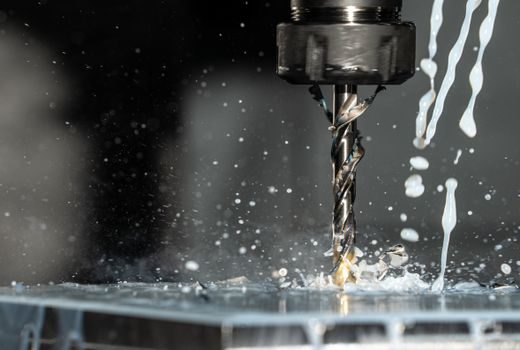
Rotary rigs are built for dry or lightly cased bores above the water table, with optional casing oscillators and bentonite slurry for cohesionless soils; the RTDrill RTD28 explicitly pairs a DTH hammer with hole diameters of 95–152 mm (3.7–6 in) suited to blast-hole and geotechnical work rather than large-diameter piling [S3]. Spoil comes out as cuttings on flights, as slurry, or as chipped rock — never as a continuous muck train.
Shield machines are designed for continuous face support: an EPB (earth-pressure-balance) shield uses conditioned spoil as a pressure plug at the cutterhead, while a slurry shield maintains face pressure by pumping bentonite through a separation plant. Neither geometry nor spoil logic is replicated on a rotary rig, and substituting one for the other on a deep soft-ground tunnel would collapse the face within hours.
Mobility, Footprint, and Site Logistics
Rotary rigs travel on crawlers, set up in minutes, and need only a flat working pad and a slurry pond (if used). The XCMG XR130E works inside a 7,546 × 3,600 mm envelope with a 17,724 mm extended mast height and 43 t operating weight, so it fits a typical urban piling plot without road-closure permits beyond standard abnormal-load rules [S1]. The SANY SR205-C10 adds remote control so the operator stands clear of the mast during kelly-bar tripping [S2].
Shield machines are non-mobile during boring: a 100 m+ launch shaft, a gantry crane, segment delivery trains, a slurry separation plant (if slurry type), and a 10–15 m diameter tail-skin clearance for the backup train. Site economics for a shield are dominated by muck handling, segment supply, and shaft sinking — none of which exist on a rotary drilling rig job.
Selection Criteria: Who Each Machine Is For
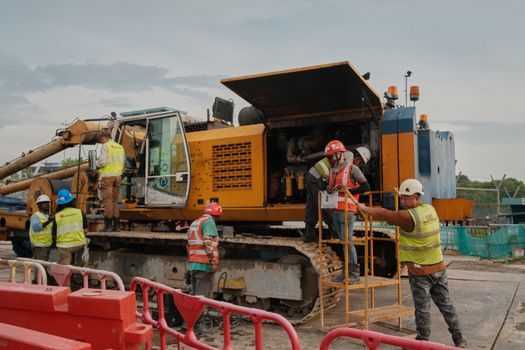
Pick a rotary drilling rig when the deliverable is a vertical or battered pile, micropile, anchor, or ground-improvement column in soil-to-soft-rock, with diameters up to ~1,800 mm and depths up to ~64 m on current OEM chassis. Pick a shield machine when the deliverable is a horizontal tunnel with a finished internal diameter, continuous face support, and a permanent segmental or sprayed-concrete lining. A project that needs both — for example, a metro station box built by cut-and-cover on rotary-drilled secant piles with the running tunnel driven by a shield — uses both machines, but never one in place of the other. [S1]
A practical selection table:
- Geometry: rotary = vertical / inclined shafts to 64 m; shield = horizontal tunnels of any length, typically 6–15 m internal diameter.<br>- Face support: rotary = open hole, optional casing; shield = continuous pressure-balanced cutterhead.<br>- Spoil: rotary = auger flights, DTH chips, slurry; shield = conditioned muck on conveyor or slurry pipeline.<br>- Lining: rotary = none in machine (cast later); shield = segmental ring erected in the tail skin.<br>- Crew and plant: rotary = 2–4 operators + crane support; shield = 15–30 person TBM crew + separation plant + segment gantry.
Limitations, Failure Modes, and Cost Bands
Rotary rigs lose to boulders, hard rock above their power-head torque limit, and deep groundwater without casing or slurry support. The CBL YG120, with 22,000 N·m max torque, is a 16 m, 1,500 mm machine — pushing it past either limit stalls the head or twists the kelly [S6]. The SANY SR205-C10 and XCMG XR130E extend those numbers but still cap out in the 64 m × 1,800 mm corner of the spec sheet, and a contractor who needs 80 m piles with a 2,500 mm socket is outside the current OEM envelope [S1][S2].
Shield machines lose to mixed-face ground (rock above, soil below), high groundwater inflows beyond the slurry plant capacity, and tight-radius curves below the manufacturer's minimum radius. Cost runs an order of magnitude higher than a rotary rig: a mid-size rotary piling rig is a low-seven-figure USD purchase, while an EPB or slurry shield for a metro tunnel is a mid-eight-figure USD outlay before shaft and segment costs. The 2026 supply picture, with active Chinese OEM launches in the rotary segment (Tianyuan, CBL, SANY, XCMG) and continued European and Japanese shield builds, has widened rotary availability without changing shield economics.
Sourcing Notes and Standards Touchpoints
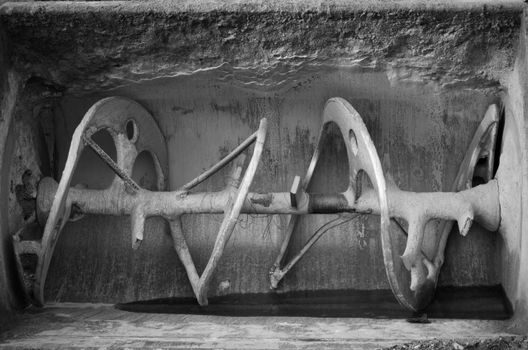
Rotary rig sourcing remains China-led for compact and mid classes, with at least four active OEM lines (XCMG XR130E, SANY SR205-C10, CBL YG120, RTDrill RTD28) catalogued on industrial B2B portals between March and May 2026 [S1][S2][S3][S6]. Buyers should validate the engine tier (CAT C13 Tier III / Tier IVf / Tier V on the RTD28 is a useful reference point for emissions compliance on jobsites that require it [S3]), hydraulic working pressure (28–35 MPa across the sampled rigs [S1][S6]), and kelly-bar configuration against the bore depth claimed.
Shield machine sourcing is dominated by Herrenknecht, CRCHI, and a smaller set of Japanese and Korean builders, with contract structure rather than spec sheet driving most decisions. The applicable baseline standards differ by class: piling rigs typically reference ISO 7960-1 and EN 16228 for auger and kelly-bar safety, while shield machines fall under project-specific tunnel specs (often derived from ITA guidelines and owner general specifications) — verify the actual document set on the contract rather than assume a single universal code.
Trackable 2026 signals: OEM datasheet refreshes from XCMG and SANY on next-generation electric-drive rotary chassis; ongoing SANY and XCMG export expansion into Southeast Asia piling markets; and continued DTH-rig model churn from RTDrill-class builders at the 95–152 mm hole-size end of the catalog [S1][S2][S3]. A related sourcing lens for buyers pairing piling with mechanical equipment can be found in the air-compressor smart-manufacturing 2026 spec cut, since rotary rigs and crawler compressors are often co-procured on the same piling spread.
For component-level specifications, see face shield.