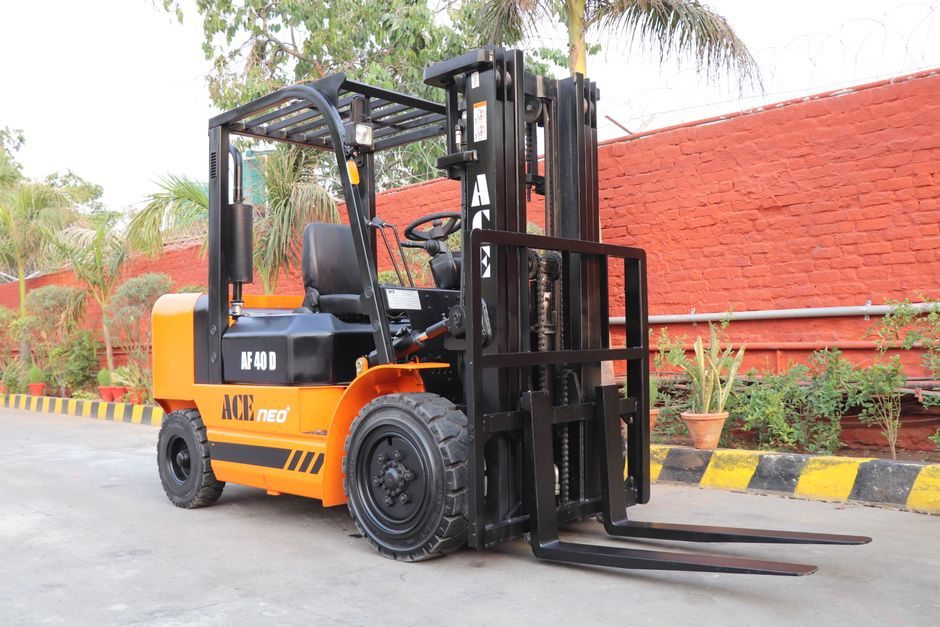
A rough terrain forklift is seldom specified for ISO Class 3–7 cleanroom interiors; the relevant fit is outdoor structural-steel erection, equipment staging, and sub-fab material handling on semiconductor fab expansion projects, where 2.5–3.5 t and 5–10 t capacity classes dominate the spec book [S4].
For process engineers reviewing tool-install contractors, the realistic question is which all-terrain lift covers a wafer-handling crate (typical 1.0–1.8 t), a chiller skid (3–6 t) or an exhaust-duct section (4–8 t) on uneven sub-fab grading, without contaminating the slab or losing stability on a 5% ramp [S5].
Where a Rough Terrain Forklift Earns Its Place on a Fab Site
Outdoor, non-cleanroom duty is the sweet spot: moving rebar, formwork, HVAC modules and palletized wafer-shipper crates between the staging yard and the building footprint. Configurable platforms — a stated design point for compact rough terrain forklifts — let the same machine switch from pallet forks to a personnel basket or jib for steel erection on the fab shell [S1].
Inside the envelope, the answer flips: a rough terrain forklift with open combustion, knobby tyres and a diesel or LPG powertrain is the wrong tool in a cleanroom corridor. For interior tool moves, a cleanroom-rated electric forklift with low-particle tyres and HEPA-filtered exhaust is the only defensible choice, while the rough terrain unit stays on the apron and the loading dock.
Capacity and Lift-Height Bands That Match Fab Construction Loads
The 2.5–3.5 t class with 2.7–6.5 m lift height covers the majority of fab yard work: chiller skids, air-handling units, electrical switchgear and the heaviest single-wafer-shipper pallets [S4]. Below that, 1.5–1.8 t / 3.0–6.0 m units handle consumable drums and crate moves without burning fuel [S4].
For heavier lifts — transformer pads, structural columns, scrubber modules — the 5.0–10.0 t class with 3.0–7.0 m lift height is the right call, typically telehandler-derived for the longer reach [S4]. High-voltage XH-series platforms (1.5–3.5 t, 3.0–6.0 m) enter the picture only when site electrification rules out diesel and the duty cycle is light [S4].
Stability, Tyres and Powertrain on Sub-Fab Ground
OSHA's late-1990s telehandler stability rule formalized the "stability triangle" concept — the load, weight and wheelbase geometry that determines whether a rough terrain forklift tips on a slope [S5]. On a fab pad with rain-softened subgrade, a 4-wheel-drive articulated chassis with diff-lock is the safer baseline than a 2-wheel-drive farm-derived chassis.
For ground protection on finished slabs near the cleanroom airlock, optional non-marking solid tyres and a Tier 4 Final / Stage V diesel with a diesel-oxidation-catalyst plus diesel-particulate-filter aftertreatment cut soot by an order of magnitude versus an unregulated engine — a meaningful reduction in the particle counts that the fab's make-up-air units must scrub.
Comparison of Main Capacity Classes for Fab-Site Duty
Three classes cover essentially all fab-construction lifts. (1) 1.5–1.8 t, 3.0–6.0 m lift, 4-cylinder diesel ~30–40 kW, fits on a 3.5 t truck-trailer and is the cheapest day-rate option for crate and drum moves. (2) 2.5–3.5 t, 2.7–6.5 m lift, 50–75 kW diesel, the workhorse for chiller and AHU skids [S4]. (3) 5.0–10.0 t, 3.0–7.0 m lift, telehandler chassis with 75–120 kW diesel, required for transformer and scrubber module placement where reach and ballast matter [S4].
Decision rule of thumb: under 2 t of single-lift load with 4 m or less reach, stay in class 1; 2–4 t of single-lift load with 5–6 m reach, class 2; above 4 t or above 6 m reach, class 3. High-voltage electric XH-series units (1.5–3.5 t) are only competitive on sites with no on-site diesel permitted, and even then only for class 1/2 work [S4].
Manufacturer Landscape and Sourcing Map

North American buyers see Hummerbee's configurable compact rough terrain platforms as a specialty source for yard trucks and articulated loaders [S1]. European fab projects typically run Manitou, JCB or Hangcha units — Hangcha publishes three XF-series rough terrain classes (1.5–1.8 t, 2.5–3.5 t, 5.0–10.0 t) and a high-voltage XH-series [S3][S4].
China-based OEM sourcing is dominated by Qingdao Yihao and EOUGEM, both exporting compact wheel loaders, skid steers, rough terrain forklifts and telescopic handlers with 19-year production histories [S2][S6]. For semiconductor-site buyers, the practical risk in going to a Chinese OEM is service-network coverage, not build quality — verify that the supplier has a dealer within 200 km of the fab for warranty turnaround.
Standards, Safety and Operator Rules That Apply on Site
Rough terrain forklifts on a fab construction site are subject to OSHA 29 CFR 1910.178 (powered industrial trucks) and, where the site is part of a larger general-industry employer, the same standard's training, daily-inspection and capacity-plate requirements [S5]. The stability-triangle rule set, also dating to the late 1990s OSHA rule, governs how loads are picked and sloped approached [S5].
For European fabs, the relevant machinery directive is 2006/42/EC and, for sites near the cleanroom, employer obligations under national worker-safety law on exhaust and particulate exposure. ATEX zoning is not normally applied to a rough terrain forklift operating on the construction apron, but a battery-electric unit is the cleanest answer where site rules treat diesel PM2.5 as a controlled emission near the air-handling intakes.
Limitations and Where the Rough Terrain Forklift Is the Wrong Tool
Three failure modes recur. (1) Using a rough terrain forklift inside a finished cleanroom — open engine, knobby tyres, no HEPA — fails every cleanroom protocol and contaminates the slab. (2) Under-specifying lift height on a 2-story fab build: a 3 m lift mast cannot place a rooftop AHU module that needs 6 m reach, forcing a crane re-mobilization. (3) Ignoring ground pressure on a rain-softened subgrade: an 8 t rough terrain forklift on saturated clay can sink 30+ cm and require a second machine to recover it. [S1]
For interior tool moves, switch to a cleanroom-rated electric counterbalance or reach truck; for very heavy transformer or scrubber lifts, the rough terrain forklift gives way to a mobile crane. For fab expansion where heavy haul and precision placement meet, an aerial work truck or telehandler with full stability interlocks is often the safer combination.
Track these signals going forward: (a) whether more Chinese OEMs (Yihao, EOUGEM) open EU service depots near Dresden, Hsinchu and Phoenix — the three largest 2026 fab build-outs; (b) whether XH-series high-voltage rough terrain forklifts reach 5 t capacity, which would close the gap with diesel class 3 [S4]; (c) the rollout of Stage VI diesel emissions in the EU, which will push more European fabs to battery-electric rough terrain units even on outdoor duty. None of these are date-certain, but each is a procurement lever to watch over the next four quarters.
For component-level specifications, see pressure transmitter.