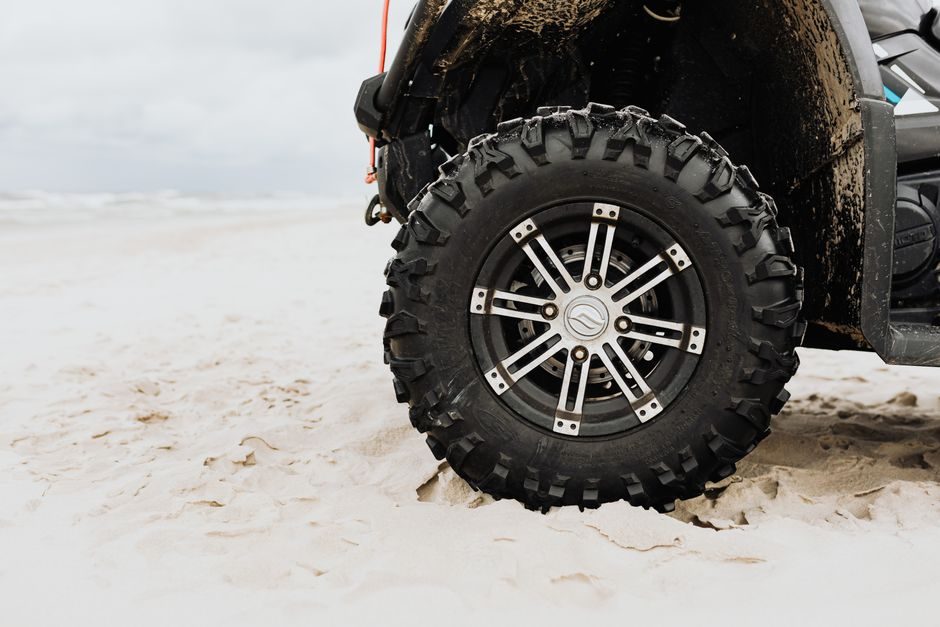
Rough terrain forklifts (RTFLs) — a sub-class of forklift used on unpaved, uneven-ground worksites — are specified by three concrete numbers: rated load (1.5–10 t is the OEM-stocked band), lift height (3–7 m), and gradability (a JAC military derivative claims 45 % and 80 km/h road speed) [S4].
Buyers should treat the machine as a four-part system — frame, driveline, mast, and operator station — because each part moves on a different cost curve. EOUGEM, JCB, Hangcha (XF/XH series) and Goodsense all publish rated-load windows and lift-height ranges that line up almost line-for-line, so the decision sits in duty cycle and ground condition, not brand [S1][S2][S3][S4][S5].
Load-Class Bands and Where Each One Breaks
Hangcha's XF series is published in three discrete load windows: 1.5–1.8 t at 3–6 m lift, 2.5–3.5 t at 2.7–6.5 m lift, and 5.0–10.0 t at 3–7 m lift [S5]. That same 1.5–10 t envelope covers the bulk of the global OEM population surveyed on ForkliftNet, including the 3.0–3.5 t Goodsense entry with flexible hydraulic steering [S4].
Beyond 10 t the catalogue thins out fast. LTMG's 20 t rough-terrain model sits as a custom-order, 180 unit/year production line item rather than a stocked SKU, with FOB Xiamen pricing shown at US$56,583 per set [S6]. The jump from 10 t to 20 t is therefore a sourcing-lead-time decision, not just a spec decision: expect 60–90 day build slots, not ex-stock dispatch.
Driveline: Diesel 4WD vs High-Voltage Li-ion
Two distinct power architectures are sold side-by-side under the "rough terrain" label. The traditional architecture is a diesel engine driving 4WD with frame leveling — Goodsense specifies a flexible hydraulic steering system "to meet off-road conditions," and JAC publishes gradability up to 45 % and water-depth rating for the same family [S4].
The newer architecture is high-voltage Li-ion. Hangcha's XH series sits in the same 1.5–3.5 t / 3–6 m window as the XF diesel line, but as an HV-Li-ion product, suitable for indoor-outdoor sites with emission limits [S5]. Hangcha America distributes both XF and XH through Rock Hill, SC, so the diesel-vs-Li-ion decision is a stock question, not a custom-build question for the 1.5–3.5 t band [S3].
Mast, Lift Height and Tyre Selection
Lift height is the most often misread spec. Hangcha's 1.5–1.8 t XF offers 3–6 m; the 2.5–3.5 t XF extends to 6.5 m; the 5–10 t XF reaches 7 m [S5]. The pattern is consistent across the segment: as rated load rises, the structural envelope allows taller masts, but the heaviest machines are usually sold for low-lift, heavy-pallet yard work, not container stacking.
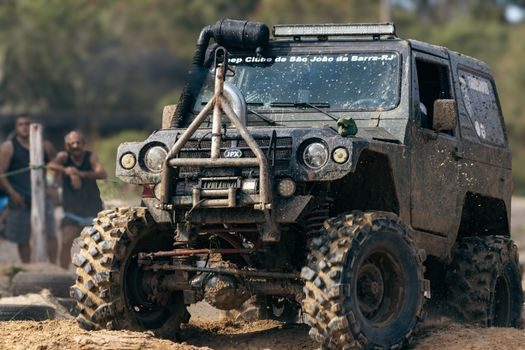
Tyre and ground-clearance choices drive real off-road capability. JCB's rough terrain range is published as a 4WD, single-mast construction-tractor-derived platform with pneumatic drive tyres and open differentials for muddy ground [S2]. The 20 t LTMG model is described as "wheel drive rough terrain" with off-road pneumatic tyres, suitable for the forestry, brick-yard and port-segment work where a standard pneumatic-tyre warehouse forklift would bottom out [S6].
Steering, Frame Leveling and Operator Visibility
Frame leveling is what separates an RTFL from a converted warehouse truck. Goodsense lists "flexible hydraulic steering" and "security to meet off-road conditions" as headline advantages for the 3.0–3.5 t model — frame leveling plus load-sensing hydraulic steering is the standard answer to slopes up to the mid-20 % range [S4].
Operator station design shows up as a differentiator even in the price-sensitive 2.5 t band: a JAC military off-road derivative is described as having a "comfortable, spacious design with excellent visibility" and standard sideshift, and is rated for 80 km/h on-road and 45 % gradability off-road [S4]. Sideshift is a small option on paper, but on rough ground it is the difference between a productive shift and a chipped-pallet graveyard.
Decision Matrix: Diesel XF vs HV-Li-ion XH vs Custom 20 t
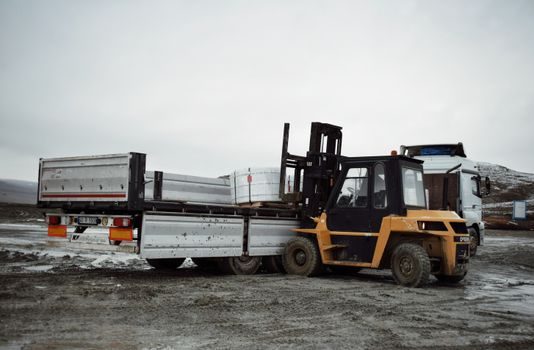
Three options cover roughly 90 % of industrial sourcing requests. The diesel XF (1.5–10 t) suits outdoor yards, lumber, brick and agricultural sites with no emission limit and refuelling logistics already in place [S5]. The HV-Li-ion XH (1.5–3.5 t) suits mixed indoor-outdoor sites — food, pharma, warehousing-adjacent construction — where diesel particulate is a contractual problem [S3][S5]. The custom 20 t diesel (LTMG-class) suits port, mining and heavy-machinery yards where load density matters more than lift height [S6].
For typical industrial buyers, the path of least regret is: (1) lock load class first (1.5–3.5 t covers 70 % of the segment's SKUs); (2) lock lift height to the tallest rack or container you will touch plus 0.5 m margin; (3) lock driveline to your site emission rules; (4) only then compare FOB and lead time. For a broader forklift selection baseline and the rough terrain sub-class definition, the same load-class-then-lift-then-driveline logic applies.
Sourcing Signals and 2026 Catalogue Watch-Points
Three signals are worth tracking. First, the 5–10 t diesel XF class now reaches 7 m lift as a stock item, not a custom build, which pulls the 5 t class into direct competition with small telehandlers for yard-logistics work [S5]. Second, Hangcha America operates a second Texas entity (Hangcha America Smart Logistics Solution Corporation, (281) 962-4900) alongside the Rock Hill, SC HQ — useful when negotiating West-Gulf vs East-Coast freight [S3]. Third, LTMG's 180 unit/year, US$56,583-per-set 20 t model indicates that above-10 t RTFLs are still built-to-order, so lead time — not price — is the controlling variable [S6].
If your project is in a related equipment class, the same load-and-reach decision logic appears in aerial work truck sizing and boom selection, and industrial robot BOMs follow a similar stock-vs-custom build split at the high-capacity end.
For component-level specifications, see pressure transmitter.