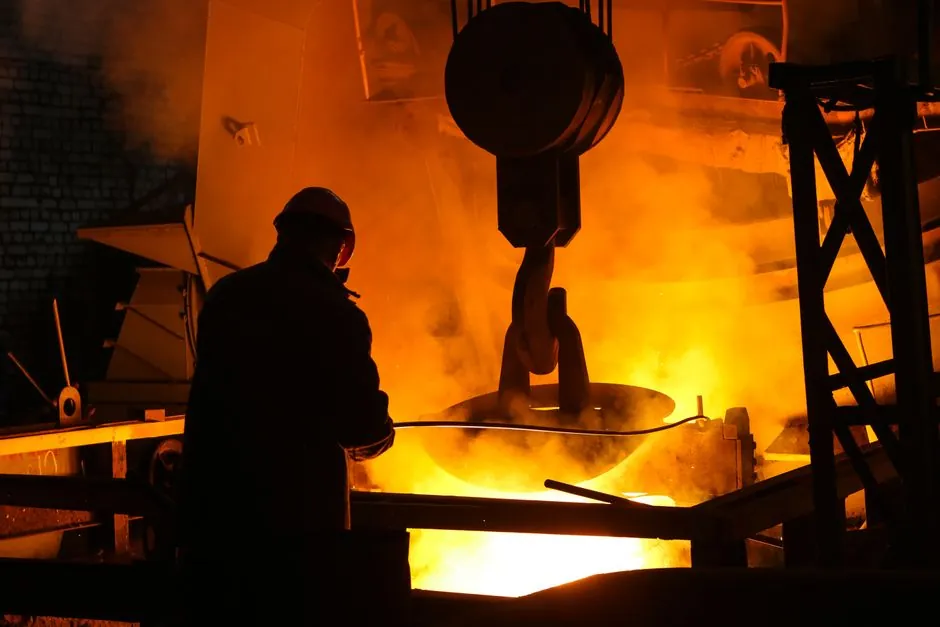
RV reducers do not replace the multi-megawatt parallel-shaft drives that run hot-strip mills, but they are increasingly specified for steel-mill auxiliary axes where precision positioning and high torsional stiffness outweigh raw horsepower [S2][S3].
The 2026 selection gate is dominated by four supplier-stack questions, not the gearbox catalogue: bearing-grade steel source, needle-bearing allocation, cycloidal disc grinder capacity, and published 8,000-10,000 hour backlash-drift data [S3]. Steel-mill buyers should expect steel-mill lead times of 8-14 weeks for 100Cr6, SCM415, and 20CrMnTi blanks through 2024-2025, and a 12-18 week critical path on the needle roller bearing stage, with a single missing bearing capable of stalling a 40-60 unit batch at final assembly [S3].
Why RV Reducers Enter a Steel-Mill Bill of Material
An RV reducer is a two-stage cycloidal-pin-wheel reduction with a needle-bearing-supported planet stage feeding a cycloidal disc and external pin gear, delivering zero-backlash output, 372-7,448 Nm/arc.min torsional rigidity across the BX20E to BX450E frame band, and 167-4,410 Nm rated torque in a 4.7-66.4 kg package [S1]. Its case over a harmonic reducer in steel-mill auxiliaries is the higher fatigue strength and stiffness of the needle-bearing planet stage, which tolerates the shock loads typical of coil-handling, tilter, and side-guide positioning drives [S1][S3].
RV reducers also bring a published design life of 6,000 hours at rated output speed, momentary maximum allowable torque of 833-22,050 Nm, and backlash held to MAX 1 arc.min on the standard-ratio 57-160 range, all of which are auditable spec values rather than marketing claims [S1]. For an engineer comparing an RV unit to a planetary reducer on the same auxiliary, the meaningful delta is the cycloidal disc's 2-4 µm profile-grinding accuracy on a 100-160 mm disc, which is what sets the 0.5-1.0 arc.min backlash-drift window over the first 8,000 hours [S3].
Steel-Mill Service Envelope: Where RV Fits, Where It Does Not
Main-mill drives (roughing stands, finishing stands, downcoilers) demand 5,000-10,000 hp class units with 1-2.8 million lb-in output torque ratings, and that is the parallel-shaft Falk Series Y and YF band, not the RV frame set [S2]. RV reducers are correctly placed on roll-changing cars, coiler mandrel positioning, side-guide adjustment, tilter synchronization, and roller-table gap servos, where the duty cycle is intermittent, the speed is low (rated output speed of 15 r/min is typical for the RV-E series), and precision matters more than continuous thermal capacity [S1][S2].
Steel-mill buyers writing a 2026 specification should treat thermal rating as the disqualifier: an RV unit selected purely on rated torque without a published 8,000-10,000 hour drift curve will fail in a hot-strip coiler position long before the gear steel reaches its HRC 58-62 through-hardening limit, because the needle-bearing cage and grease retention envelope degrade faster than the cycloidal disc itself [S3]. By contrast, worm reducer and gear reducer platforms dominate the slow-moving crane and conveyor drives that do not need the RV's positioning accuracy.
Material Stack: 100Cr6, SCM415, 20CrMnTi in 2026
The cycloidal disc is machined from 100Cr6 (DIN 1.3505, AISI 52100 equivalent) and through-hardened to HRC 58-62, the eccentric shaft is SCM415 case-hardening steel, and the planet wheel carrier is 20CrMnTi, with case-hardening on the latter two at a 0.8-1.5 mm effective case depth to HRC 58-60 to absorb the cycloidal disc's Hertzian contact stress [S3]. This three-material stack is consistent across every major RV reducer drawing published since 2024 and is the single largest source of 2026 lead-time risk in a steel-mill procurement cycle [S3].
Buyers should treat the EAF capacity-allocation shift of 2025 as background, not relief: lead times for these three steel grades ran 8-14 weeks through 2024-2025, and the same window is holding into 2026 because cycloidal-disc grinding-machine capacity is concentrated in 3-4 East Asian builder clusters, with 2026 order books reportedly full into Q3 [S3]. On a steel-mill RFQ, ask for the disc grinder OEM and model as a predictive indicator of build capacity, because it is more useful than the reducer brand name on the front of the catalogue [S3].
Bearing, Sealing, and Lubrication: The 12-18 Week Critical Path
Needle roller bearings supporting the planet wheel pins and the main bearing stage are the longest pole in the tent, with 12-18 week lead times that can stall a 40-60 unit batch at final assembly if a single line-item is missed [S3]. The four spec values to lock at the bearing spec sheet, not the reducer catalogue, are dynamic load rating C in kN, limiting speed in rpm under oil-mist lubrication, dimensional tolerance class P0 or P6 per ISO 492, and cage material (pressed steel versus machined brass), each of which changes the 10,000-hour drift outcome on a steel-mill duty cycle [S3].
Sealing and grease retention are the second qualification gate: an EPDM or HNBR lip seal with a felt dust seal typically achieves IP65, while a fully sealed oil-bath design with magnetic drain plug is required for IP67 washdown or food-grade adjacent-mill installations [S3]. For hot-coiler and tilter positions, a vendor that publishes a 10,000-hour test report with measured backlash drift typically quotes 8-15% above the spot-market price, and that premium is the cheapest insurance against a 6-10 hour unplanned mill outage [S3].
Selection Criteria Comparison: RV, Planetary, Parallel-Shaft on a Steel-Mill RFQ

The comparison below lines up the three families a steel-mill buyer typically weighs for a high-precision auxiliary drive, using four spec-led criteria that map directly to the 2026 supply-chain reality. [S3]
1) Torsional stiffness: RV units span 372-7,448 Nm/arc.min across the BX20E to BX450E frame band [S1], planetary reducers in the same frame class typically land at 50-150 Nm/arc.min for the 100-200 frame, and parallel-shaft Falk Y/YF units are not rated on this metric because they target multi-megawatt continuous duty, not path-following accuracy [S2][S3]. 2) Continuous thermal capacity: RV reducers are rated to 6,000 hours design life at 15 r/min rated output speed, planetary units are broadly comparable, and parallel-shaft Falk Y/YF units run to 10,000 hp and 2.8 million lb-in output torque for the 23 standard Y and 20 standard YF sizes [S1][S2]. 3) Backlash drift over 8,000 hours: RV reducers drift 0.5-1.0 arc.min on a vendor that publishes 10,000-hour data, planetary units typically drift more on a like-for-like frame, and parallel-shaft drives are not specified in arc-min [S3]. 4) Steel-mill lead time in 2026: RV reducers run 8-18 weeks on the steel-and-bearing stack, planetary units are shorter on the bearing line, and parallel-shaft Falk units are project-quoted, not catalogue-priced [S3].
Failure Modes and 2026 Sourcing Traps
The three failure modes that show up in a steel-mill RV write-up are needle-bearing cage failure from inadequate limiting speed under oil-mist, cycloidal disc profile wear from grinding accuracy worse than 4 µm on the 100-160 mm diameter, and seal breach under IP65 versus IP67 mis-spec on tilter and coiler positions adjacent to descaling spray [S3]. Each of these is auditable before PO: cage material and limiting speed on the bearing spec sheet, disc grinder OEM and model on the vendor qualification audit, and seal material plus drain plug on the cutaway drawing [S3].
The 2026 sourcing traps are not the headline price; they are the 6.4% apparent unit-cost gap between two suppliers that resolves, on inspection, to a 200-450 mm lead-time gap on needle bearings or a 0.5-1.0 arc.min backlash drift over 8,000 hours, with the cheaper unit silently transferring the cost to the mill's spares budget [S3]. Buyers should also weigh the 8-15% premium for a vendor with a published 10,000-hour drift report against the cost of one coil-handling bay outage, and use that as the negotiation floor [S3].
Trackable signals for the next 90 days: needle-bearing allocation letters from named makers (INA, SKF, NSK, NTN) on a 12-week stock confirmation, and a cycloidal disc grinder OEM/model disclosure on the vendor qualification audit, both of which are the leading indicators of whether the 2026 RV supply chain will hold its 8-18 week window or slip into a 24-30 week window on hot-coiler and tilter positions [S3].
Related analysis: Pick a Dump Truck for Demolition: Steel Body, Axle Count, and Site Match.