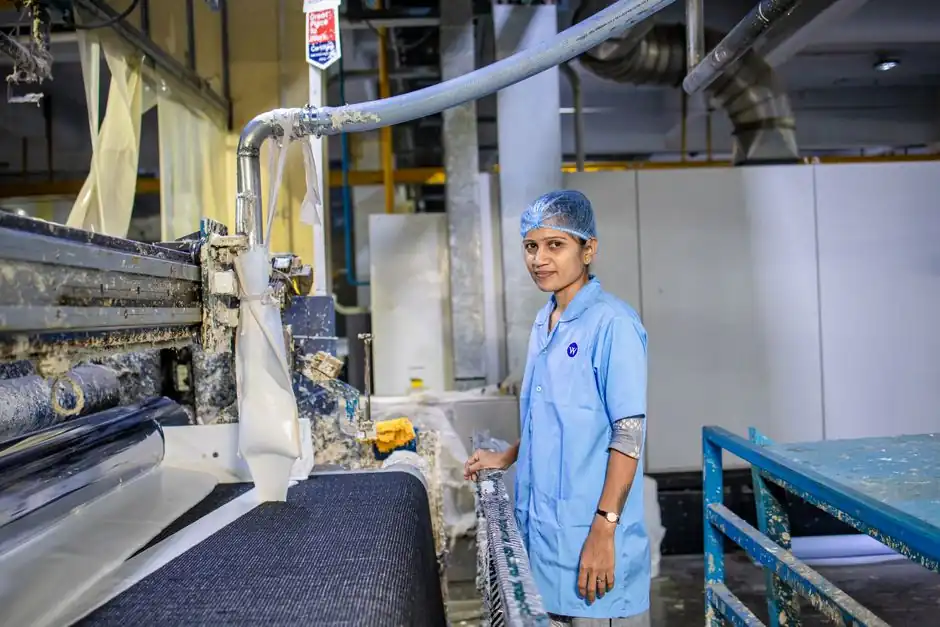
Textile-mill drive buyers in 2026 overwhelmingly default to the RV30 and RV40 frame sizes (063 mm center distance) when specifying RV reducers for spinning frames, looms, and knitting machines, because the RV/NMRV worm-gear family covers the 30:1 and 40:1 reduction ratios those machines actually need [S1][S2].
Three concrete numbers drive the spec: noise floor at or below 65 dB to protect yarn, 100,000+ hour design life from the 2-stage cycloidal-plus-planetary architecture, and precision backlash as tight as 0.5 to 1 arcminute on premium builds, with standard planetary units running 3 to 5 arcminutes [S2].
Why the RV/NMRV Family Fits Textile Duty
RV (also written NMRV in IEC-style cataloging) combines a worm primary stage with a cycloidal or planetary secondary, giving high-ratio reduction in a small foot print, which matters when loom builder cabinets are dense with drives and heat rejection area is limited [S2].
For textile duty specifically, vendors publish noise ratings at or below 65 dB and frame sizes from 025 through 150 mm center distance, with the RV030 (30:1) and RV040 (40:1) covering the bulk of yarn-machinery gear ratios [S1][S2]. The 0.55 kW, 80B5 flange-mount, B3 position configuration shown in the S2 datasheet is a typical spinning-frame drive package, paired with a YE3-class high-efficiency three-phase motor when energy compliance matters [S2][S3].
Selection Criteria Mapped to Textile Process Steps
Textile plants are not one process: spinning, weaving, dyeing/finishing, and stenter frames each stress the drive differently, and the gear reducer spec has to follow the worst-case load step, not the average [S3].
Spinning frames need steady torque at low to mid RPM and are sensitive to vibration that can break fine counts, so a 2-stage RV with 0.5 to 1 arcminute backlash is the safer pick. Weaving looms (rapier, air-jet, water-jet) impose cyclic shock loads at every beat-up, so the cast-iron housing and 3x rated-torque shock margin quoted for RV-class units is the gating figure, not the steady-state torque. Dyeing and stenter lines run hot, wet, and continuous; here an IP65 minimum housing seal, food-grade or synthetic grease, and a corrosion-resistant coating matter more than backlash. Drying and conveyors after the dye range tolerate a step-down to a standard planetary reducer if the duty is steady and continuous, but any indexing or tension-control dancer roll wants the RV-style precision [S2][S3].
Frame Size, Ratio, and Motor Match: a Decision Table

Buyers should match three numbers in order: required output torque at the machine's worst load step, the input speed the motor will run at (typically 1400 or 1750 RPM at 50/60 Hz), and the backlash class the process can accept [S2][S3].
For a typical rapier loom or circular knitting machine, an RV040 size with 30:1 to 40:1 ratio driven by a 0.55 to 1.5 kW motor is the common match, and the same 80B5 flange/B3 foot pattern can be reused across the line to keep spares common [S2]. For a stenter or dryer conveyor, the same RV040 sized at 50:1 or 63:1 lets the motor run closer to its base speed for better efficiency, and pairing with a variable-frequency drive such as the SV200 class inverter gives the wide speed range dye houses need [S3]. For ultra-fine yarn winders, drop to a precision planetary reducer at 1 arcminute or below, since 3 to 5 arcminute backlash in a standard RV can show up as periodic thickness variation in the yarn.
Comparison: RV vs Cycloidal vs Planetary vs Worm for Textile
RV reducers, cycloidal reducers, planetary reducers, and worm gear reducers all show up in textile machinery catalogs, and the right pick depends on the load profile, not the brand label [S2].
On life, RV-class 2-stage units are quoted at 100,000+ hours versus roughly 50,000 hours for single-stage cycloidal, and that gap widens on cyclic shock loads typical of looms [S2]. On backlash, precision RV reaches 0.5 to 1 arcminute while standard planetary sits at 3 to 5 arcminutes, so for yarn-quality-critical stations the precision RV wins. On shock margin, cast-iron RV housings with NSK bearings are rated for 3x rated torque momentary, which is the spec that matters for beat-up shock on weaving machines, while a basic worm gear reducer is fine for slow speed, steady conveyor service but not for cyclic shock. On efficiency, helical-planetary units typically beat worm at high ratios, but worm primary stages in the RV family deliver the high reduction ratio (up to 100:1 in a single stage) that lets the motor run at its efficient base speed [S2][S3].
Standards, Lubrication, and Sealing for Mill Environments

Mill air carries lint, lubricant mist, and humidity swings between dye-house wet zones and dry-finish areas, so the IP rating and grease choice are not optional [S2][S3].
Food-grade or synthetic greases are commonly stocked as an option for washdown and dye-house zones, with stainless or coated housings for corrosion resistance, and an IP65 minimum is the practical floor for any reducer mounted in a wet-finish line. A reduction ratio label in the catalog follows a consistent code: NMRV030-60 denotes 030 center distance (30 mm) with 60:1 ratio, NRV-040-30 denotes 040 center distance at 30:1, and the same scheme extends to RV40/50/63/75/90/110/130/150 across the catalog [S2]. Industry references for the worm-gear family follow JB298281 ministry standards on the manufacturer side and CE documentation on the export side, which should be confirmed on the mill-specific certificate of conformity before commissioning [S2].
Who RV Reducers Are For, and Who Should Look Elsewhere
RV reducers are the right pick for mills running rapier and air-jet looms, circular knitting machines, winding and twisting frames, and stenter/dryer conveyors where the duty is 24/7 and vibration, noise, and lint are real constraints [S2][S3].
They are not the right pick for ultra-fine yarn winders below 5 dtex, where sub-arcminute backlash from a precision planetary is mandatory; not for high-speed spin-draw lines above 8000 RPM input, where balance and dynamic balance class on the rotor dominate; and not for sanitary food or pharmaceutical washdown with full IP69K chemical exposure, where stainless-housed stainless-steel gear units replace the cast-iron RV [S2]. For those edge cases, a precision planetary reducer with ceramic-coated output shaft and stainless bellows seal is the cleaner match.
Common Sourcing Mistakes in 2026 Mill Specs
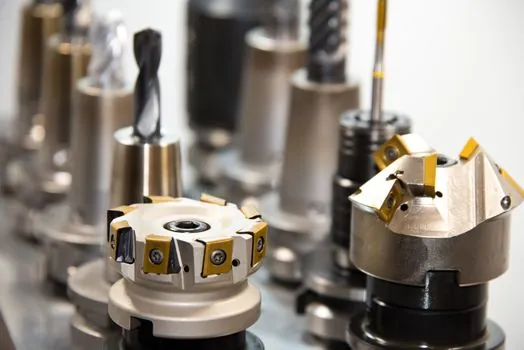
The most common spec error is over-torqueing the frame, picking an RV50 when the load step only needs an RV30, which drives up both price and footprint, and complicates spares inventory across the line [S1][S2].
The second is under-specifying backlash: a standard 3 to 5 arcminute unit will pass bench test and fail in production at the winder, so quote precision 0.5 to 1 arcminute on any station handling yarn above 30 dtex [S2]. The third is mixing flange footprints (B5 vs B14 vs B3 foot) without confirming the motor face match, since the 80B5 pattern is the most common but not universal. For a cross-sector benchmark of marine-grade reducer selection where ingress and class approvals are tighter, see Marine RV Reducer Selection: Specs, Class Approvals, Sourcing, which covers the same RV family against stricter environmental rules and is a useful reference when a mill has coastal humidity exposure [S2].
Verifiable Next Nodes for Spec Audits
Two trackable signals: confirm on the mill's PO that the reducer carries an explicit noise figure at or below 65 dB at 1 m, and a backlash figure in arcminutes (not a vague "precision" label), and require the manufacturer to publish the JB298281 or equivalent conformity line item so a replacement unit years from now is drop-in compatible [S2][S3].