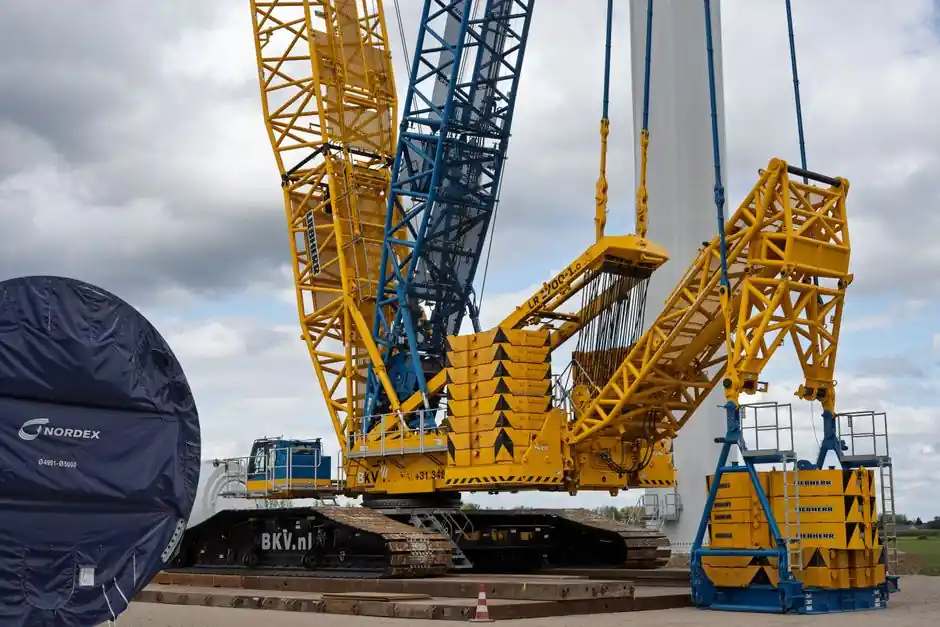
Large crawler crane transport can require 15–25 trailers or more for a 300–500 ton machine [S5].
The largest savings come from controlling boom-section loads, eliminating empty trailers, coordinating permits and escorts, and selecting self-assembly equipment that avoids a separate assist crane [S1][S5].
How many loads should a large crawler crane move?
A mid-size 100–150 ton lattice boom crawler typically requires 6–10 trailers, while a 300–500 ton crane can require 15–25 trailers or more [S5]. The load plan must cover the upper house, carbody, tracks, boom sections, and counterweights as separate transport items [S5].
For boom sections, the first decision is not whether every section must travel separately, but how many sections can be combined within legal width, height, weight, axle-load, and route limits. A fully assembled lattice crawler is too wide, tall, and heavy for normal road movement, so the boom and major machine components must be separated for public-road transport [S5].
Transport economics should be measured per delivered section, not only per tonne. A long route survey, a special trailer, or a road closure can make a nominally lighter section more expensive than a heavier consolidated load [S5]. The detailed planning sequence is covered in Crawler Crane Lattice Boom Transport Logistics Guide.
Which transport-cost levers reduce the most expenditure?
A mid-size crawler crane can require 5–10 trailers and weeks of planning [S5].
Use the following decision comparison for the principal options:
Self-assembly is the key option when the selected crane supports it. Hydraulic cylinders or Quick Draw devices can support disassembly and reassembly without a separate assist crane, materially reducing mobilization cost [S5]. That feature does not solve transport by itself, but it removes a related crane, operator crew, fuel, lift plan, and site-access cost.
How should boom-section loads be grouped?

Group sections only after checking the exact section dimensions, connector geometry, center of gravity, lifting points, and allowable road loads. The truss structure distributes stress efficiently, but transport imposes different constraints from the final crane configuration: a section can be structurally efficient yet unsuitable for a standard trailer [S3].
Set the loading plan against three separate limits: legal vehicle limits, physical route limits, and crane receiving limits. Physical route limits include bridge capacity, utility lines, tight turns, road geometry, and escorts. Crane receiving limits include ground bearing capacity, unloading space, and the erection sequence at the destination [S5].
Do not add a jib merely because it extends reach. A jib increases reach while reducing load capacity, so it must be removed or added according to the lift program rather than treated as a transport accessory [S7]. The crawler crane configuration should be fixed before final trailer loading, because late changes to boom, jib, or counterweight selection can invalidate the transport plan.
How do permits, routes, and scheduling control hidden charges?
Most crawler crane components require oversize or overweight permits, and upper-house and carbody components weighing 40,000–90,000 lb can require overweight permits [S5]. Components exceeding 80,000 lb may require superload permits and route surveys [S5].
Route surveys should be completed before trailer orders are confirmed because long-load restrictions can force an alternate route, escort plan, or vehicle redesign. A single low-loader journey within a 50-mile radius may start at £600 before the crane, trailer, escort, permits, loading, unloading, and standby charges are fully counted [S4]. Distance is therefore only one cost variable.
For a large crane, schedule permits, trailer availability, escorts, crane-site access, and the receiving foundation as one work package [S5].
Does self-assembly reduce transport or only site cost?

Self-assembly mainly reduces mobilization cost by removing the need for a separate assist crane during boom handling [S1][S5]. Its direct impact on public-road transport is limited because the machine still must be separated into transportable components unless a dedicated road and configuration permit allow otherwise [S5].
Model capability must be confirmed rather than inferred from the general use of lattice booms. The single-girder crane and overhead bridge crane categories do not provide equivalent transport data, while a mobile crane may be needed as an assist machine unless the crawler has a suitable self-assembly system [S5].
Self-assembly also changes the risk allocation. If the crane cannot perform a planned handling step independently, the savings disappear because an assist crane must be added after mobilization planning has failed. The feature should be evaluated against the planned removal, transport, unloading, and erection sequence, not as a general product label.
How should procurement prevent oversized-capacity freight?
Choosing a crawler crane with substantially more capacity than the lift program requires raises purchase price, transport costs, fuel consumption, and maintenance expense [S6]. Capacity selection should therefore be based on load, radius, configuration, and required outreach, not on a desire to preserve unused nominal capacity.
Prepare the lift program before ordering the transport fleet. It should define the working radius, maximum load, required boom length, jib requirement, counterweight arrangement, assembly sequence, and site dates [S7]. The large gantry crane class is not a substitute for a crawler on this route because the transport constraints discussed here apply to road-mobile lifting equipment rather than fixed gantry systems.
One crawler configuration may still be used across a long project with a lower cost per tonne, even though its initial transport and mobilization cost is higher than that of a telescopic crane [S2]. That trade-off favors a crawler for sustained heavy lifting, while a separate transport budget is required. The commercial decision should therefore compare the complete delivered and operating cost, including 15–25 possible trailers for a 300–500 ton crane, rather than comparing purchase price alone [S5].
What transport record should be used to verify savings?
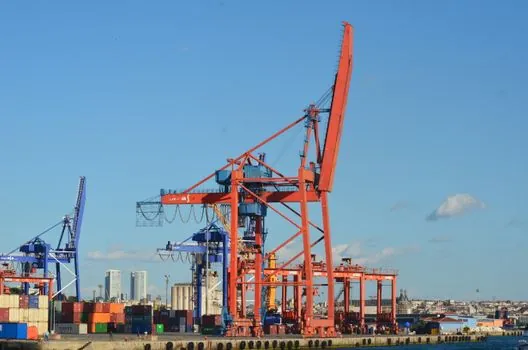
A useful transport record contains one line for every trailer load, including section identifiers, dimensions, weight, trailer type, route, permit status, escort requirement, loading time, delivery time, and unloading cost. It should also record assist-crane hours, fuel, standby time, and the number of crane shifts used for assembly. [S5]
Compare each shipment with the approved logistics baseline rather than with a generic per-kilometre rate. The baseline must include the 2–4 week planning period, 1–3 days of disassembly, 1–3 days of reassembly, and every permit, escort, utility-line, and trailer cost recorded in the move [S5].
The next controllable checkpoint is the load-plan review before trailer procurement: confirm section combinations, route feasibility, self-assembly capability, destination foundations, and site sequence. Any change after permits and trailers are committed should be treated as a change order because it can add several trailer loads, special escorts, or an assist crane that the original transport budget did not contain [S1][S5].