
SAE J1363 (Jan 1985, reaffirmed Nov 1995) defines a dump-body's volumetric rating as the sum of a struck envelope plus a 2:1 angle-of-repose heap above the side rails, giving two numbers the spec sheet must publish side by side [S1].
Heaped capacity is universally described as roughly one-third larger than struck: a non-ejector CAT 740 body rates 18 m³ struck and 24 m³ heaped, a 33% delta that lines up with the 2:1 surcharge arithmetic [S2]. Engineers comparing dump truck data sheets need to track both figures because payload weight, not volume, is what trips the legal GVW on an off-highway hauler.
Struck Capacity: A Pure Geometric Envelope
Struck capacity is the volume contained inside the body when material is scraped perfectly level with the top rail cappings along the body length and tapered down at the tail end to the floor, an envelope that "only really exists in theory as a mathematical calculation" [S2]. It is the simpler of the two J1363 numbers and is read directly off the body CAD model, bounded by the strike plane and the inside contour of the side and floor plates.
For the CAT 740 standard rock body, that envelope is 18 m³; for an iron-ore body on the same chassis the struck figure drops because the side and floor are thickened with wear liner, shrinking the inside width before any payload is loaded [S2]. This is why the same truck model can publish different struck volumes for rock, coal, and iron-ore variants, and why specifiers must check the body variant, not just the chassis model code, when reading a mining dump truck data plate.
Heaped Capacity: Struck Plus a 2:1 Surcharge
J1363's heaped rating is the struck volume plus the volume of a triangular surcharge piled at a 2:1 angle of repose (horizontal:vertical), calculated to a single apex point at body centreline [S2][S3]. The same 2:1 surcharge concept appears in SAE J296 for mini-excavator and backhoe buckets, where the angle is instead 1:1, and in CECE's competing standard, which uses 1:2, so the J1363 2:1 figure is specific to off-highway truck bodies and should not be mixed with bucket ratings [S4][S5].
The 2:1 heap formula scales linearly with body plan area: doubling the struck floor area roughly doubles the surcharge volume on top, so the 33% heaped/struck ratio holds across body sizes from 18 m³ ejector-style rigid frames up to 190-400 ton mining classes flagged in the 2000 SAE paper 2000-01-2652 [S1]. For comparison, an SAE J-rated excavator bucket uses Vh = Vs + Ve at 1:1 repose, which yields a smaller surcharge fraction than J1363's 2:1 truck-body definition [S4].
Why the J1363 Heap Falls Short in the Real Mine
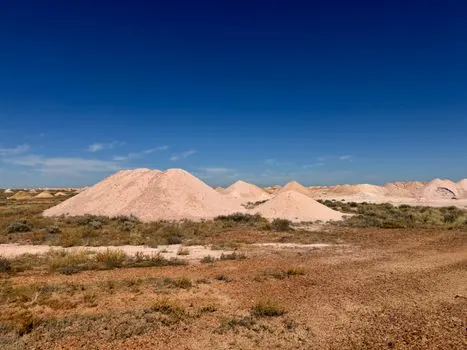
Field experience captured in SAE 2000-01-2652 (Hagenbuch, Philippi-Hagenbuch) is blunt: J1363's standardised 2:1 heap "really begins to self-destruct" as truck classes grew from 170-190 t in the mid-1980s to 400 t, because the fixed 2:1 angle ignores site-specific material repose, density, and load distribution fore-aft on the chassis [S1]. A 300+ t class off-highway truck runs a single tyre that costs $25,000-30,000, so mis-placed or over-rated heaps translate directly into tyre and chassis failures, the financial case the paper builds for site-specific "Load Profiled" bodies [S1].
Operating practice tracks this: typical shot-rock fill factors in a properly loaded body land at 85-90% of the SAE 2:1 heaped rating, so a 24 m³ heaped CAT 740 actually carries 20.4-21.6 m³ of broken rock in production, well short of the published J1363 envelope [S2]. A purpose-built iron-ore body is typically about two-thirds the cubic volume of the equivalent rock body, because iron-ore density at 3.3 t/m³ loose (specific gravity 5.2 solid) hits chassis payload limits long before the J1363 heap is filled [S2].
Payload Weight, Not Heap Volume, Trips the Truck
J1363 is a volumetric rating, not a weight rating: legal payload is set by chassis GVW and tyre load limits, and the two numbers only line up when the material's loose density matches the OEM's design assumption [S1]. For overburden at 1.95 t/m³ on a 39.5 t CAT 740, the weight limit lands at 20.25 m³, which is below the 24 m³ heaped figure and close to the 20.4-21.6 m³ real-world fill range, confirming the chassis is payload-bound, not volume-bound, on that material [S2].
Density drift changes the math: crushed coal at roughly 0.8-0.9 t/m³ can be loaded to the full 2:1 heaped envelope without exceeding chassis ratings, which is why the CAT 740 photo in the J1363 reference thread shows a coal body that is genuinely "heaped" in the SAE sense [S2]. Iron-ore, by contrast, runs heavy enough that loading to the 2:1 heap would overload the chassis and "all bets are off" if the loading crew piles to the J1363 line on dense ore [S2].
Decision Matrix: Struck vs Heaped vs Payload-Limited
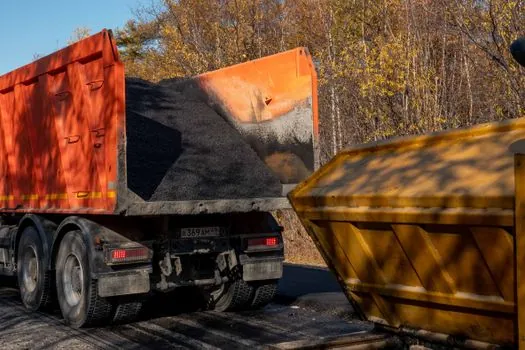
Three numbers govern every load: (a) J1363 struck, the pure geometric envelope; (b) J1363 2:1 heaped, typically 1.33× struck; (c) payload-limited, derived from chassis GVW divided by material loose density [S1][S2]. On dense ore the payload-limited figure is the smallest of the three and is the actual production constraint, while on light coal the J1363 heaped figure becomes reachable, and struck is only relevant for water-volume or struck-weight audits where surcharge must be excluded [S2].
For procurement, the practical comparison reads: J1363 struck is the right metric for body-liner wear volume and for matching to a shovel pass count; J1363 2:1 heaped is the right metric for fleet utilisation studies and cycle-time modelling; payload-limited is the right metric for tyre life, chassis life, and regulatory compliance [S1][S2]. The Hagenbuch patent US8280596B2 codifies this into a CAD method: build the load model at the actual material angle of repose, then iterate the body shape until the load's centre of gravity sits in the chassis sweet spot, which is essentially the J1363 process re-run with site-specific inputs [S3].
When to Override J1363, and What to Watch
Specifiers should override the J1363 2:1 heaped number whenever the site's material has an angle of repose materially different from 2:1, which is most wet clay, fine iron-ore, and run-of-mine coal with high fines content; in those cases the heap flattens and the actual carried volume can exceed the J1363 envelope before the chassis payload limit is reached, raising spillage and tyre-load asymmetry risk [S1]. The 2000-01-2652 paper recommends a site-surveyed angle of repose and density feeding the body CAD model, exactly the workflow the patent covers, and the same source notes that as truck classes passed 300 t the cost of getting the heap wrong escalated past $25,000 per failed tyre [S1][S3].
Two trackable signals: SAE J1363 reaffirmation date (last Nov 1995 per the 2000 paper, so any 2025-2026 reaffirmation cycle is the next reference point for spec compliance) [S1], and OEM body-variant data sheets, which now publish struck, 2:1 heaped, and a payload-limited figure separately for rock, coal, and iron-ore variants on the same chassis. Operators running mixed fleets should pin body selection to the densest regular material, then verify with on-site weighbridge data, since the J1363 heap only matches reality when the material actually piles at 2:1.
Spec-level background on the components involved: pressure transmitter.
Related analysis: Split Taper Bush vs Taper-Lock Bushing: Removal Method Compared.