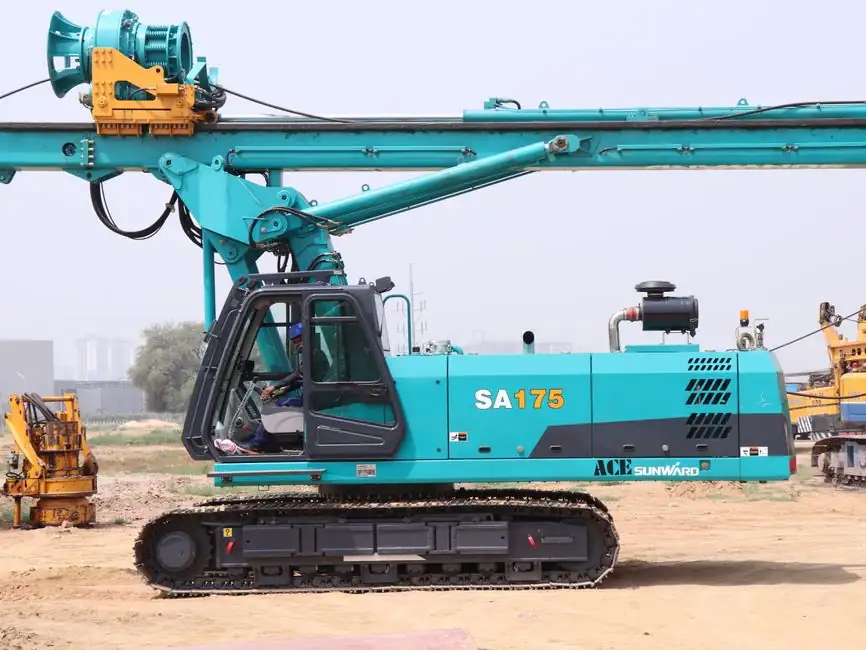
Rotary drilling rig maximum torque scales with bored pile diameter, with published data placing 6 kN·m units on 500 mm holes, 10 kN·m units on 800 mm holes, and 150 kN·m powerheads on 1,600 mm-diameter bored piles [S2][S8].
For large-diameter bored piles over 600 mm, Kelly drilling is the most common dry rotary method, using a telescopic Kelly bar to drill through most soil and rock profiles [S3]. The torque-to-diameter relationship is driven by cutting tool diameter, rotational speed, and ground resistance, not by pile length [S1].
Torque and Diameter Bands by Rig Class
Small/mini rotary rigs (FR6 to FR50A) span 6 kN·m at 500 mm diameter up to 50 kN·m at 1,000 mm diameter, with maximum drilling depths of 11–15 m [S2]. The FR35 at 35 kN·m pairs with 1,000 mm holes, the FR45 at 45 kN·m with 1,000 mm holes, and the FR50A at 50 kN·m with 1,000 mm holes, illustrating that torque climbs within a fixed diameter class to handle harder ground rather than wider holes [S2].
Mid-range foundation rigs such as those cataloged in the 2026 Buyer's Guide list max rotary torque around 15,000 ft-lbs (≈203 kN·m) paired with 36 in (≈914 mm) hole diameter, Kelly winch first-layer line pull of 8,000 lbs, and a low-speed/high-speed drill range of 30/60/100 rpm [S1]. For working specs on these mid-class machines, the rotary drilling rig reference page consolidates powerhead, winch, and mast geometry.
Heavy large-diameter rigs reach 150 kN·m torque on 500–1,600 mm diameters with 5–30 rpm rotary speed, typically using a Cummins 170 kW diesel power pack for deep cement mixing and bored pile work [S8]. Chinese OEM Sany's SR360 (2008) and SR420 (2009) program pushed powerhead torque into the 360–420 kN·m class for 2–3 m diameter bored shafts, with SR460 (2011) and SR630 (2015) further extending the upper torque envelope [S5].
Selection Criteria: Torque per Meter of Diameter
Empirical torque demand per meter of hole diameter climbs non-linearly with ground resistance: soft-to-medium soil typically needs 10–30 kN·m per meter, dense gravel or weathered rock needs 30–80 kN·m per meter, and hard rock with boulders pushes demand above 100 kN·m per meter [S2][S8]. A 1,000 mm hole in dense gravel therefore requires roughly 30–80 kN·m, which is why the FR35 (35 kN·m) and FR50A (50 kN·m) both cap at 1,000 mm diameter and not larger [S2].
Rotary speed and torque are inversely coupled on most powerheads: high-speed/low-torque gears (60–100 rpm) suit small-diameter augering in soft soils, while low-speed/high-torque gears (5–30 rpm) suit large-diameter hard-ground cutting [S1][S8]. Operators typically shift down before torque demand peaks, since stalling a powerhead at high rpm risks Kelly bar twist-off in bored piles above 1,000 mm.
Method, Diameter, and Application Match-Up
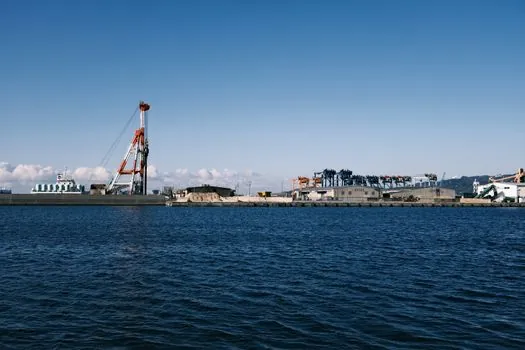
Reverse circulation drilling extends bored pile diameter up to approximately 3.2 m, used in karstic and challenging soil conditions where Kelly bars become uneconomical [S1]. Double rotary drilling with continuous casing handles unstable ground at 600–1,500 mm diameters, where a standard Kelly bar would lose hole stability [S1]. Continuous flight auger (CFA) suits predrilling and smaller-diameter dry piles below 600 mm, displacing rather than removing soil [S1].
Large-diameter bored piles are defined as foundation structures with cylindrical diameters larger than 600 mm, manufactured by rotary excavation and cast in place with concrete [S4]. With bentonite or polymer slurry support, modern equipment can construct foundation piles up to 4,000 mm diameter and over 100 m deep, with bentonite slurry mixed at 30–70 kg per 1,000 L of water and polymer at 0.5–3 kg per 1,000 L [S4].
Drilling Tools and Their Torque Demands
Tool selection inside the bored pile is governed by torque capacity, not by hole depth: rock augers, core barrels, and bucket augers each carry different torque coefficients that drive required powerhead output [S7]. A rotary hammer attachment is sometimes used for boulder breaking before the main auger passes, but it shares the Kelly bar's torque limit rather than extending it.
Down-the-hole (DTH) hammers are deployed for very hard rock or boulder zones, mounted directly behind the drill bit to add percussive energy on top of rotary cutting [S1]. For rigs sized to Kelly-bar bored piles over 1,500 mm, the rotary drive is typically configured to deliver full torque at the lowest gear, leaving DTH air capacity as a separate specification that does not subtract from cutting torque.
Limitations and Failure Modes
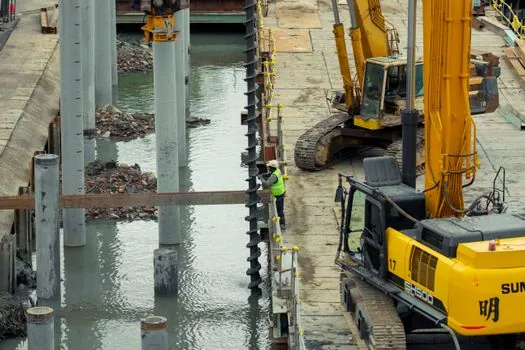
Kelly drilling's upper diameter limit on most mid-class rigs sits near 1,500–2,000 mm because Kelly bar torsional capacity, not powerhead torque, becomes the binding constraint above that range [S3]. Torque demand also spikes with soil stickiness, where clay adhesion to the auger flight effectively raises required breakout torque by 20–40% versus clean granular soil [S4].
Bored pile construction sequence (drilling, reinforcement cage insertion, concrete casting, curing) imposes a separate time-window constraint: if torque-limited drilling stalls, slurry walls can collapse before the cage is placed, especially in cohesionless soils below the water table [S4]. Dry pile construction is restricted to self-stable soils; wet pile construction with bentonite or polymer is mandatory below the water table, and cased pile construction is used where even slurry support is insufficient [S4].
Standards and Sourcing Notes
No single ISO or API standard governs the torque-to-diameter ratio for rotary drilling rigs, so OEMs publish their own powerhead curves tied to ground conditions and Kelly bar ratings [S3][S5]. The Liebherr LB series, CZM EK series, Bauer BG series, TEI TD series, and Tescar TT5 are all benchmarked in the 2026 Pile Buck Buyer's Guide on maximum rotary torque, hole diameter, and Kelly winch line pull as comparable metrics [S1]. Sany's history of SR360 (2008) to SR630 (2015) powerhead escalation tracks the same torque-diameter envelope, with the SR360 cited as the largest-torque rig in Asia at its launch [S5].
For the bored pile end product, foundation capacity depends on skin friction along the shaft and end-bearing at the base, both of which are diameter-dependent but are not driven by rig torque once the hole is drilled [S1]. Related pile driver specs cover the driven-pile alternative path where bored piles are not selected, and torque sensor calibration data ties rig powerhead output back to verifiable kN·m readings during acceptance testing.
Decision Matrix by Diameter and Ground
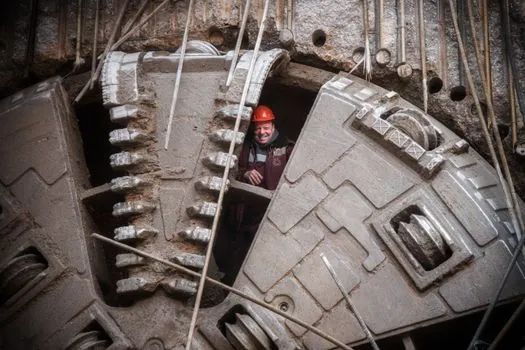
For 500–800 mm bored piles in soft-to-medium soil, a 6–10 kN·m mini rig (FR6/FR10 class) is the cost-effective match, with maximum drilling depth of 11–12 m [S2]. For 1,000 mm bored piles in dense soil or weathered rock, 35–50 kN·m units (FR35/FR45/FR50A) cover the common envelope, with 13–15 m depth ratings [S2]. For 1,200–1,600 mm bored piles in mixed ground, 150 kN·m-class heavy rigs with 5–30 rpm low-speed gearing are specified, typically on 30–60 m-depth projects [S8]. For 2,000–4,000 mm-diameter bored piles or depths over 60 m, reverse circulation or grab-drilling methods supersede Kelly-bar rotary, with separate slurry and casing tool trains [S1][S4].
Trackable next signals: OEM publication of updated powerhead torque curves for the 2027 model year, and field data on FR-series rigs operating above 1,000 mm diameter with the new high-torque gear sets [S2][S5]. Operators planning a 1,200 mm+ Kelly-bar bored pile in 2026 should request a powerhead torque curve at the operating rpm, plus Kelly bar torsional rating, before committing rig and method selection [S3].
See also our earlier report, Tempering Oven vs Heat Treatment Furnace: Temperature Range and Airflow Specs.