For phone, tablet, wearable and notebook housings in Al/Mg alloy, PC/ABS plastic, or stainless steel, the practical spec gate is low pressure (0.2–0.6 MPa), fine abrasive (120–240 mesh glass beads or ceramic), and an automatic closed-loop system with wet or HEPA-filtered dust control, per published 2026 selection guidance [S5][S3].
Electronics-housing surface treatment is split across three material families (light-alloy shells, engineering-plastic shells, stainless steel mid-frames) and three batch profiles (small-batch R&D, mass-production line, precision appearance parts), so the equipment, abrasive and dust-extraction choices diverge by roughly an order of magnitude in pressure and unit cost [S5].
Material-first machine type mapping
Aluminum and magnesium alloy shells, the most common phone and laptop chassis, require removal of CNC tool marks, an even matte finish, no sand streaks and no through-holes; the consistent recommendation is a rotary automatic or translational reciprocating automatic sandblasting machine using glass beads, ceramic sand or stainless steel balls [S5]. Plastic shells (PC/ABS) are more sensitive: the goal is a matte effect without substrate damage, indentation, or stress whitening, so a low-pressure automatic machine (0.2–0.4 MPa) or a wet sandblasting machine with resin sand or fine glass beads is specified [S5]. Stainless steel mid-frames and small structural parts use crawler-type or translational automatic machines for pre-treatment, derusting and uniform matte finishing prior to drawing [S5].
Suction-type machines remain the generalist choice for small-batch and proofing work, while pressure machines are reserved for heavy substrate work; wet units slot in where dust containment is the binding constraint [S1][S3]. A typical large-format automatic cell measures roughly 4000 mm × 1500 mm × 2800 mm overall with a 1200 mm × 1200 mm × 1200 mm working cabin, a 1000 mm × 1000 mm × 2300 mm independent pulse-jet dust box, and 4–24 blast guns on a PLC/touch-screen platform, configurable to 4, 6, 8, 12 or 16 guns [S2][S4].
Pressure, abrasive and surface-finish targets
For soft Al/Mg alloy shells, the operating window is 0.3–0.6 MPa, with fine glass beads or 120–240 mesh ceramic sand delivering a surface roughness of Ra 0.8–3.2 μm, scratch-free [S3][S5]. For PC/ABS and similar engineering plastics, the window drops to 0.2–0.4 MPa, typically with resin sand or very fine glass beads, to suppress whitening and micro-cracking [S5]. For stainless steel components (cabinets, switch panels, distribution boxes), the same double-side automatic platform runs 0.4–0.8 MPa with 6/8/10 mm nozzles and 12–24 blast guns using sand, glass beads or aluminum oxide for combined insulation, anti-corrosion and anti-fingerprint surface [S4]. Coating-prep surfaces target Sa2.5 cleanliness with ≤5 particles/cm² residual, while pre-electroplating surfaces target Ra 0.8–1.6 μm [S3].
Pressure stability is non-negotiable on electronics shells: variable-frequency pressure regulation is the standard requirement, because fluctuation shows up immediately as visible sand marks or bright spots on a Class-A cosmetic surface [S5]. Nozzle wear is a parallel failure mode: nozzles must be replaced once the bore enlarges by +25% over original diameter, otherwise blast uniformity drifts and rework rates climb [S3].
Dust control, wet vs dry, and cleanroom fit
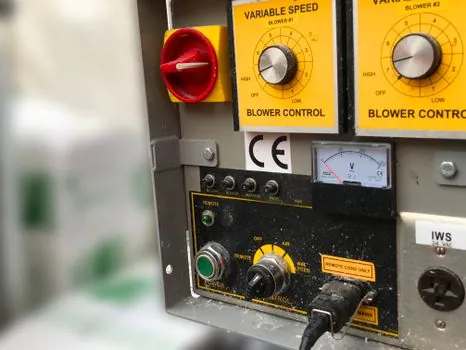
Electronics factories typically run pulse-bag dust collection plus a secondary filter-element stage; where the surrounding workshop is dust-sensitive, closed-cabinet negative-pressure dust extraction is specified to prevent migration onto adjacent SMT or coating lines [S5]. Indoor dust-emission ceilings in selection literature are commonly set at ≤10 mg/m³, which is what pushes buyers toward wet sandblasting machines (water-abrasive mixing) for high-end phone and wearable shells [S3][S5]. Wet cabinets also damp the abrasive stream, which lowers the risk of micro-pitting on glossy plastic surfaces and eliminates the secondary-pollution problem of dry cabinets [S1][S3].
For plants without compressed-air infrastructure sized for blasting, the air-compressor matching rule is concrete: suction-type machines need 7.5–11 kW at ≥0.6 MPa, while pressure-type machines need 15–37 kW at ≥0.8 MPa [S3]. A practical electronics-housing cell with 8–16 guns and 0.4–0.6 MPa typically sits at the low end of that envelope, around 11–15 kW, which keeps the upstream compressor cost and noise footprint manageable inside an assembly hall.
Batch-size and layout decision
Small-batch, multi-SKU electronics work (mold tryout, NPI samples, sub-10k pieces per month) maps to a multi-station rotary automatic machine in 8/12/16-station configurations: small floor area, uniform blast coverage, and fast changeover for odd-shaped shells [S5]. Mass production in the hundreds of thousands per month (phone mid-frames, tablet back covers) maps to pass-through or translational-reciprocating automatic machines on an assembly-line layout, with continuous flow and minimal manual handling [S5]. For precision cosmetic parts with strict dust-free requirements (premium phone shells, smartwatch cases, hearable charging cases), wet automatic sandblasting with water-abrasive mixing is the consistent pick because dust emission collapses to near-zero and the surface is finer than equivalent dry blasting [S5].
Fixtures are not an accessory on this kind of work. Servo-driven gun traverse and fixture positioning accuracy of 0.1 mm is the published baseline for repeatable appearance; manual gun adjustment on cosmetic shells is a known defect source (sand marks, pits, light/dark zones) [S5]. A cyclone separator, dust box and screening machine, in that order, form the standard abrasive-recovery loop so that broken media and fines are removed before they re-enter the blast stream and scratch the next part [S5].
Budget bands and total-cost view
Published 2026 budget bands for a hardware/electronics plant, in CNY, run roughly 10,000–30,000 for a manual suction cell, 50,000–150,000 for an automatic conveyor or rotary machine, and 200,000–1,000,000 for a full sandblasting room [S3]. Stainless-steel double-side automatic cells in OEM listings sit at 10,000–50,000 USD/set, MOQ 1, with 45–60 day delivery and a 36 sets/year supply rate [S4]. A dust-free industrial cabinet series, marketed for electrical and stainless-steel work, is built around an integrated environmentally-rated dust-removal system rather than a separate extraction unit, which simplifies site installation for smaller electronics plants [S6].
For electronics housings specifically, the cost-driving variables are gun count (12–24 on a double-side line), wet-vs-dry configuration, abrasive-recovery loop, and dust-emission class. Choosing pressure over suction roughly doubles compressor cost; choosing wet over dry adds a dryer, water-recycling tank and a small pump, but saves on dust-extraction ductwork and floor space [S3][S5]. Across all three material families, published guidance converges on the same three controls: a variable-frequency pressure regulator, a +25% nozzle-replacement rule, and a closed abrasive-recovery loop with cyclone plus screening [S3][S5].
Common defect modes and the rejection gates
The recurring failure modes on electronics shells are: sand marks and pits from coarse media, high pressure or gun vibration; substrate whitening on PC/ABS from over-aggressive dry blasting; dimensional drift on thin Al housings from pressure spikes; and dust contamination of downstream coating or anodizing lines from an under-sized collector [S3][S5][S10]. The published deburring-machine variant for electronic parts explicitly targets low-pressure precision, dust-free clean operation, full closed-loop automation, and substrate-safe flexibility, with a special burr-removal pass that does not damage the underlying material [S10].
For a related batch-coating plant, lighting-fixture surface prep follows a similar Al-alloy, low-pressure logic but with higher cosmetic Ra targets; for a higher-impact substrate family, farm-machinery surface prep shifts toward 0.6–1.0 MPa pressure machines and 20–80 mesh steel grit. Aerospace and electronics shells diverge on dust-emission class but converge on closed-cabinet negative-pressure extraction, a pattern documented in aerospace shell sandblasting specs. Trackable signals over the next procurement cycle: published 2026 pressure-window narrowing below 0.2 MPa for next-gen glass-backed phone shells, and wet/dry hybrid cabinets that switch modes for mixed PC/ABS and Al-alloy batches in the same shift [S5][S10].
The underlying component specifications are covered under sand blasting machine, shot blasting machine, and sand cooler.