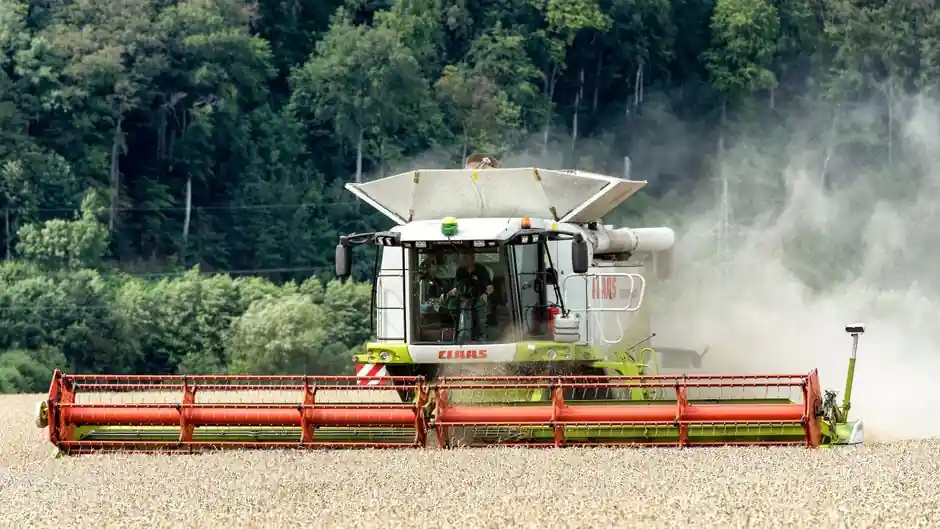
Agricultural equipment, including tractors, harvesters, plows, and combines, sheds rust, paint, and chemical residue fastest with media selection tied to part geometry, not a generic abrasive choice [S4].
Specifiers should treat the sandblasting machine, air supply, and media recovery as one system: professional work draws 25 to 50 CFM at the nozzle, while hobbyist spot-blasting only needs 10 to 20 CFM [S5]. For shop owners weighing manual cabinet vs open-air pressure pot, the deciding factor is part size and production mix, not brand [S2].
Equipment classes that actually fit farm machinery
Three configurations dominate agricultural work: pressure blasters, where the abrasive sits in a pressurized canister for high, continuous airflow; siphon blasters, where suction pulls media up from a non-pressurized tank; and gravity-fed hoppers, which sit above the gun for small controlled jobs [S5]. Pressure pots are the workhorse on farm equipment because frames, wheel hubs, and combine housings are large, awkward parts where flow consistency matters more than portability [S5]. Cabinet-type sand blasters, with a sealed work chamber, suit small brackets and hydraulic fittings, while a tumble or rotary table unit handles batch throughput for small to medium parts [S2]. For the largest machines like tractor chassis, a blast room beats any portable rig because the part stays put and the operator controls the nozzle from inside [S1].
For broader context on how this equipment class is categorized, see the sand blasting machine reference page and the shot blasting machine reference page for the wheel-blast cousin, which uses steel shot or grit thrown by an impeller rather than compressed air [S1][S6].
Tank size, nozzle bore, and air demand math
Tank capacity scales with autonomy: ACF offers pot volumes of 8, 18, 24, 50, 90, 130, 170, and 200 L, where a larger tank extends the operator's run time between refills [S3]. Pairing a 200 L pot to a small hobbyist compressor is wasted capital; a 50 L tank paired to a 25-50 CFM compressor is the realistic farm-shop baseline [S3][S5]. The relationship between nozzle bore and air consumption is fixed: a larger bore drops blast pressure unless CFM rises in proportion, so nozzle selection is a compressor decision as much as a finish decision [S5].
Two practical thresholds guide farm-shop buyers. First, dustless wet blasting, which mixes water with abrasive, cuts airborne dust and is widely specified for in-shop tractor restoration where operator exposure and surrounding crop-dust contamination are concerns [S4]. Second, suction (siphon) cabinets stay economical for small-batch changeovers, but they cannot match a pressure pot's productivity on combine panels or plow frames [S2][S5].
Manual cabinet vs pressure pot vs blast room: a decision matrix
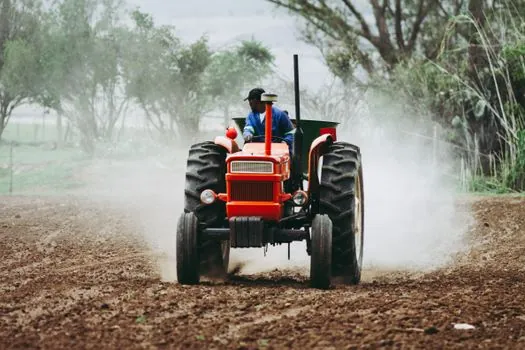
Manual cabinet sand blasters win on flexibility for small batches, varied shapes, and frequent changeovers, and they keep cost per part low when volumes are modest [S2]. Pressure pot systems (portable or skid-mounted) win on throughput for mid-size parts like wheel rims, axle housings, and drawbar assemblies, where the operator needs mobility around the part rather than the part going into a cabinet [S2][S5]. Blast rooms win on the largest ag equipment, including combine headers and tractor chassis over roughly 3 m, where crane access and full-coverage blasting outweigh the floor-space cost [S1].
A side-by-side read for farm-machinery specifiers looks like this. Manual cabinet: low capital, small footprint, suited to brackets and hydraulic parts, 10-20 CFM range [S2][S5]. Pressure pot (portable): medium capital, high mobility, 25-50 CFM required, suited to frames and panels in the field or shop [S5]. Blast room: high capital, large footprint, suited to combine and tractor chassis restoration, supports multiple operators and dustless wet media [S1][S4]. Wheel-blast (shot blasting) machines add a fourth lane for high-volume batch work where steel shot or grit is recycled internally; see the shot blasting machine reference and the construction machinery equipment category for adjacent applications [S1][S6].
Media selection for rust, paint, and chemical residue on ag steel
Farm machinery accumulates three distinct contaminant layers: Fe-oxide rust from moisture and fertilizer exposure, multi-layer alkyd or epoxy paint from prior repaints, and chemical residue from pesticides or fuel [S4]. Fine glass bead or soda media suits paint stripping on thin-gauge panels where warping is a risk, while aluminum oxide or fine steel grit handles heavy rust on cast-iron housings [S1]. Garnet and crushed glass are the workhorse mid-cost media for general-purpose farm work, balancing cut rate and recyclability [S1][S3].
Dustless wet blasting, where water is injected at the nozzle, suppresses airborne dust and is the practical choice for indoor restoration of tractor cabs and combine operator stations, where OSHA-grade respiratory protection would otherwise dominate job cost [S4]. For batch production of small brackets, a tumble or rotary table unit keeps media recycling closed-loop, dropping long-term media cost per part [S2].
Compressor sizing, dust collection, and OSHA containment
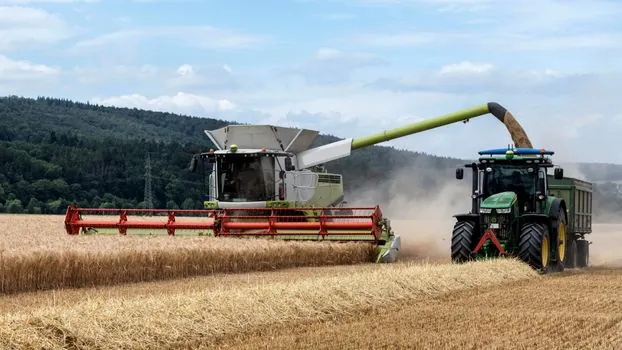
Sandblasting is a CFM-driven application, not a PSI-driven one, which is the most common buyer error when matching a compressor to a sandblasting machine [S5]. Hobbyist work below 20 CFM is unsuitable for sustained farm-machinery restoration, where 25-50 CFM at the working pressure is the realistic professional range [S5]. Reciprocating compressors are common in farm shops because of lower upfront cost, while rotary screw compressors deliver the steady airflow that pressure pots need for continuous duty [S5].
Dust collection and containment are not optional. Abrasive blasting generates respirable crystalline silica dust, and farm shops restoring multiple tractors per month need a negative-pressure enclosure or a wet/dustless system, plus a media-recovery separator, to keep media cost and exposure both under control [S1][S4]. See the sand mixer reference page and the resin sand line reference page for adjacent foundry equipment that shares the same media-handling and dust-control design logic [S1].
Field service, portable rigs, and on-farm blasting
Portable dustless blasting rigs now handle in-field tractor and harvester work, bringing 25-50 CFM of compressed air, a water-injected blast stream, and a recovery skirt to the machine's footprint [S4]. This avoids disassembling combines and large implements for transport, which is often impractical during the seasonal working window [S4]. For maintenance teams operating across multiple sites, a 108P-class portable pressure blaster paired to a tow-behind compressor is a common package for spot repair between full restorations [S2].
Two signals to watch in 2026: portable dustless rigs are displacing open-air dry blasting for in-field ag work, and suppliers are increasingly offering closed-loop media recovery as an option rather than an upgrade, which compresses per-part media cost for high-volume farm operations [S2][S4]. For related foundry-side media handling that influences abrasive selection upstream, see the sand cooler selection map for electronics housing foundries and the vacuum pump type spec map.