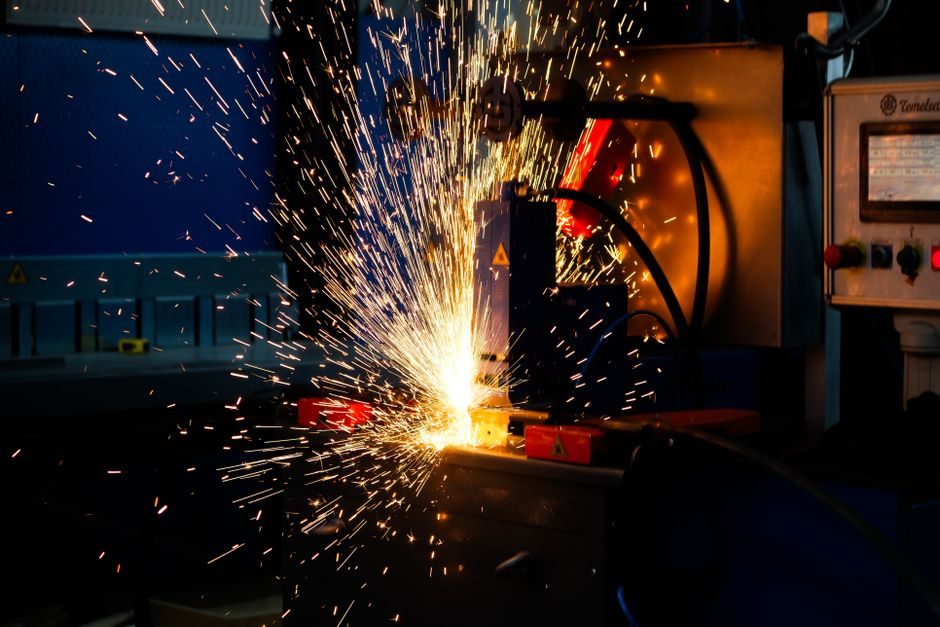
Sand blasting machines propel fine abrasive (garnet, glass bead, aluminium oxide, silica) through a compressed-air nozzle; shot blasting machines throw steel shot or cut wire via a high-speed rotating impeller wheel — no compressed air consumed for media acceleration. The two technologies address different surface-prep windows: sand blasting targets fine cleaning, deburring, paint-stripping and architectural matte finishes; shot blasting targets heavy descaling, rust and mill-scale removal, peening, and high-throughput structural steel preparation to SA 2.5 / SA 3 white-metal grades [S1][S2].
Selection hinges on three measurable gates — substrate hardness, hourly throughput, and post-blast cleanliness grade. DirectIndustry lists 73 suction/injector sandblasting SKUs across 18 manufacturers (June 2026 snapshot), and the China export catalogue alone shows wheel-conveyor, hook-type, wire-mesh-belt and roller-conveyor shot-blast configurations as separate machine families [S1][S3]. This means one generic "blaster" RFQ will return wildly mismatched bids; the specifier has to lock the driving media and the workpiece geometry first.
Driving Media: Compressed Air vs Mechanical Impeller
Sand blasting relies on a venturi effect: compressed air at typically 0.5–0.8 MPa draws abrasive through a handheld nozzle, an injector gun, or a suction cabinet. DirectIndustry's suction-sandblasting-machine category (18 manufacturers, 73 SKUs, June 2026) is dominated by cabinet-style and portable open-nozzle units sized for 50–500 kg/h abrasive flow at 7–10 bar shop-air supply [S1]. Injector (induction) guns use lower air volumes (≈0.3 MPa) and suit light duty, in-line touch-up; pressure-blast pots deliver 2–4× the impact energy per particle and are the workhorse for paint-stripping and rust removal on structural steel [S1][S2].
Shot blasting eliminates compressed air for media propulsion. A high-speed impeller (typically 2,500–3,600 rpm, blade tip speed 60–100 m/s) centrifugally throws steel shot, cut wire, or steel grit onto the workpiece. China-listing manufacturers Knnjoo and Keejoo categorise their catalogues by conveyor type — hook (H-beam, small-batch), roller conveyor (plate, profile), wire-mesh belt (thin sheet, stampings) and steel-plate pre-shot lines — which is the industry shorthand for the workpiece geometry each machine family is built around [S3][S6].
Surface Finish, Cleanliness Grade and Dust Load
Wet/vaporous (vapour-blast) variants suppress dust and are the standard pick for in-shop paint-prep cells and stainless work where ferrous contamination must be controlled; Chinese export listings (made-in-china, June 2026) show wet sand-blasting cabinets at US$3,000–10,000 per unit in the small-format class [S4].
Shot blasting with cut wire or SAE S230/S330 steel shot reaches SA 2.5–SA 3 at 3–6× the linear throughput of a 2-man sandblast crew on plate and section, with profiles 80–200 µm depending on shot size and impact angle. The trade-off is abrasive containment: shot-blast rooms and tumble-blast barrels are sealed, with elevator-and-separator回收回路 reclaiming shot; the abrasive consumption reference for steel shot on structural steelwork at Sa 2.5 sits around 100–250 g per m² of blasted surface, versus 1–3 kg/m² for mineral abrasive in suction-blast cleaning [S8]. Dust load is intrinsically lower per square metre in shot blasting because the media does not shatter on impact the way silica or garnet does; the dust collector on a wheel-blast room is sized to fine particulate and fines only, not the bulk abrasive stream.
Substrate, Geometry and Job-Mix Fit
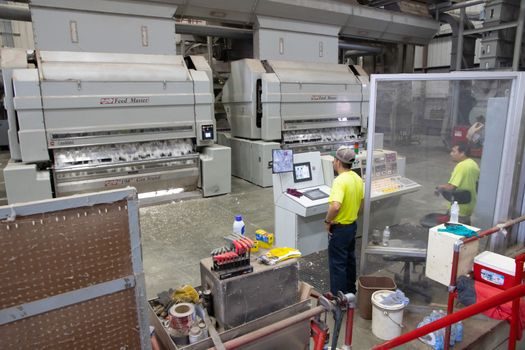
Sand blasting is geometry-agnostic — the operator points the nozzle, so curved tanks, weld seams, inside corners and irregular castings are reachable. This is why Adarsh Fabricators, an Indian foundry-equipment builder, lists sand blasting alongside sand mixers, core sand mixers and knockout machines in the same foundry toolchain: the sandblast cabinet is the secondary cleaning step after the shakeout, not the primary descaling cell [S9]. For architectural, monument and stainless work, glass-bead and fine-alumina suction-blast cabinets deliver the controlled matte finish that the wheel-blast pattern of a shot-blast room cannot match [S1][S5].
Shot blasting is geometry-restricted but throughput-massive. Hook-type machines cycle H-beams and fabrications on overhead conveyors through a blast chamber; roller-conveyor machines feed plate and sheet at 1–6 m/min continuous; tumble-blast barrels handle small castings and stampings in batch. TS Blasting and Keejoo both market these families as a "complete surface-finishing solution" because the conveyor, dust collector and shot-recovery elevator are engineered as one line [S6][S7]. A sandblasting operation cannot match that throughput on a plate-prep cell, and a shot-blast room cannot reach into a fabricated tank shell the way a nozzle can. The two technologies are not substitutes — they are adjacent stations in a paint-shop or foundry flow.
Cost, Maintenance and Media Economics
Entry capital for a sandblasting setup is sharply lower: a suction-blast cabinet is 1/5 to 1/10 the price of a small hook-type shot-blast machine in the same shipping region. June 2026 export catalogues (made-in-china) show wet-blast cabinets at US$3,000–10,000 and mid-size suction pots at US$1,500–6,000, while Keejoo's Chinese-domestic hook and roller-conveyor shot-blast lines sit in the US$25,000–120,000 band depending on chamber width and conveyor length [S3][S4][S6]. The Indian manufacturer TS Blasting quotes comparable parity on small portable suction units and a 3–5× premium for enclosed shot-blast rooms with elevators [S5][S7].
Operating-cost reversal is where the math flips on heavy work. Compressed air is the dominant cost line for sandblasting — a 75 kW compressor running a 2-nozzle crew on structural steel burns roughly 7–12 kWh per m² cleaned, which at 2026 industrial tariffs in most regions puts the air-blast energy line alone at US$0.50–1.20/m². A wheel-blast impeller on the same job draws 0.5–1.5 kWh per m² on the blast drive, with shot consumption 100–250 g/m² (steel shot at ≈US$1.0–1.4/kg). Steel shot also has a 1,500–3,000-cycle reuse life in a well-tuned separator-elevator loop; mineral abrasive is single-pass and becomes dust [S8]. The crossover where shot blasting becomes the cheaper cleaning path typically falls around 1–2 t/h of cleaned steel — below that, the sandblasting crew is the more flexible tool. For foundry sand-handling energy and throughput on the upstream side, see the spec cut on sand coolers in the same plant.
Side-by-Side Comparison: 4 Decision Criteria
Against the four gates that actually drive a buy decision — media system, cleanliness reach, throughput per shift, and unit cost to install — the two technologies split cleanly. Sand blasting wins on geometric reach, low entry price, fine profile control, and the ability to handle small batch / mixed-substrate work. Shot blasting wins on heavy-plate throughput, SA 2.5/SA 3 cleanliness at scale, energy per square metre on steel, and dust load in the working environment. Buyers specifying new lines in 2026 should classify every work-piece by substrate thickness and contour complexity first, then route thin/complex parts to suction or pressure blast, and route heavy plate / section to wheel-blast — running both in parallel where the job mix justifies the floor space [S1][S3][S6].
For 1-man job shops and field paint-prep contractors, the pressure-blast pot with a 2 m³/min compressor is the standard answer. For shipyards, structural-steel fabricators, foundry cleaning cells and plate service centres, a hook or roller-conveyor shot-blast room sized to the daily tonnage is the only path to margin. The earlier sand blasting machine selection: 4 spec levers for 2026 buyers guide breaks down the cabinet-and-pot sizing in more depth; the broader resin sand line reference covers the upstream moulding side that a foundry cleaning station plugs into.
Limitations, Failure Modes and Sourcing Checks
Sand blasting with silica-bearing media is regulated in most jurisdictions because respirable crystalline silica dust is a recognised health hazard; the practical answer in 2026 is non-silica abrasive (garnet, aluminium oxide, glass bead, slag) plus a sealed cabinet or vacuum-recovery hood, not open-air blasting on construction sites without enclosure. Compressor-air quality matters — moisture in the line drops abrasive velocity and packs the nozzle; a refrigerated dryer and 0.5–5 µm particulate filter upstream of the pot is a routine ask on the 2026 export listings [S2][S5].
Shot blasting failure modes sit on the impeller and the separator: worn blades cut velocity and roughness stability (Knnjoo's 2026 technical note flags impeller-blade condition as the dominant variable in roughness repeatability), and a mis-tuned elevator lets unbroken shot into the dust collector, which destroys filter life [S3][S6]. Sourcing-side checks for the 2026 procurement cycle: confirm the wheel diameter and blade-count for the target profile, confirm shot-recovery capacity in kg per pass, and ask for the wear-package price on blades, control cage and side liners — those three items are the operating-cost story. Buyers comparing the wider fleet of pre-blast handling equipment can cross-reference the shot sleeve and shot blasting machine entries for chamber and wear-parts geometry.
The defensible 2026 split is unchanged from prior years: route the decision by substrate, geometry and daily tonnage, not by marketing copy. Signal to watch into H2 2026 — Keejoo and Knnjoo domestic-catalog updates will likely show higher impeller kW on the new 2.5–4 t/h hook lines, and Indian export catalogues (TS Blasting, sandblastingmachine.in) are likely to push wet/vapour-blast cabinet SKUs as the silica-substitution play hardens into spec [S5][S6][S7].