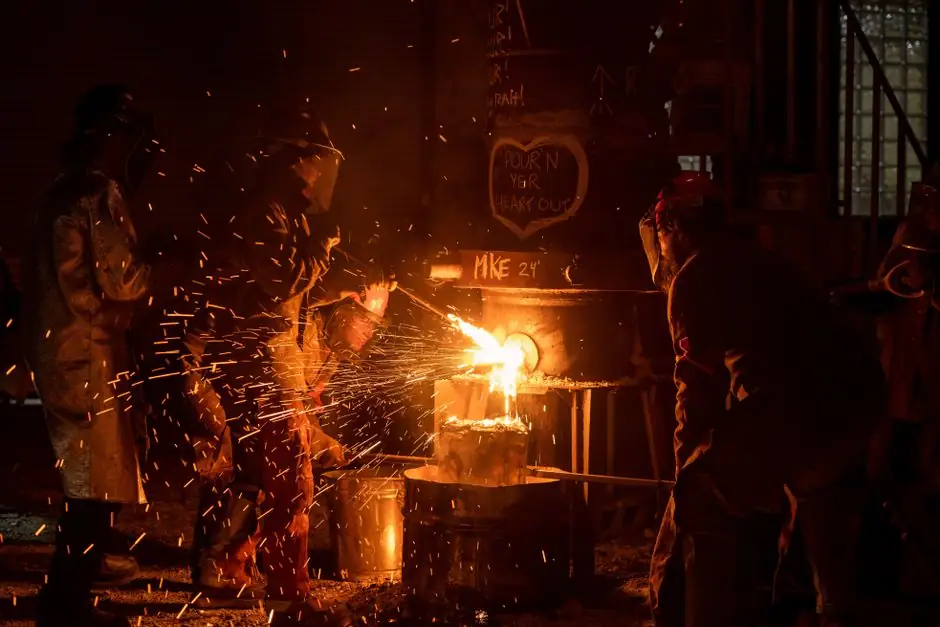
Sand casting still accounts for over 60% of all metal castings globally as of the most recent industry survey, and that share is even higher in the energy-equipment segment where large housings, valve bodies, and turbine stators dominate the order book [S5].
Specifying a sand casting mold for an energy product is not a one-line decision: it sits on three axes (alloy family, geometric complexity, dimensional tolerance), and the wrong choice on any one of them shows up later as porosity, hot tears, or excessive post-machining stock [S1][S4].
Green sand vs resin sand vs shell: criteria-based comparison
Green sand, an aggregate of silica sand, water, bentonite clay, and combustible additives, is the default route for energy-grade iron and steel castings up to roughly 5,000 kg because the clay-bonded system can be reconditioned and reused cycle after cycle, which keeps tooling cost per part low [S1].
Resin-bonded (no-bake or furan) sand is the right pick when the part carries undercuts, thin walls, or internal passages that demand a strong, non-collapsing core, but it carries a sand-prep premium and longer bench life, so it is usually reserved for medium-volume runs or for parts where green sand cores would erode during pour [S3].
Sand molds remain preferred for gravity-fed pours where molten metal flows into the cavity without external pressure, which matches most energy-stationary castings (pump casings, gearbox housings, valve bodies) where controlled fill rate matters more than high-pressure die-casting cycle time [S6]. The comparison below maps the three families against the four decision criteria an energy buyer actually scores on:
Selection matrix: green sand scores well on cost, throughput, and recyclability but only fair on surface finish and minimum core complexity; resin-bonded sand flips that profile (best on detail and finish, higher on cost and lead time); shell sand (croning) sits between the two on cost and is typically chosen for thin-wall steel parts below roughly 200 kg where tight tolerance matters [S3][S6].
Alloy-driven material choices for energy castings
Common sand-cast alloys for energy service include aluminium (ADC12, A356, AL6061), bronze family alloys (aluminium, manganese, silicon bronze), brass, ductile and grey iron, mild steel at 0.15% to 0.30% carbon, and stainless steel, each picked for a different operating duty [S4].
Grey iron is the default for pump casings and valve bodies where machinability and vibration damping matter more than tensile strength, while ductile iron is specified when the same geometry needs higher elongation and impact resistance; both rely on green-sand molding with chromite or silicochromite base sand when aluminium contamination must be avoided [S4].
Aluminium alloys are used where mass matters (turbine housings, generator end-caps) and require base sands such as silicochromite and chromite to control metal-mold reaction, while stainless steel sand castings are the workhorse for hydro-turbine runners and high-temperature valve trim because the alloy tolerates the slower fill rates of sand molding without the cracking seen in thin-section die casting [S4][S5].
Process control points that decide whether the casting passes
Pattern shrinkage allowance must be set per alloy (different contraction rules for iron vs aluminium vs bronze), and core prints must be registered correctly or the sand casting mold halves will shift, producing mismatched dimensions on bores that later fail pressure-test acceptance [S1][S5].
Gating and riser design is the single biggest process variable: the runner, sprue, and in-gate system must feed molten metal uniformly and allow gas and steam to escape through permeable sand or risers, otherwise the casting freezes short or contains gas porosity that shows up only after hydrotest [S5].
Foundries running ISO 9001:2015-certified systems report that automated green-sand molding and pouring (used in volume brass/bronze shops) tightens lead time and consistency, while manual molding is reserved for short runs or prototype castings where pattern changes happen weekly [S1].
When sand casting is the wrong choice
Sand casting is not the right answer for very high-volume, thin-wall, tight-tolerance parts under roughly 1 mm wall thickness, where investment casting or die casting becomes more economical per piece once tooling is amortized [S2].
Lead was once a common sand-casting material, but modern health-and-safety rules restrict it to controlled environments, so specifying lead-bearing alloys for new energy equipment is generally a non-starter even though the alloy is technically sand-castable [S4].
For large hydraulic valve bodies and pump casings in the 200 to 5,000 kg range, sand casting remains the only cost-effective process; designers picking a process in that weight band should default to a green-sand or resin-sand mold base layout and only move to investment casting if the geometry includes features that sand cannot release [S4][S6].
Standards, sourcing, and supplier qualification
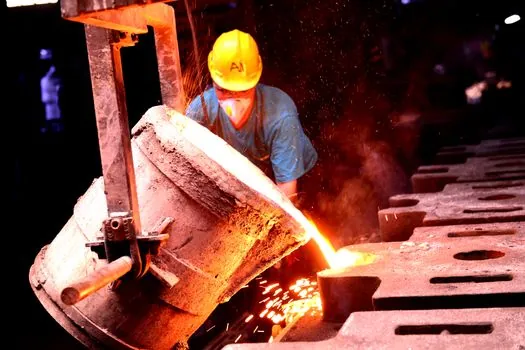
Energy-equipment buyers typically reference ISO 9001:2015 for general foundry quality systems and add material-specific standards (ASTM A536 for ductile iron, ASTM A48 for grey iron, ASTM B26/B26M for aluminium) on the casting print; dimensional acceptance is then gated by the buyer's own drawing tolerances plus any customer-spec pressure-test or NDT requirement [S1].
Foundry short-listing for energy work should look at pattern-making capability in-house (wood, metal, or EPS foam patterns), core-making capacity for resin-sand cores, evidence of automated green-sand molding for volume runs, and prior energy-sector references in pump, valve, or turbine casings [S1][S5].
Trackable next signals: watch for revision of ASTM A536 and ASTM B26M in the 2026 to 2027 window as additive patterns and 3D-printed sand molds become more common in iron and aluminium foundries, and watch resin-sand lead times at energy-focused foundries as utility capex picks up through 2026 [S1][S3]. For related reading on a sister topic, see Sand casting mold selection for pump and valve production and Sand casting mold selection for hardware: 2026 spec map.