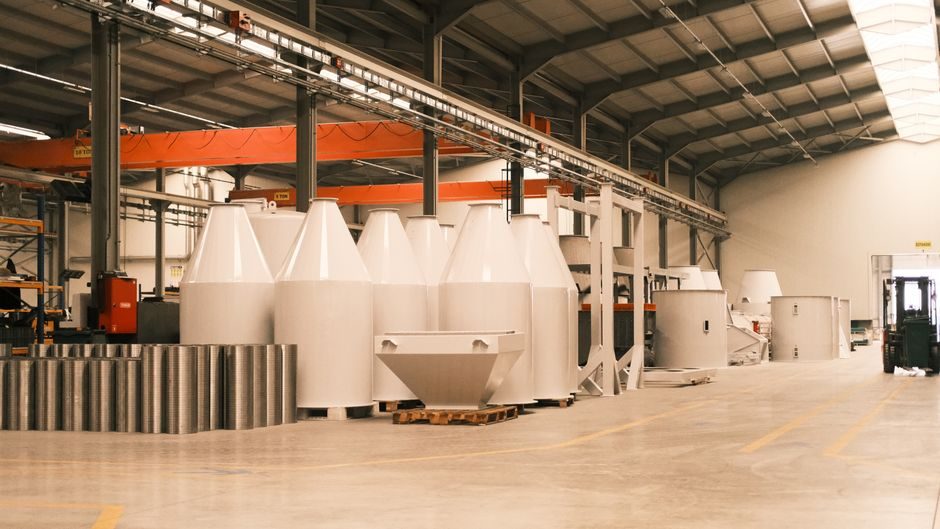
Foundry sand mixers in 2026 are classified by binder system rather than by brand: green (clay-bonded), resin-bonded (furan/phenolic/alkaline phenolic), coated (thermal/hot-process), and self-hardening (no-bake, including sodium silicate and pep-set) [S1][S2]. Each class drives a different rotor geometry, mixing cycle time, and liquid-binder dosing tolerance.
Two mechanical configurations dominate the 2026 OEM catalog from Chinese foundries such as Qingdao Dingli and Qingdao Xinyuanzhu (Sanzhuji): vertical rotor-wheel mixers for high-speed dispersion in the 5–60 t/h band, and horizontal twin-shaft paddle mixers for continuous high-throughput green-sand preparation above 40 t/h [S1][S2]. Both manufacturers group their sand mixers under broader lines that include sand regeneration, drying, and electronic dosing scales [S1].
Binder-Based Classification: Four Working Classes
Foundry buyers in 2026 select a sand mixer class by the binder system the line will run, because the chemistry dictates residence time, rotor tip speed, and liquid-addition accuracy. The four classes are green (clay + water + bentonite, moisture 3–5%), resin (furan/phenolic, acid- or amine-cured, resin dosage 0.8–2.0% of sand weight), coated (thermally pre-coated with phenolic resin, 2–5% resin, hot-process at 160–200 °C), and self-hardening / no-bake (sodium silicate-CO₂, alkaline phenolic, or pep-set ester-cured) [S1][S2].
Resin-sand lines are explicitly identified as a separate product family by both Dingli ("Resin Sand Treatment Equipment") and Xinyuanzhu (Sanzhuji) [S1][S2], confirming that a single power mixer platform is rarely specified across all four chemistries. Coated-sand preparation requires an upstream heating stage and is treated as its own line rather than a mixer variant [S1].
Mechanical Geometry: Vertical Rotor-Wheel vs Horizontal Twin-Shaft
Vertical rotor-wheel (disk) mixers place the agitating blades on a high-speed vertical shaft inside a stationary pan; tip speeds of 18–28 m/s are typical, which gives a 30–90 s mixing cycle and clean dispersion of liquid resin onto sand grains [S1]. Dingli's catalog lists dedicated resin-sand and coated-sand machines (e.g. the FS1612 coated-sand model) using this configuration [S1].
Horizontal twin-shaft paddle mixers carry two counter-rotating shafts with low-speed paddles (tip speed 3–6 m/s); they handle higher tonnage per unit (commonly 40–120 t/h on green-sand lines) but give a less uniform resin coating, so they appear more often in green-sand preparation and large sand regeneration circuits than in resin lines [S2]. The trade-off is mechanical: rotors see less wear in paddle machines, but binder distribution uniformity is harder to validate batch-to-batch [S2].
Throughput, Cycle Time, and Dosing Accuracy

Rated capacity bands in the 2026 Qingdao OEM catalogs sit in three ranges: small lab/bench mixers 0.1–2 t/h, mid-range vertical mixers 5–20 t/h for batch resin and coated-sand work, and large horizontal paddle mixers 40–120 t/h for green-sand preparation feeding automatic molding lines [S1][S2]. Dingli specifically lists "Dosing Water Dispenser" and "Sand Electronic Scale" as separate auxiliary products, reflecting the requirement that liquid binder be metered to within roughly ±1% of set-point on resin-sand batches [S1].
Cycle time matters more than nameplate tonnage for resin sand: a 5-t/h vertical mixer running 60-s cycles can match the per-hour output of a larger machine with longer residence, and it gives a tighter binder distribution. Buyers should compare rated tonnage AND cycle time, not tonnage alone [S1][S2].
Selection Criteria Compared: Four Mixer Classes
Use the four-row comparison below to shortlist. Cost column reflects typical Chinese-OEM 2026 turnkey pricing logic: green-sand is the lowest because clay is cheap, resin sits mid-range, coated is the most energy-intensive, and self-hardening varies sharply with binder choice. [S1]
• Green (clay) — low capex, high throughput (40–120 t/h paddle), tolerance for moisture variation, suits cast iron/steel jobbing foundries. Limitation: dust and bentonite recovery in the return-sand loop [S1][S2]. • Resin (furan/phenolic) — short cycle (30–90 s), tight binder dosing (±1%), best for medium-to-large steel castings. Limitation: gas evolution during pouring requires fume treatment [S1][S2]. • Coated (thermal) — pre-coated grains, low moisture in the mold, premium surface finish for shell cores. Limitation: heater energy at 160–200 °C, dedicated regeneration line [S1]. • Self-hardening (no-bake) — large one-off castings, low binder cost (sodium silicate path), but stripping time is hours, not minutes. Limitation: silicate-bonded sand is harder to reclaim than resin sand [S2].
Who Sand Mixers Are For — and Who They Are Not For
A foundry running more than roughly 5 000 t/yr of castings and needing consistent mold hardness across three shifts benefits from a 10–20 t/h vertical resin-sand mixer with electronic dosing — both Dingli and Sanzhuji publish this capacity range as their standard resin line [S1][S2]. A small job shop making under 500 t/yr on green sand can stay on a simple horizontal paddle without an electronic binder scale, because moisture variation dominates over resin dosing precision at that scale [S2].
They are NOT a fit for: high-mix low-volume prototyping (where hand-mulled bench mixers are faster to change over), non-ferrous die-casting or investment casting (no sand system at all), or any line where return-sand temperature exceeds roughly 80 °C without a downstream sand cooler, because resin binders scorch and bentonite loses swelling capacity above that point [S1].
Integration with the Surrounding Line
A sand mixer is the centre of a four-stage circuit: storage → mixing → distribution → return-sand regeneration. Both 2026 OEM catalogs group these as one turnkey line: "Green Sand Molding Line" and "Resin Sand Production Line" appear as integrated product families rather than as standalone mixers [S1][S2].
Dingli exposes the surrounding equipment explicitly — clay-sand, resin-sand, coated-sand, used-sand regeneration, and sand drying lines all share the same auxiliary set (electronic scale, water dispenser, magnetic separator) [S1]. Sanzhuji's published reference list of 1 700+ foundry customers and 13 years of export activity to Russia, Pakistan, Indonesia, Egypt, Ghana, Argentina, and Morocco indicates the same turnkey delivery model is the norm for 2026 Chinese-OEM export contracts [S2]. Their factory footprint of 8 000 m² workshop + 1 200 m² office + 5 500 m² open-air area (110 employees) underwrites the claim that mixers ship as part of a packaged line, not as a standalone [S2].
Standards, Sourcing, and Quality Verification
ISO 9001:2015 is the baseline quality standard explicitly claimed by Qingdao Xinyuanzhu/Sanzhuji across the full product range, and CE marking is listed alongside for export-bound sand mixers, resin-sand mixers, jolt-squeeze moulding machines, and hydraulic multi-piston moulding machines [S2]. Buyers should verify the certificate scope covers the specific mixer model, not just the company registration.
For emissions on resin lines, EU-bound foundries in 2026 still reference the IED (Industrial Emissions Directive) for organic-carcinogen-bearing waste gas during pour and shake-out; Chinese-domestic deliveries follow GB 39728-2020 "Emission standard of air pollutants for foundry industry" plus local ultra-low-emission upgrade rules [S2]. BV (Bureau Veritas) pre-shipment inspection is offered as a paid option by Sanzhuji, which is one practical way to lock nameplate tonnage and cycle time before the mixers leave the workshop [S2].
Common Failure Modes and Sourcing Risk
Three failure modes drive most warranty calls in 2026: rotor-blade wear on vertical resin-sand mixers running above 25 m/s tip speed, bearing overheating on horizontal paddle shafts when sand carry-over exceeds roughly 8% moisture, and binder-pump diaphragm fatigue on machines older than roughly 6 000 operating hours [S1][S2].
Sourcing risk is concentrated in two places: (1) post-2024 export controls on a small set of high-power inverter drives used to vary rotor speed (irrelevant on most fixed-speed paddle machines but material on premium vertical mixers), and (2) replacement rotor-blade lead time from the OEM, which can run 6–10 weeks for a non-standard pan diameter. Specify spare rotors and confirm the OEM can ship them before contract signature, not after installation [S1][S2].
Both will shift the price/performance line that this reference is anchored to. Foundries considering core-room expansion can also revisit core-making machine selection logic alongside a sand-mixer upgrade, since core sand and molding sand are usually drawn from the same preparation circuit. Buyers building the scale side of the line should pair this map with the weighing indicator vs electronic scale selection logic, because the dosing scale is the single instrument that decides whether a resin mix stays inside spec batch after batch.