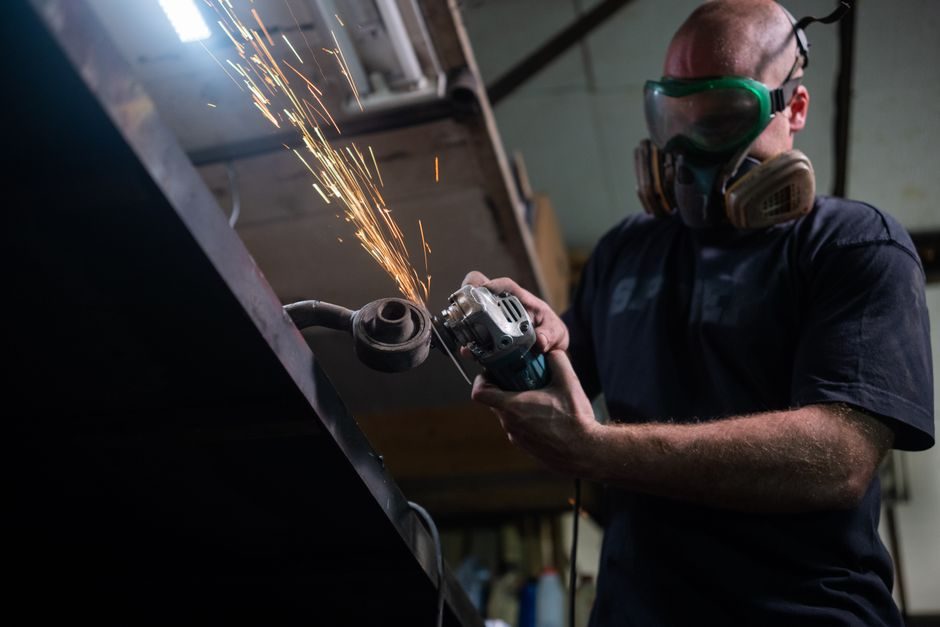
A sand reclamation unit and a fettling grinder sit on opposite ends of the foundry sand loop: the reclamation unit receives spent system sand, knocks out clay/binder, and returns a reusable fraction to the muller, while the fettling grinder sits at the cleaning station and turns risers, gates, and surface flash into airborne fines that are themselves a feed stream to the reclamation unit rather than a substitute for it.
The decision is functional, not competitive. Foundries under that throughput frequently send loaded dust to landfill and accept the binder cost instead — that is a cost-per-tonne call, not a process-equivalence call.
Process Position and Material State in the Sand Loop
Spent green sand leaves the casting shakeout at 4–8% moisture and 5–12% loss-on-ignition (LOI), depending on bentonite replacement ratio and pouring temperature; spent no-bake (chemically bonded) sand leaves at 0.5–2% moisture with 1.5–3.5% residual resin on the grain, which is the number that drives whether you need thermal reclamation at 700–820 °C or whether a lower-temperature mechanical or attrition scrubber at 300–450 °C is enough [S3].
Reclamation units in the mechanical family — vibratory attrition scrubbers, fluidized-bed scrubbers, and rotary drum units — are sized to throughput in t/h and to target AFS fineness number (typically AFS 40–55 for reuse in the muller). Thermal units add a gas-fired or electric fluidized-bed reactor and a quench cooler, with residence time of 20–60 minutes; energy draw lands between 280 and 520 kWh per tonne of dried, recovered sand, which is the single largest operating cost on the line [S1].
Fettling grinders work on solidified castings, not on sand. A 230 mm cup wheel on a swing-frame grinder at 6 800 rpm removes 2–8% of casting mass as particulate, with airborne dust loadings of 5–25 mg/m³ at the operator's breathing zone when a properly designed LEV hood is fitted — and 80–150 mg/m³ when it is not. The dust from fettling is a fine mineral fraction contaminated with ferrous metal swarf; it is a downstream feed stream to a reclamation-classifying stage, not a sand-substitute for system make-up.
Throughput, Footprint and the Real Cost-per-Tonne Levers
Reclamation throughput is rated in t/h of dry feed sand. A 5 t/h mechanical attrition unit typically draws 90–130 kW and occupies 35–55 m² of floor space including bucket elevator, dust cyclone, and bag filter; a 5 t/h thermal fluidized-bed line draws 1.4–2.6 MW of thermal input plus 250–400 kW electrical, and occupies 90–140 m² with a 6–10 m stack on the afterburner [S1].
Fettling grinder throughput is rated in kg/h of metal removed, and is governed by wheel diameter, motor power, and operator cycle. A 5 kW swing-frame grinder with a 180 mm abrasive cup wheel removes 8–20 kg/h of cast iron or steel at 80–120% of operator cycle; a 15 kW swing-frame unit with a 230 mm wheel removes 30–70 kg/h under the same conditions. The real limiter is dust extraction — 2 000–6 000 m³/h of LEV airflow per station is the design range that keeps operator exposure below 10 mg/m³ of total inhalable dust [S3].
Cost-per-tonne of recovered sand on a mechanical reclamation line runs $4–$9/t for energy and wear parts on a green-sand system, and $18–$34/t on a thermal line for phenolic-urethane no-bake systems at 2025 natural-gas prices; the fettling grinder's operating cost is closer to $0.40–$1.10 per kg of metal removed, dominated by abrasive wheel consumption at 60–180 g of wheel per kg of metal cut.
Selection Criteria: When You Need Which
Specify a sand reclamation unit when any two of the following hold: (a) spent-sand disposal cost exceeds $25/t of dumped mass, (b) virgin silica purchases exceed 800 t/year, (c) the process is no-bake chemically bonded with phenolic, furan, or phenolic-urethane binder, or (d) the foundry is subject to a non-hazardous industrial landfill restriction on LOI>5% material. The sand reclamation unit buying guide for 2026 walks through the throughput and process-family cut that drives that call. [S1]
They are not specified for sand processing; their product stream is a downstream feed.
You do not need a reclamation unit if your annual spent-sand mass is below 1 200 t, your disposal route is non-hazardous at under $15/t, and your binder is green-sand bentonite. You do not need a fettling grinder array if your castings are under 5 kg net weight and are cleaned in a tumble-blast or shot-blast machine instead — the abrasive-belt approach with a floor grinder or angle grinder is enough for that scope.
Options Comparison: Reclamation Family and Grinder Family
For reclamation, the three families line up against four criteria — recovery rate, LOI reduction, energy draw, and capex order of magnitude. Mechanical attrition scrubbers recover 70–85% of feed, drop LOI by 30–50%, and draw 25–35 kWh/t; wet mechanical units add a dewatering stage and a water-treatment loop. Thermal fluidized-bed units recover 85–95%, drop LOI to under 0.3%, and draw 280–520 kWh/t — the highest-cost family but the only one that gives a near-virgin-grade output on phenolic-urethane no-bake sand. Combined mechanical-plus-thermal lines recover 90–95% at 180–260 kWh/t and are the standard answer at foundries above 30 t/day of no-bake pour weight [S1][S3].
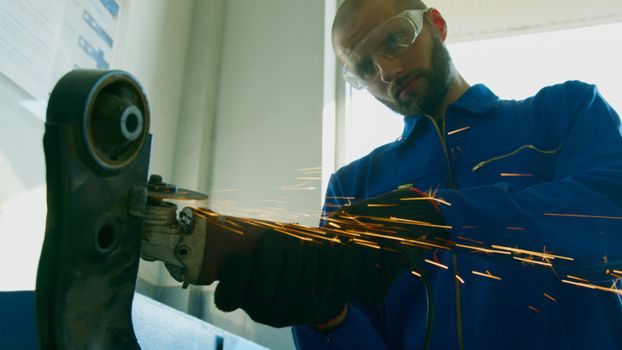
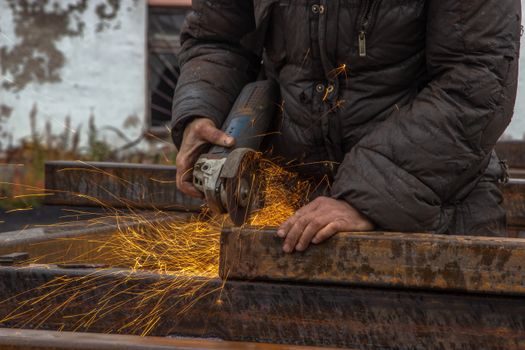
For fettling, the four options on a 5–15 kW power band line up as: swing-frame grinders (most flexible, lowest capex, highest operator exposure); pedestal/stand grinders (highest throughput per station, fixed workpiece, require a jig); robotic grinding cells (highest capex, lowest exposure, cycle-tied); and portable hand-held angle grinders for finishing and rework. The first three are the dedicated fettling class; the fourth is finishing, not fettling, and does not feed a dust-extraction system designed for 5–25 mg/m³ containment.
A useful one-line comparison: a thermal reclamation unit is to spent foundry sand what a shot-blast machine is to a raw casting — both are throughput- and energy-intensive capital equipment that pays back on a per-tonne loop. A fettling grinder is to a finished casting what a degassing unit is to a melt — a smaller, station-level tool sized to a specific step, not a process loop.
Use Cases in Steel, Iron and Non-Ferrous Foundries
Steel foundries on phenolic-urethane no-bake with 15–40 t/day of pour weight are the canonical thermal-reclamation case: binder content of 1.5–3.0% on the grain makes mechanical scrubbing alone leave LOI at 0.8–1.5%, which is too high for direct muller return without a 20–30% virgin-sand bleed. A fluidized-bed thermal unit brings LOI to under 0.3% and lets the bleed drop to under 5% [S3].
Iron foundries on green sand with 30–120 t/day of pour weight are the canonical mechanical-reclamation case: LOI on the grain is 5–12% but most of it is bentonite, and an attrition scrubber plus a vibrating screen plus a magnetic separator returns 75–85% of feed at AFS 45–55, which is the correct band for re-bonding. Pair this with a 7.5–15 kW swing-frame fettling grinder per cleaning station, hooded to 2 500 m³/h of LEV airflow, and the line holds 5–15 mg/m³ at the operator's breathing zone.
Non-ferrous aluminium and bronze foundries on shell or no-bake resin-bonded sand at 5–15 t/day are the borderline case: throughput is below the usual thermal-reclamation payback, and a 1–3 t/h mechanical attrition unit is the standard answer. Fettling on these alloys is done with 180 mm cloth-backed abrasive discs on a pedestal grinder at 1 440 rpm surface speed, which gives a cleaner cut and a lower spark load than a fettling grinder sized for steel.
Limitations, Failure Modes and Standards Anchors
Mechanical reclamation fails on no-bake sand above 1.5% residual resin because the binder film does not fracture under wet or dry scrubbing; the recovered sand shows an AFS rise of 8–15 points and a pH drift of 0.5–1.2 units, both of which the muller will punish with brittle castings. Thermal reclamation fails when the afterburner exit temperature drops below 760 °C, because unburned phenolic resin fragments re-condense on the bag filter and create a fire load; the standard operating band is 780–820 °C at the afterburner outlet with a residence time of 0.6–1.2 s [S3].
Fettling grinders fail in three modes: wheel shatter (caused by drop-loading a 230 mm cup wheel above 6 800 rpm surface speed), operator vibration exposure above 5 m/s² RMS on a 4-hour equivalent (A(8) above the action value in ISO 2631-1 type weighting), and LEV failure. The first is controlled by wheel-grade selection and a soft-start inverter; the second by an anti-vibration handle and a 2-hour max continuous-grinding cycle; the third by a magnetic-tipped LEV hood that is inspected weekly.
Dust control on both systems is anchored to OSHA 29 CFR 1910.94 for ventilation and to ACGIH TLV-TWA of 3 mg/m³ for respirable crystalline silica in jurisdictions that follow the 2024–2025 review cycle. Foundries shipping castings into the EU also have to meet the IED Chapter IV thresholds on waste, which is where a working FRL unit on the pneumatic conveying line stops oil-aerosol contamination of the recovered sand and keeps the reclamation output on-spec for the next muller charge.
Sourcing, Lead Time and Trackable Signals for the Rest of 2026
Reclamation unit lead time at the 5–10 t/h class is 16–28 weeks ex-works for the reactor vessel alone, plus 6–10 weeks for the dust filter and 4–6 weeks for the control panel; the on-site mechanical install adds another 6–8 weeks. A 2026 buyer should plan on 32–44 weeks from PO to first sand through the unit, which is the single biggest reason a foundry under 15 t/day of pour weight should not order one [S1].
Fettling grinder lead time is 3–6 weeks for a stock 5–15 kW swing-frame unit ex-stock, 10–14 weeks for a robotic cell. The trackable 2026 signal on the grinding side is the gradual transition to 150 mm high-frequency brushless drives at 1 200–1 800 Hz, which drop A(8) hand-arm vibration exposure by 35–50% and are now available from the major European OEM lines at a 15–25% price premium over the standard induction-motor swing frame. The trackable 2026 signal on the reclamation side is the rise of modular 1–3 t/h attrition units sized for the 5–15 t/day no-bake foundry — a category that did not commercially exist at this price point before 2024 and is now displacing some thermal-line orders at the lower end of the throughput range.
Both signals are bookable: the shakeout machine selection guide is a useful adjacent read on the front end of the sand loop, and the shell core shooter buying guide covers the core room side that feeds a green-sand muller in the first place.