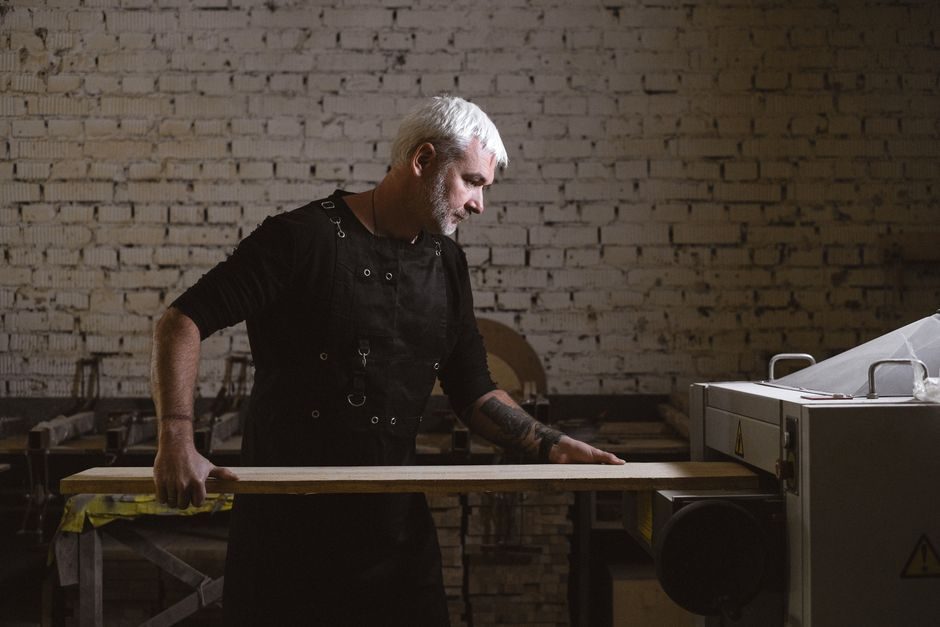
Choosing a sander in 2026 is a substrate-and-duty match: random-orbit sanders (ROS) cover 80% of finishing work on wood, metal, and composites, while belt sanders handle the high-removal end at 5-7 g/min on softwood [S1]. The decision tree is short but unforgiving — picking the wrong orbit size or dust port ruins cycle time, finish quality, and operator exposure to wood dust.
This guide lays out seven spec gates every process engineer or shop buyer should clear before signing a PO: abrasive backing, orbit or stroke geometry, pad diameter, dust extraction interface, power source (corded vs brushless cordless vs pneumatic), vibration/Noise level, and OSHA-aligned dust control. For the underlying hand-tool physics see the sander reference page; for upstream surface-prep instruments that feed into a sanding line, the pressure sensor entry covers the load-cell side of automated force control.
Abrasive Backing and Hook-and-Loop vs PSA
Hook-and-loop (H&L) pads dominate 2026 ROS and detail sanders because changeover is 1-3 seconds versus 30-60 seconds for pressure-sensitive adhesive (PSA) discs [S1]. PSA still wins on high-heat cut-off wheels and on random-orbit discs above 150 mm where H&L grip can fail at >80°C pad temperature.
For 125 mm (5") and 150 mm (6") ROS pads, specify 8-hole or multi-hole H&L pattern matched to the extraction backing pad; mismatch drops extraction efficiency from ~85% to under 50% and pushes respirable dust above OSHA's PEL of 5 mg/m³ for PNOC (Particulates Not Otherwise Classified, 29 CFR 1910.1000). For wider format work the automatic level buying guide covers a related but distinct flatness workflow where sanding is the prep step, not the finish step.
Orbit Diameter and Pad Diameter Pairing
Random-orbit sanders are sold in three orbit classes: 2.5 mm (1/10") micro-orbit for fine finishing and clear-coat prep, 5 mm (3/32") general purpose, and 8-12 mm (5/16"-1/2") aggressive stock removal [S1]. Pairing a 12 mm orbit with a 75 mm pad produces hogging action; pairing it with a 150 mm pad gives a swirl-free finish at slower feed rates.
Pad diameter drives ergonomics: 75 mm (3") palm sanders fit into corners on cabinet backs, 125 mm (5") ROS is the industry workhorse for furniture and auto-body, 150 mm (6") ROS covers large flat panels, and 225-300 mm (9"-12") disc sanders handle flooring and metal surfacing at 3,000-4,000 RPM. Trigger pull force should stay under 25 N for full-shift work; above that, grip fatigue drives operators to bypass dust collection and blow off between passes.
Dust Extraction: Single-Port, Multi-Port, and Self-Generated Vacuum
OSHA's National Emphasis Program on silica (started 2017, ongoing 2024-2026 inspections) and the EU's WOOD-DUST OEL of 2 mg/m³ (3 mg/m³ in some member states, 8 h TWA) make the dust port non-optional for any sander used on wood, stone, or composite [S1]. Three extraction architectures compete: passive single-port ROS that needs a 1,200-2,500 W shop vac, multi-port (8-49 hole) ROS with passive pad flow, and self-generated vacuum ROS with onboard impeller.
Self-generated-vacuum ROS hit 80-90% capture at the pad versus 40-60% for passive single-port; the cost is 1-2 kg added tool weight and a 30-50% price premium. A HEPA H13 (≥99.95% at MPPS) vacuum upstream is mandatory for silica work; a regular shop vac rated for wood dust does not meet the spec. For comparison the pneumatic nail gun selection guide runs through the same HEPA/dust-control logic applied to a framing nailer with onboard blower — different tool, same compliance math.
Power Source: Corded AC, Brushless Cordless, and Pneumatic
Corded 230 V (EU) / 120 V (US) AC ROS deliver continuous 250-400 W input power and weigh 1.5-2.5 kg; they are still the right call for high-throughput cabinet shops and production lines where battery cycle time kills takt. Brushless 18 V cordless ROS hit parity in 2024-2026: 250-350 W mechanical output, 2.0-3.0 Ah packs delivering 30-45 minutes of intermittent cutting, and no brush-service interval [S1].
Pneumatic ROS (composite-body, palm-grip) are the standard in collision repair and metal fab because they shed heat better, survive solvent wash-down, and weigh 0.7-1.2 kg. They need 6-7 bar (90-100 psi) clean dry air at 400-600 L/min; a 10 m hose run can drop 1 bar if the line is undersized. Always size the FRL (filter-regulator-lubricator) for ≥1.5× the tool's free-air consumption — undersized FRL is the leading cause of pneumatic ROS underperformance on shop floors that also run industrial valve actuators off the same manifold.
Vibration, Noise, and Operator Exposure Limits
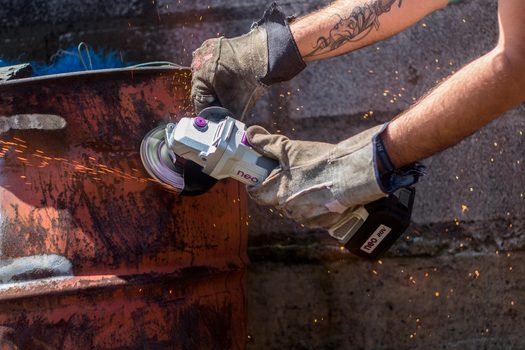
EU Directive 2002/44/EC caps hand-arm vibration at 5 m/s² A(8) (8-hour daily exposure); random-orbit sanders sit in the 2.5-8 m/s² range depending on pad size and material. Anti-vibration (AVT) handles and tuned counterweights drop TRI (triaxial vibration total) by 30-50% on premium models. The 125 mm 18 V brushless ROS with AVT and 5 mm orbit is the closest 2026 tool to the 4 m/s² threshold that buyers can still hand to full-shift operators without mandatory medical surveillance [S1].
Noise runs 75-95 dB(A) at the operator ear; OSHA's PEL is 90 dB(A) (8 h, 29 CFR 1910.95), and EU Directive 2003/10/EC pushes the lower exposure action value to 80 dB(A). Sound-dampened ROS and integrated extraction cut noise 3-6 dB(A) — a 5 dB drop halves the permissible exposure time on paper. Always cross-check the published triaxial vibration value against the spec sheet's test standard (EN 60745 or ISO 28927); some low-cost Asian-market tools do not declare the test standard and should be treated as non-compliant for EU sale.
Belt Sanders vs Orbital Sanders: Decision Grid
Use the matrix: belt sanders win on flat-panel stock removal, edge sanding, and dimensioning lumber — typical belt width 75-100 mm, belt speed 250-500 m/min, removal rate 5-10 g/min on softwood; random-orbit sanders win on curved, contoured, and finish surfaces because the orbit pattern hides scratch direction. Finish quality is the second axis: belt scratch pattern is unidirectional and shows under raking light, ROS produces a circular scratch that scatters light and reads as uniform. [S1]
Operator skill is the third axis — a belt sander removes wood fast enough to ruin a workpiece in under a second (a 75 mm belt at 300 m/min cuts 0.5 mm of pine in roughly 0.1 s of dwell), while a ROS forgives a 2-3 second overlap. For shops doing both, a 100 × 610 mm (4" × 24") belt sander for dimensioning plus a 125 mm 5 mm-orbit ROS for finishing is the standard 2026 pairing; pneumatic is preferred for any metalwork, corded AC for any production line running 8 h shifts. Mirror the spec discipline used in the oxy-fuel cutting torch selection flow — gate-by-gate compliance, then a final go/no-go on duty cycle.
Spec Cut: Three 2026 Reference Configurations
Cabinet-shop line: 125 mm 18 V brushless ROS, 5 mm orbit, H&L pad, 8-hole extraction, paired with HEPA H13 shop vac, AVT handle, 2.5 m/s² declared TV. Collision-repair prep: 75 mm pneumatic palm-grip ROS, 2.5 mm orbit, PSA 6-hole disc, 6 bar/450 L/min supply, low-profile composite body for overhead work. Flooring / large-area metal: 225 mm (9") electric disc sander, 3,500-4,200 RPM, 1500 W AC, passive dust skirt feeding a 50 mm (2") extraction hose, mandatory hearing protection above 85 dB(A) zone. [S2]
Track three signals through 2026 H2: (1) EU OEL revision under the new Carcinogens and Mutagens Directive amendment that may lower the wood-dust limit toward 1 mg/m³ by 2027 — this would force HEPA H14 (≥99.995%) on the upstream vacuum, not H13; (2) the 2026 IEC 62841-2-4 amendment for handheld sanders, which tightens declared-vibration tolerance to ±1.5 m/s² and forces re-test of every existing SKU; (3) the rollout of 18 V / 21 V dual-voltage batteries that let one pack drive ROS, pressure transmitter calibration tools, and shop lighting on the same platform. None of these is a 1 July 2026 hard deadline, but all three are inside the next 12-month buy-window. Cross-check with the sander reference page for geometry math, and treat any published spec sheet missing the test-standard clause (EN 60745 / ISO 28927) as a non-starter for EU or UK specification.