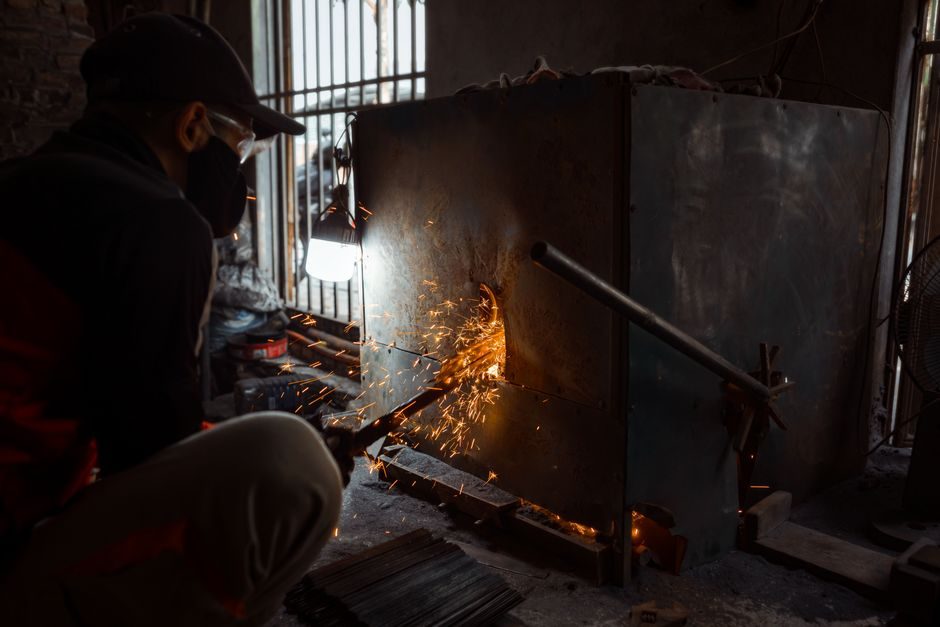
An oxy-fuel torch is the lowest-cost per linear cut on carbon steel from 3 mm to over 300 mm when the operator matches nozzle bore, fuel gas, and oxygen pressure to plate thickness, per TWI's process note on the oxyfuel process [S2]. The selection is governed by a stack of physical limits: minimum preheat to reach ignition temperature (~870 °C for low-carbon steel), oxygen purity (typically 99.5% minimum for clean cuts), and nozzle standoff (commonly 3–6 mm) — not by brand preference.
Buyers in structural fabrication, shipyard plate processing, and demolition scrap yards all run into the same gating decisions: which fuel gas to plumb, which nozzle series to stock, and whether to invest in a mechanized oxy-fuel cutter versus a hand torch. The five-gate filter below covers the spec levers a process engineer should lock before pricing a machine or a torch outfit.
Fuel gas family and flame chemistry envelope
Acetylene (C2H2) produces the hottest neutral flame of any commercial fuel at roughly 3,160 °C and the narrowest primary combustion zone, which is why it is the default for hand cutting and for thin plate (under 25 mm) where minimal heat-affected zone matters [S2]. Propane (C3H8) and propylene (C3H6) sit in the 2,800 °C range, MAPP (methylacetylene-propadiene) around 2,950 °C, and natural gas (predominantly methane) lowest at about 2,540 °C [S2]. The lower flame temperature of propane and natural gas forces higher preheat flow and longer preheat time, but those fuels are traded because of cylinder cost and storage safety — acetylene's flammable range and cylinder pressure limits (100 kPa discharge typical, with internal acetone-saturated acetylene handling rules) make bulk storage a regulatory burden above roughly 1,000 m³ annual draw [S2].
Selection rule: if the shop cuts mostly plate over 50 mm on a mechanized cutting machine, propane or natural gas beats acetylene on cost per metre; if the work is mixed gauge or includes field work where portability matters, acetylene stays the default fuel. Mixing fuels on the same torch body is a hardware mistake — the seat geometry and tip orifice are cut for a specific flame profile, and swapping from an acetylene tip to a propane tip is not optional.
Plate thickness envelope and nozzle series mapping
Oxy-fuel cutting is economic from roughly 3 mm up to 600 mm in heavy industrial rigs; below 3 mm the heat input distorts the workpiece faster than the kerf can travel, and above 600 mm oxygen pressure requirements and cut quality degrade without specialty lance injectors [S2]. The TWI process note maps the working envelope to a small set of nozzle series — for example, a 1/8" (3.2 mm) nozzle orifice typically services 3–10 mm plate, a 3/64" to 5/64" nozzle handles 10–25 mm, and heavy nozzles above 1/4" (6.4 mm) are reserved for plate over 100 mm with oxygen supply above 300 kPa [S2]. Nozzle bore is the single most consequential part number on a torch.
The spec gate: pick the nozzle before picking the torch. A machine-grade torch body (one-piece forged or tip-mix design, with a mixer chamber) can hold a range of nozzles, but the riser-cutting-machine class of hand torches and the heavy industrial torches are not interchangeable for nozzle series. Buyers should confirm the nozzle seat standard (typically a 3/8"-24 or 1"-14 threaded seat for medium/heavy duty) and the inlet thread (9/16"-18 BSW for oxygen, 5/8"-18 for fuel on North American torches) match their existing hose set before ordering.
Cutting oxygen pressure, purity, and supply sizing

Cutting oxygen pressure and flow scale roughly linearly with plate thickness: a 25 mm cut runs near 200 kPa at ~150 L/min, a 100 mm cut climbs past 350 kPa at ~600 L/min, and a 200 mm cut can demand over 700 kPa and 1,000+ L/min for clean kerf [S2]. The TWI guidance states oxygen purity of 99.5% as the working minimum — below that the cut face roughens, dross adhesion worsens, and kerf widens. Pipeline supply, bulk liquid oxygen, or cylinder manifold are all valid; the gate is sustained flow at working pressure, not peak cylinder rating.
For propane and natural gas on a mechanized line, preheat oxygen runs 100–200 kPa and preheat gas 50–100 kPa, depending on nozzle; acetylene preheat is held below 100 kPa by safety convention to avoid flashbacks into the torch body. Spec gate: any torch selected for a CNC oxy-fuel cutter must be paired with a gas train that includes a flashback arrestor on each fuel line and a reverse-flow check valve on the cutting oxygen line, per TWI safety guidance [S2].
Hand torch versus machine torch and torch height control
Hand torches (1/2" to 1" bar stock, lever or squeeze-grip) suit field work, small shops, and plate under 50 mm; machine torches (specifically designed for straight cuts, with rack-and-pinion or motorized drives) are required for kerf straightness better than ±1.0 mm/m on plate over 25 mm [S2]. The TWI process note highlights that on plate over 100 mm, THC or motorized height tracking is the difference between a sellable bevel and a scrap piece.
Decision gate: if the buyer cuts plate 25 mm and up in production volume, specify a machine torch from day one; if the work is field demolition or short production runs, a heavy hand torch with a 90° head and a 1.2–1.8 m extension is the lower capital answer. Mixing in plasma — the Lincoln Electric EUROTOME 2 listed in the DirectIndustry catalogue as a combined oxy-fuel/plasma exhibit unit [S1] — is a niche path for shops that need to cut stainless and non-ferrous alongside carbon steel without a second dedicated table.
Standards, certifications, and safety hardware to lock on the order
The hardware and procedure stack is governed by the EN ISO 5172 (gas welding/blowpipe equipment) family for torch bodies, EN ISO 3821 (hose), and EN 12517 for non-destructive testing of welds on cut surfaces; torch certification for hazardous-area work (e.g., petrochemical site fabrication) requires the same ATEX/IECEx considerations as any hot-work tool, with the operator carrying a gas test certificate and a fire watch per the site permit. [S1]
Spec gate for purchasing: any torch outfit selected for shop work should ship with regulators matched to the gas (acetylene regulator body in left-hand thread by convention, oxygen in right-hand), EN ISO 3821 twin hoses (red for acetylene/fuel, blue for oxygen) of 6.3 mm or 8 mm ID, and a documented compatibility matrix of nozzle series to plate thickness — buyers who skip the matrix end up ordering nozzles by trial-and-error. For comparison guidance across thermal cutting options, the related spec cut on plasma versus oxy-fuel torches gives a criteria-based line on cost per metre, thickness envelope, and cut quality plasma cutter vs oxy-fuel torch spec cut.
Comparing the four main fuel options on decision criteria
Stacking the four commercial fuels against four spec criteria makes the selection a numerical exercise rather than a brand debate. Acetylene wins on flame temperature (3,160 °C) and preheat time, but loses on cylinder cost-per-m³ and storage regulatory burden [S2]. Propylene and MAPP sit in the middle: higher flame temperature than propane, lower than acetylene, with simpler cylinder handling than acetylene. Propane is the workhorse of mechanized structural-fabrication shops — 2,800 °C flame, cheap bulk supply, and a wide preheat flow window. Natural gas is the lowest-cost bulk fuel where pipeline supply is available, with the trade-off of needing higher preheat flow and longer preheat dwell at the start of each cut.
On plate thickness: acetylene and MAPP are most efficient below 50 mm; propane and natural gas hold the 50–300 mm band efficiently; above 300 mm all four fuels are outclassed by powder-injection lance injectors that use iron or aluminum powder feed in the oxygen stream, a different machine class entirely. For cost-driven fabrication shops cutting mild steel plate in the 6–100 mm range, propane on a mechanized cutting machine with THC is the dominant 2026 selection.
Trackable signal for the next purchasing cycle: as hydrogen blends enter industrial gas distribution in some regions, expect fuel-gas nozzle designators to add a fifth series optimized for H2/CH4 mixtures; this is a procurement question to raise with the gas supplier and the torch OEM when the bulk contract is up for renewal. Verify nozzle-to-thickness compatibility matrix, regulator thread conventions, and EN ISO 5172/3821 compliance are written into the purchase order — the documentation gap is where most shops lose time on commissioning day.