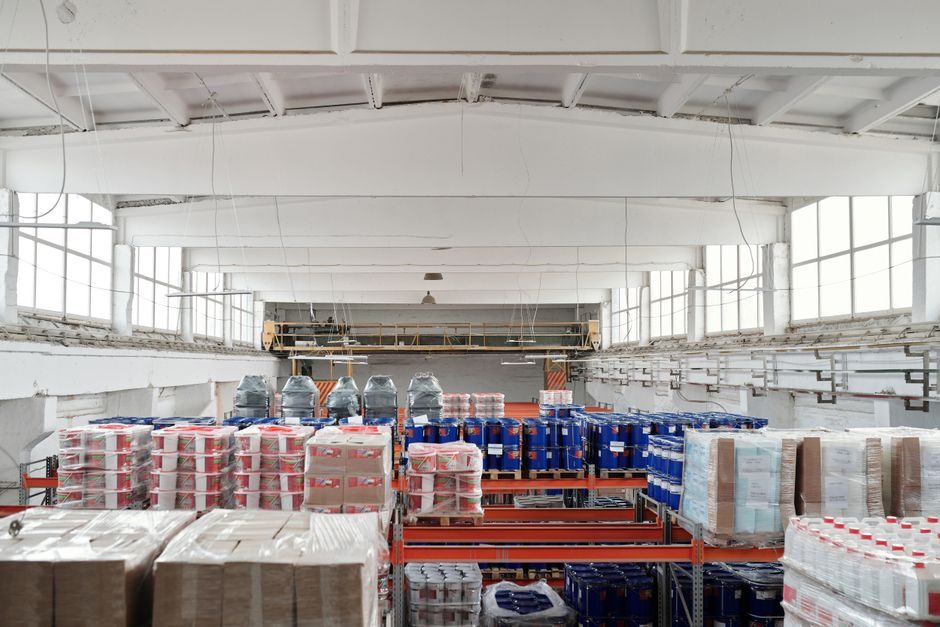
KWS Manufacturing's 125,000 ft² facility runs 98.6% on-time delivery and 48.3% early shipments on its CEMA stock screw conveyor line, while Turkish OEM İnotek ships SCC-type cement screw conveyors in tube sizes Q114–Q323 mm with 140/200/240 rpm standard reducer ratios — two data points that bracket the size and speed envelope most retail-distribution buyers will be sizing against [S1][S2].
For a retail SKU environment — bagged rice, sugar, pet food, dry chemicals, hardware pack lines, e-commerce fulfillment — the working envelope usually lands at 4"–12" (100–300 mm) diameter, 5–40 ft (1.5–12 m) length, 100–500 ft³/h (2.8–14 m³/h) throughput, and 304/316 stainless or mild carbon steel flights. A related walkthrough of screw conveyor selection for air cargo shows the same U-trough geometry translating to lighter-duty flows, useful for cross-checking your spec sheet.
Definition and Scope: What Counts as a "Retail-Distribution" Screw Conveyor
Retail-distribution screw conveyors move bagged, boxed, or free-flowing granular product between receiving, storage, picking, and shipping points inside a warehouse or DC. The mechanical envelope — shafted helicoid flight, trough or tubular housing, end-bearings, optional hanger bearings every 8–10 ft (2.4–3 m) — matches general-purpose CEMA Standard 300/350 construction. İnotek's continuous screw flights, cold-rolled from special steel at 3–10 mm thickness and 15–500 mm outside diameter, cover most retail SKU sizes without custom tooling [S2]. For a primer on the underlying geometry and component families, see the screw conveyor reference page.
Retail is distinct from heavy-bulk (cement, grain elevator) and from ultra-clean (pharma, food-contact dairy): it sits in the middle, where CEMA standard components, mild-steel flights, and bolt-on flange connections are acceptable. Zhejiang Feipuda's auger and screw conveyor line — operating from Jiaxing, Zhejiang — supplies a comparable mid-tier configuration aimed at packaging and environmental lines, reinforcing that the 4"–12" segment is heavily commoditized at the OEM tier [S3].
Selection Criteria: Diameter, Speed, Material, and Cleanability
Four variables drive the SKU decision in retail distribution. First, diameter: a 6" (152 mm) screw at 100 rpm moves roughly 50–80 ft³/h of 40 lb/ft³ granular; scaling to 9" (228 mm) at the same 100 rpm roughly triples throughput, per CEMA Standard 300 chapter 2 sizing tables. Second, rotational speed: İnotek's standard reducer ratios of 140, 200, and 240 rpm suit most cement-silo metering roles; retail bagged-goods lines typically derate to 60–120 rpm to limit particle degradation and noise below 75 dBA at 1 m [S2].
Third, material of construction: 304 stainless for general dry-food and pet-food contact, 316 stainless where wash-down or chlorides are present, mild carbon steel (A36/1018) with epoxy or powder coat for hardware and non-food retail. KWS maintains a large inventory of CEMA stock components manufactured to CEMA Standards, which simplifies retrofit and reduces lead time for replacement flights and hanger bearings [S1]. Fourth, cleanability: U-trough designs with removable covers and externally-mounted hanger bearings (rather than in-trough bearings) are now the default for retail food-grade lines because they allow tool-less access for allergen changeover — a topic the screw conveyor reference page covers in more depth.
Who This Spec Is For — and Who It Is Not For

Shafted U-trough or tubular screw conveyors are appropriate for: receiving hoppers feeding a weigh-scale, in-line dosing between mixer and packer, bagged-goods reclaim under a pallet rack, and DC-to-truck loading of free-flowing granular product at up to ~500 ft³/h. They are not appropriate for: hard, sharp, or stringy material (glass cullet, metal stampings, agricultural straw), high-temperature product above 200 °C without special alloy flights, sanitary wash-down dairy or meat processing, or any application requiring gentle handling of fragile finished goods — those require flexible screw, belt, or vibratory conveyors instead. [S2]
Retail buyers should also note that CEMA Standard 300 covers horizontal and slightly inclined (up to ~15°) shafted conveyors only; steep-angle (>15°), vertical, or live-bottom reclaim applications need CEMA Standard 350 (vertical screw) or a different equipment class entirely. KWS designs and manufactures conveying equipment for every bulk material handling application in this space, but the same vendor will steer a buyer away from screw geometry when the material or angle is wrong [S1].
Option Comparison: U-Trough, Tubular, Shaftless, and Flexible
Four screw geometries compete in the retail SKU band, and the right pick depends on material, cleanability, and angle. The U-trough shafted conveyor is the workhorse: low cost, easy to inspect, easy to clean with removable covers, but limited to ~15° incline and 100–500 ft³/h. Tubular shafted conveyors enclose the flight completely, suiting dust-sensitive retail environments and outdoor installations, at a 10–25% cost premium over U-trough. Shaftless screws handle wet, sticky, or stringy waste — not the typical retail SKU, but sometimes used in retail-store back-of-house waste compacting. Flexible screw conveyors (a spiral wound around a wire core inside a plastic or stainless tube) suit low- to mid-throughput (50–200 ft³/h) inclines up to 90°, commonly seen in bag-emptying stations. [S2]
For a complementary comparison at the next size bracket up, the screw conveyor selection for automotive parts logistics article walks through heavier-duty 9"–18" configurations used in line-side delivery. The decision criteria line up the same way — diameter, material, speed, cleanability — but the throughput band and the consequence of a failure are both higher.
Real Use Cases: Receiving, Reclaim, and DC Loading
Three patterns dominate retail installations. First, receiving-to-silo: a 6"–9" tubular screw under a receiving hopper meters inbound granular (sugar, rice, pet food) into a storage silo; İnotek's SCC-type cement conveyor in Q114–Q323 mm tube sizes is a close analog, originally designed for cement-silo metering but mechanically equivalent [S2]. Second, pallet-rack reclaim: a short 4"–6" U-trough screw at 60–100 rpm pulls broken-bag product from a floor-level hopper back into the pack line; this is where CEMA stock components earn their keep because the duty is intermittent and spare parts need to be on the shelf. Third, DC-to-truck loading: a 9"–12" tubular screw, often inclined 10°–15° with a flared inlet, loads granular retail product into bulk trucks or tote bins at 200–500 ft³/h. KWS's bulk material handling systems cover this envelope explicitly, with both CEMA Standard components and engineered-to-order units [S1].
Limitations, Failure Modes, and Sourcing Standards
The dominant failure modes in retail-duty screw conveyors are hanger-bearing seizure (especially in dusty product), flight wear at the in-feed end, shaft deflection between bearings, and trough-bottom abrasion. Limiting each: keep product velocity below ~1 m/s to control wear, use external hanger bearings with grease zerks accessible from outside the trough, specify 1/4"–3/8" (6–10 mm) flight thickness for abrasive product, and check CEMA Standard 300/350 for maximum recommended shaft length between bearings at the selected diameter and rpm. [S2]
Standards to anchor the spec: CEMA Standard 300 (screw conveyors), CEMA Standard 350 (vertical screw conveyors), and CEMA Standard 401/402 (components and inventory). For food-contact lines, FDA 21 CFR 110 and 3-A Sanitary Standards may apply; for general retail (non-food), no food-grade certification is needed and CEMA-standard carbon steel is acceptable. İnotek is certified ISO 9001:2008 — a quality-system baseline that most retail procurement teams will accept as a minimum [S2]. Material-handling OEM pages such as Dynatech Conveyors India continue to list CEMA-style screw conveyors alongside belt and casting conveyors for general industrial retail and packaging use, confirming that the spec envelope is stable across regional OEMs [S4]. For applications involving a ball screw or lead screw — which are precision positioning components, not bulk-material conveyors — the selection logic is entirely different, and buyers should not conflate the two.
Track three signals over the next two quarters: (1) CEMA's pending revision work on Standard 300 chapter 2 sizing tables, which historically updates every 4–5 years; (2) 316 stainless flight pricing and lead times at the 4"–12" size band, where retail food-grade demand is the swing variable; and (3) KWS's published on-time-delivery rate against the 98.6% baseline, which is a useful proxy for whether the CEMA stock-component channel is keeping up with retail DC build-out [S1][S2].