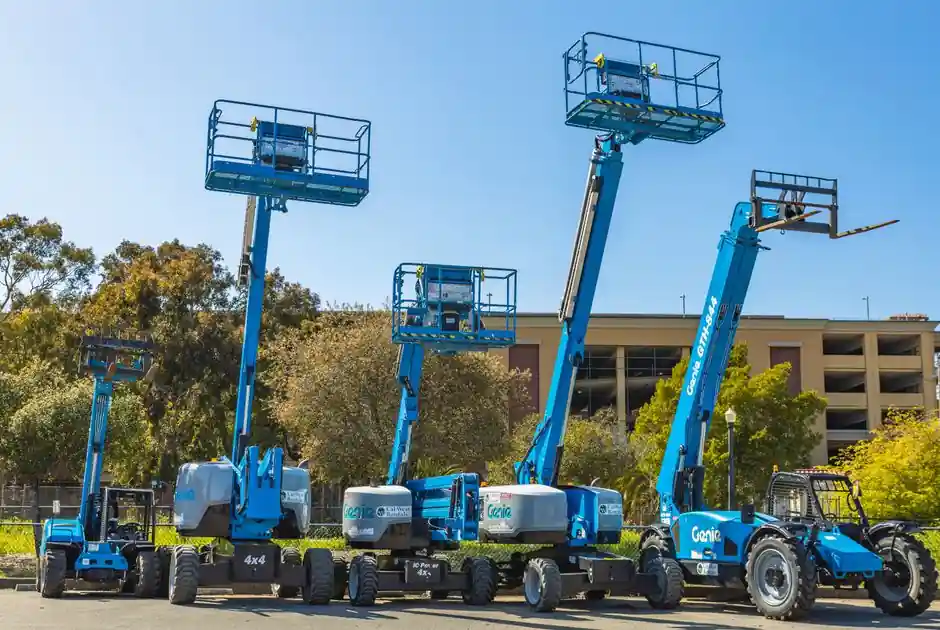
A forestry aerial lift truck with a chip dump body can provide 45–60 ft working height while carrying debris in bodies up to 11 ft 9 in long, combining tree access and material transport in one vehicle [S2].
These trucks suit tree trimming, pruning, removal, utility clearance and storm cleanup crews that need to collect branches, wood chips, tools and other job-site material without deploying separate support vehicles [S1][S3].
What the Combination Truck Delivers
A forestry bucket truck uses a hydraulic boom and personnel bucket to position crews beside elevated branches, while a chip dump body provides a reinforced steel enclosure for branches and processed wood debris [S1][S6].
Forestry bucket trucks and chipper dump trucks combine lifting systems, storage capacity, and debris-transport capabilities for tree-service work [S1]. Published configurations include a 14 x 72 in chip body, with the same body used for tools and transported debris [S4].
For comparison, a dedicated bucket truck prioritizes reach, while a chip dump truck prioritizes debris capacity. A combination truck trades some specialization for fewer vehicles and fewer transfers between the cutting area, chip body and disposal site [S7].
Reach, Body Capacity and Chassis Fit
Published forestry packages span 45 ft to 60 ft working height, with 96 in body width and 54 in body height repeated across all three Dur-A-Lift configurations [S2].
Broader aerial platforms are also available: rear-mount over-center units reach 63.67 ft, while behind-cab over-center units reach 75.83 ft [S5]. These figures are working heights, not horizontal reach, so trees with broad canopies require a separate reach and clearance assessment before purchase.
Compare the Main Configurations
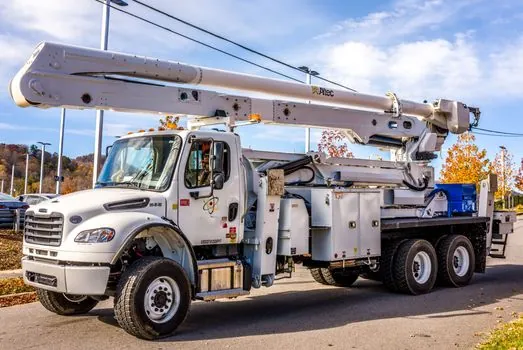
The compact 7 ft 6 in body option favors maneuverability in urban environments [S2]. The 9 ft 9 in body adds 27 in of body length without changing the 96 in width or 54 in height [S2].
The 11 ft 9 in body is 24 in longer than the mid-size version and is available with a DPM2-53 aerial providing up to 60 ft of working height [S2]. By comparison, the 14 x 72 in Arbortech body offers 2 ft 3 in more length and 24 in less width than the Dur-A-Lift bodies, but its source does not specify an aerial working height [S4].
Selection should therefore compare working height, horizontal outreach, body volume, chassis configuration and total operating weight rather than body length alone. Reach specifications also vary by mounting arrangement, with 63.67 ft rear-mounted and 75.83 ft behind-cab systems listed by Aspen Equipment [S5].
Urban, Utility and Off-Road Applications
Urban forestry packages offer shorter configurations for urban maneuvering and aerial options with up to 45–60 ft of working height [S2].
Utility vegetation management requires controlled positioning around conductors, but proximity to energized infrastructure also makes the boom configuration and operating envelope more important than payload alone [S3]. The comparison between a bucket truck and self-propelled boom lift for utility pole work provides additional criteria for work requiring frequent ground repositioning.
For storm cleanup, the chip body permits crews to collect limbs generated during trimming and removal before returning to a processing or disposal point [S1][S6]. The enclosed body also organizes tools and smaller equipment, which are typical components of a tree-service fleet [S1].
Debris Handling and Operating Constraints
Heavy branches create a concentrated loading problem. Arbortech offers a power hoist for unloading heavy tree limbs to improve efficiency and safety [S4].
Debris weight also affects vehicle configuration. A larger chip body can reduce disposal trips, but added payload must be balanced against chassis axle ratings and the aerial lift's operating configuration [S4]. The published 14 x 72 in body is presented as a way to maximize cubic yards while remaining below Commercial Driver’s License requirements, making registration class a central procurement criterion rather than an afterthought [S4].
Procurement Checklist for Forestry Fleets
Start with the tallest work that must be reached, then specify the working height and horizontal outreach separately. Dur-A-Lift offers 45 ft, 50 ft and 60 ft working-height options, while Aspen Equipment lists 60.83 ft, 63.67 ft, 75.83 ft and trailer-mounted 38 ft configurations [S2][S5].
Next, match the chip body to operating access. Published bodies range from 7 ft 6 in to 11 ft 9 in long with a 96 in width and 54 in height, while the Arbortech design measures 14 x 72 in [S2][S4]. Specify hydraulic tool circuits at the platform, insulated boom sections, crossbody tool storage and ground-mat storage where the duty cycle requires them [S5].
Finally, validate mounting, axle capacity, payload, dump clearance, driver-licensing class and local operating restrictions before placing the order. Forest work near overhead conductors requires a site-specific assessment rather than reliance on a reach number alone [S3].
The most trackable procurement signals are the selected aerial’s published working height, the chip body’s verified dimensions and payload, the chassis and axle ratings, and the number of separate trucks required for one trimming and debris-removal cycle [S1][S2][S5].