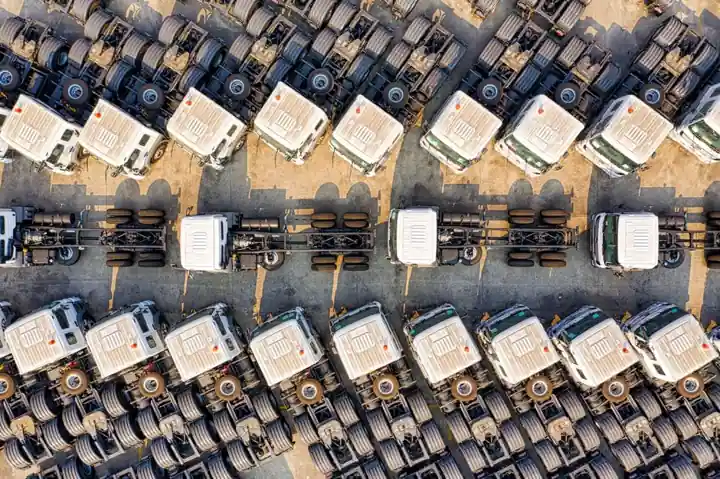
Automotive tier-1 and tier-2 plants handling plastic pellets, aluminum chips, stamping offcuts, and bumper regrind rely on dilute-phase positive-pressure pneumatic conveying running at 15-30 m/s air velocity, with dense-phase systems specified only for abrasive or friable parts above 2 mm [S1][S4].
The fit question is narrower than the marketing copy suggests: the line has to move clean, dry, free-flowing bulk from railcar or silo to press-side hopper, often 50-300 m, with bend counts of 8-15 per run, and with dust control that survives an audit [S1][S5][S7].
Three architectures engineers actually specify
Pneumatic conveying splits into positive-pressure, vacuum, and combination systems, and each has a defined role in an automotive plant [S1][S4]. Positive-pressure systems push material with a blower or compressor downstream of the feeder and are the simplest layout for one source feeding one or more hoppers over distances up to 300-500 m [S1][S4]. Vacuum systems pull from multiple intake points to a central receiver, which suits plants that need to collect from 5-20 press cells into one receiver for central reclaim [S4].
Dense-phase conveying moves material in slugs or waves at lower velocity (typically 3-10 m/s) with high solids-to-air ratios, reducing particle degradation and elbow wear for materials like plastic pellets or finished components where surface finish matters [S1][S4]. For most automotive dry-bulk feeds, dilute-phase remains the default because of its lower capital cost and simpler rotary airlock selection [S1].
Material properties that drive the spec
The four decision numbers are bulk density, particle size, friability, and moisture content, and they map almost mechanically to phase selection [S1][S4][S5]. Plastic pellets (bulk density 500-700 kg/m3, 2-6 mm, free-flowing) sit comfortably in dilute-phase positive-pressure at 18-25 m/s, while aluminum chips (bulk density 200-500 kg/m3, irregular, abrasive) usually require dense-phase or a different conveyor class entirely [S1].
Material-to-air ratio, the single best predictor of system behavior, sits around 5-15:1 by weight in dilute-phase and climbs to 30-100:1 in dense-phase designs, which directly changes the blower sizing, the receiver volume, and the filter area [S1][S4]. Hygroscopic materials such as nylon regrind demand dry-air or nitrogen conveying to keep moisture below 0.05% by mass and prevent hopper bridging, and the same enclosure can be switched to nitrogen for combustible dusts [S5].
Routing, bends, and the part automotive plants always underestimate
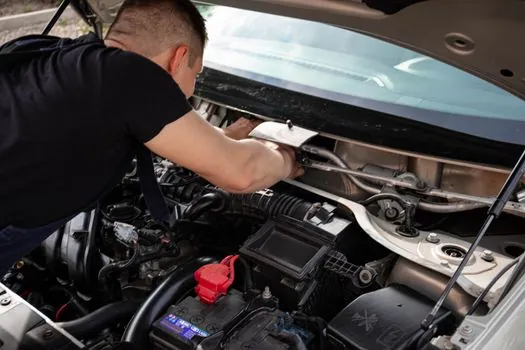
Pipeline routing in automotive plants rarely follows the clean P&ID; the line snakes around press lines, mezzanines, and utility chases, and bend count is the single biggest variable in pressure drop prediction [S5]. A single 90-degree standard-radius elbow can equal 3-6 m of straight pipe in pressure loss depending on the solids-to-air ratio, and a long-radius bend (R/D = 6 or higher) typically cuts that loss by 30-50% versus a standard R/D = 1.5 elbow [S1][S5].
Long-radius elbows are non-negotiable on dense-phase lines and on any line moving pellets larger than 4 mm; after-bend rope regions concentrate 60-80% of the mass flow in the lower 20% of the pipe cross-section, which is what causes the classic plug-and-blow instabilities engineers chase for months [S5]. A practical floor rule is to budget at least 8-12 m of straight pipe before the first bend after a rotary airlock or venturi feeder, and to keep total bend count under 15 for any run below 200 m [S1][S5].
Where pneumatic wins, where it loses, in a tier-1 plant
On the three comparison axes that matter to a plant engineer, pneumatic conveying beats mechanical for dust control, footprint, and routing flexibility, but loses on energy use and on heavy or wet material handling [S4]. A pneumatic line through a pneumatic conveyor system typically carries 5-50 t/h over 50-400 m, occupies a fraction of the floor space of a belt or chain conveyor, and keeps the entire run enclosed to below 5 mg/m3 respirable dust, which is the threshold most plants aim for inside ISO Class 8 areas [S1][S4][S7].
Mechanical conveyors still win for stamping scrap, oily turnings, and any material above 50 mm or above 1,500 kg/m3 bulk density, where pneumatic lines would need unrealistic air volumes and would damage elbows in days [S4]. For reference, a 100 m dilute-phase pellet line at 20 m/s and 10 t/h draws roughly 1,500-2,500 m3/h of air, which is the order of magnitude a plant engineer should sanity-check against available compressed-air capacity before specifying [S1][S4].
Components, controls, and the ATEX overlay
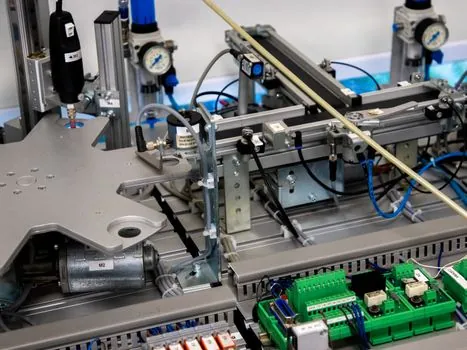
The canonical component stack is a blower or compressor, rotary airlock or venturi feeder, conveying line with long-radius elbows, filter-receiver or cyclone, and a control package with pressure transducers at pick-up, midpoint, and receiver [S1][S4]. A 2026 spec for a new European plant also adds a leak-detection pressure switch, a blocked-line detection routine on the PLC, and a purge cycle on the receiver to keep combustible dust below the lower explosive limit before the next fill [S7].
For Zone 21/22 areas (the standard classification for inside dust-handling enclosures where combustible plastic pellet dust is present), a pneumatic system is the cleaner option because the entire material path is enclosed, but the filters, rotary airlocks, and any sight glasses still need ATEX certification to the relevant equipment category, and the conveying gas can be switched from air to nitrogen for materials with MIE below the energy that could be released by a static discharge inside the line [S1][S5]. On the actuation side, the pneumatic actuator and pneumatic cylinder inventory that drives diverter valves and receiver isolation should be sourced from the same vendor family as the conveying blower package, because pressure and duty-cycle ratings are easiest to match when the pneumatic train is designed as one system rather than three separate quotes.
Common failure modes and what to spec against them
The three failure modes that consume most service calls in automotive plants are elbow erosion, filter blinding, and line-plugging at the first bend after the feeder [S1][S5]. Elbow erosion is solved by specifying long-radius bends with replaceable wear-back sections in 400-500 Brinell abrasion-resistant steel, and by keeping conveying velocity for abrasive materials under 20 m/s [S1].
Filter blinding shows up as a steady rise in differential pressure past 1.5-2.0 kPa and is solved by oversizing the filter area to at least 1 m2 per 500 m3/h of air and by adding automatic reverse-pulse cleaning tied to dP, not to a timer [S1][S4]. Line-plugging is almost always a bend or feeder problem, and a mid-line pressure tap at 30-50% of the run length, alarmed at 30% above normal operating pressure, gives operators a 30-60 second window to intervene before a full plug [S1][S5].
Sourcing, integration, and what 2026 vendors offer
Custom-engineered pneumatic conveying systems for the automotive sector are dominated by North American and European integrators who build around standard blower packages, and the lead time for a 100-300 m custom line in 2026 is typically 16-24 weeks from PO to commissioning [S2][S9]. For material handling and packaging integration, plants often bundle conveying with bulk bag unloaders, weigh batching, and downstream conveying and logistics packaging skids so the controls ship from one integrator rather than three [S2][S7].
On related equipment that often rides along with a conveying project, the storage and tote handling decisions around storage cages for automated warehouses are usually settled first, because the receiver hopper height, footprint, and truck-loading dock geometry all derive from those upstream container decisions.
Trackable signals for the next planning cycle: automotive battery-cell and EV lightweighting lines are pulling pellet-handling capacity upward as plants retool around polypropylene, polyamide, and carbon-fiber compounds, and dense-phase nitrogen-purged systems are appearing in vendor catalogs in higher numbers than the previous build cycle, which is worth a fresh quote in any 2027 capex review [S7].