A self-priming pump is only as corrosion-resistant as its wetted materials, its mechanical seal faces, and its rated temperature window — selecting a unit on flow alone is a known path to premature failure when the process fluid is HCl, NaOCl, hot CIP, or a solids-bearing slurry [S1][S2][S3].
Three construction families dominate chemical, hygienic, and industrial-water service: engineering-plastic self-priming pumps for dilute acid/alkali transfer, AISI316L sanitary self-priming pumps for food, dairy, and pharmaceutical CIP returns, and SUS304/SUS316 die-pressed self-priming pumps for general water boosting and fuel transfer [S1][S3][S6].
Material Selection for Corrosive Service
Plastic-bodied self-priming pumps such as the Xin'anjiang FZ / FVZ / FPZ series are specified where dilute acids, alkalis, and salt solutions would attack cast iron, with fluoroplastic or PP/PVDF internals providing chemical resistance at the cost of lower pressure and temperature limits than metallic equivalents [S1]. Engineering-plastic self-priming units are widely used in wastewater neutralization, electroplating rinse transfer, and small chemical dosing loops where metal-ion contamination must be avoided [S1].
For pharmaceutical and food-grade transfer, AISI316L stainless steel on all wetted parts (pump case, cover, impeller) with EPDM elastomers is the current default; AISI304 is used for non-wetted structural parts to control cost [S3]. When chloride levels exceed the AISI316L pitting threshold — typically above 200–500 ppm Cl⁻ at ambient temperature — upgrading to alloy-20, duplex 2205, or a fluoroplastic-lined body becomes necessary rather than optional [S1].
Seal Architecture and Face Material Pairings
Self-priming pumps rely on a mechanical seal because the priming chamber and air-separation stage cannot tolerate the leakage a packed stuffing box would admit. The sanitary YUY self-priming seal uses a stationary ring of SUS316L-embedded graphite against a silicon-carbide (SiC) movable ring, with EPDM as the secondary contacting elastomer — a pairing rated for -10 °C to +140 °C service and 0.5 MPa maximum inlet pressure [S3].
Flushed mechanical seal circuits on the same sanitary platform specify 0.1 MPa maximum flush-water pressure and 0.25–0.5 L/min flush consumption, which a process engineer should confirm against plant barrier-fluid pressure ratings before commissioning [S3]. Motor conformance to IEC 60034 and IEC 60072 with optional explosion-proof variants allows the same pump frame to cross hazardous-area boundaries when gas-bearing media are handled [S3].
Performance Bounds: Suction Lift, Air Handling, and Temperature
The defining mechanical advantage of a self-priming pump over a standard end-suction centrifugal is its ability to redraw air from the suction line and re-establish flow after the suction has been lost — a side-channel or water-ring priming chamber typically lifts 4–7 m at sea level when the priming chamber is filled [S3][S6]. For sanitary applications the design is explicitly used when the liquid level is unstable and below the pump inlet, and as a CIP return pump in cleaning cycles [S3].
Comparative experiments on a clear-water self-priming pump under fast and slow start-up regimes show a three-segment Q-curve evolution during the priming transient, which means a slow ramped start reduces peak air-entrainment loads on the seal faces versus a direct-on-line start [S4]. Temperature derating is mandatory: an EPDM seal at 140 °C service falls to roughly half-life near 120 °C with continuous chemical exposure, which is why a swap to FKM or PTFE-faced seals is the standard upgrade above 90 °C oxidizing-acid service [S3].
Failure Modes That Pass the Datasheet Check
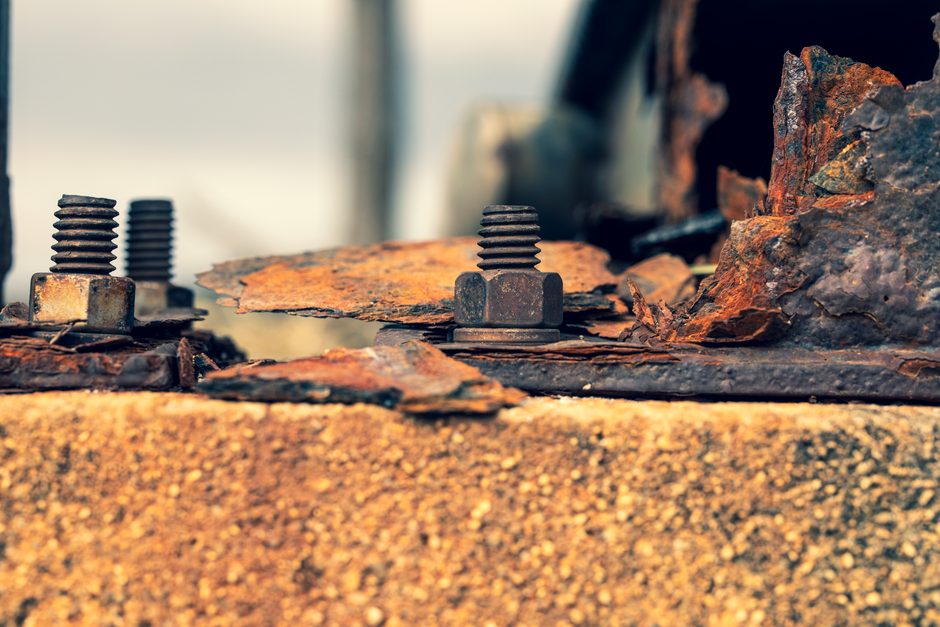
Three corrosion-related failure modes routinely pass a desktop pump selection but fail within months on site. First, chloride stress-corrosion cracking of AISI304 brackets, nameplates, or adapter flanges when 316L wetted parts are paired with 304 hardware in marine or chlor-alkali service — a discrepancy invisible in flow curves [S1][S3]. Second, galvanic coupling between a stainless impeller and a steel shaft sleeve in a dilute acid where stray currents accelerate the less-noble member [S1].
Third, dry-running after prime loss on a plastic-bodied self-priming pump, where the thermoplastic casing softens above its HDT and the side-channel geometry permanently distorts — engineering plastics tolerate brief dry running far worse than cast iron [S1]. Solid-liquid separation designs address a related failure mode: a cyclone-fed self-priming pump suffers accelerated wear on the casing and impeller, so a separator with dedicated abrasion-resistant liners is the engineered solution rather than a metallurgical upgrade of the pump alone [S7].
Comparison Table: Construction Family vs Service Fit
Three construction families dominate, and the right choice depends on chemistry, temperature, and hygiene class rather than flow rate: [S4]
Engineering-plastic self-priming (FZ/FVZ/FPZ) — best for dilute acid/alkali at ≤80 °C; lowest cost; cannot handle aromatic or strong oxidizing media; dry-run sensitivity is high [S1].
AISI316L sanitary self-priming (side-channel) — best for food, dairy, pharma CIP returns; -10 °C to +140 °C with EPDM; SiC/graphite seal faces; CIP-cleanable; Cl⁻ service is limited to roughly 200–500 ppm before upgrading [S3].
SUS304 die-pressed self-priming (SZ/B series) — best for industrial water boosting, car wash, light fuel transfer; SUS304 casing with reinforced-plastic impeller and diffuser is the standard build; not for corrosive or hygienic service [S6].
For deeper hygienic-pump selection gates, the sanitary centrifugal pump certification 7-gate checklist maps the parallel certification path for CIP-rated centrifugal units, and a side review of bag filter access spec clarifies the upstream strainer clearances that a self-priming pump actually requires to hold prime.
Standards, Sourcing, and Documented Limits
For hazardous-area motor selection on a gas-bearing self-priming pump, the IEC 60034 / IEC 60072 motor framework with an explosion-proof variant is the explicit reference cited by the sanitary OEM, and CE marking is declared for the European market [S3]. Ecodesign conformity for water-pump models such as the DESMI NSA close-coupled self-priming centrifugal is documented at the OEM level against the EU water-pump ecodesign directive, an important procurement gate for EU-bound units [S5].
Supplier audits for corrosive-service self-priming pumps show a heavily China-manufactured supply base, with three documented suppliers (Shanghai Gaochuang acid-resistant pump-valve, Tianjin Wansheng Chemical, and Jiande pilot plant) carrying CB82084563 inventory references for the generic "anticorrosive self-priming pump" category [S2]. When the working fluid is a solids-laden slurry, a self-priming pump alone is rarely the right answer: a separator-pump combination with abrasion-resistant liners solves the wear problem at the source [S7].
Track the EU water-pump ecodesign implementing acts for the next tier of GWP / efficiency thresholds, and watch for revision cycles in IEC 60034-30 motor efficiency classes that will reset the explosion-proof motor menu on new sanitary self-priming builds. For context on how a parallel centrifugal family is being certified, the sanitary centrifugal pump 7-gate checklist is the closest peer reference. A self-priming pump's corrosion performance is governed by wetted metallurgy, seal-face pairing, and rated temperature window — confirming those three numbers against the process fluid's Cl⁻ content, pH, and solids load prevents the failure modes that no datasheet curve can predict.
For the relevant spec sheets and selection criteria, see self priming pump, decade resistance box, and insulation resistance tester.