For sites under 8 storeys or with 4-10 week durations, self-erecting tower cranes now complete commissioning in under 30 minutes from a single trailer with a 1-2 person crew, removing the assist-crane cost line that dominates top-slewing mobilization budgets [S3].
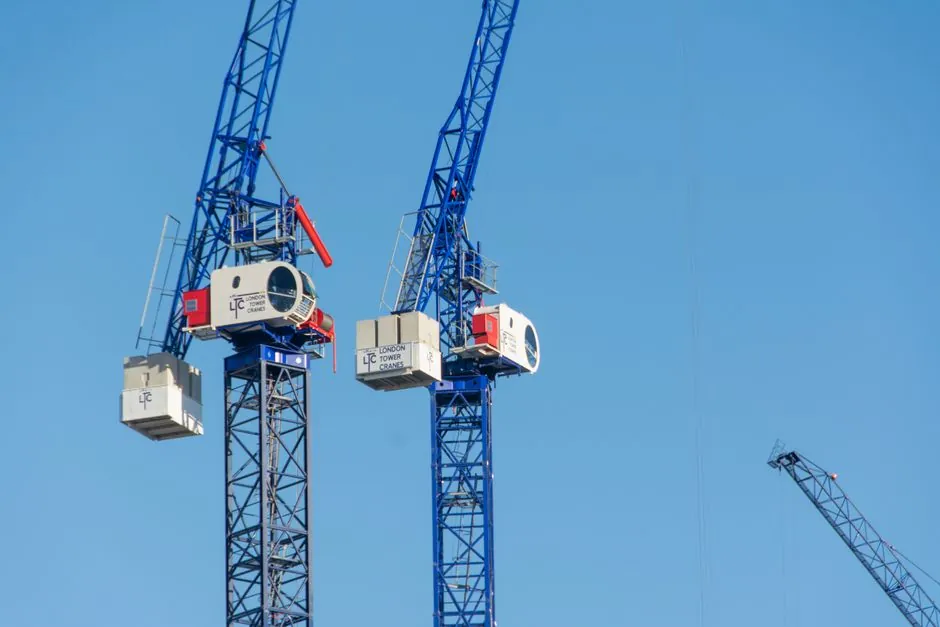
For high-rise, heavy industrial or dense urban cores, top-slewing hammerhead, flat-top and luffing jib cranes remain the only option: their top-mounted slewing ring rotates 360 degrees with a 60-100+ m working radius, lifting 12-40+ t at full reach where SETCs physically cannot reach or load [S1][S2][S5].
Defining the Two Categories: Slewing Position and Erecting Method
Top-slewing tower cranes rotate the jib from a slewing unit mounted on top of the mast, allowing the horizontal (or luffing) jib and counter-jib to swing a full 360 degrees around the tower axis for unrestricted lift placement [S5][S6]. A traditional top-slewing crane is a static structure: the mast must be climbed in sections with a separate assist (mobile or crawler) crane, then the jib and counter-jib are pinned on, so a typical site sees 2-5 days from first delivery to first lift plus a reinforced concrete foundation block [S2][S6].
Self-erecting tower cranes, in contrast, fold onto a single transport trailer and use on-board hydraulics to telescope the mast and unfold a horizontal jib without any external assist crane, which is the structural feature that drives their under-30-minute to under-2-hour setup benchmark on Potain's current Igo M, Hup, Evy and Igo T series [S3][S7]. The trade-off is kinematic: SETC masts top out around 30-40 m hook height and the jib is typically shorter than a hammerhead's, so the category is purpose-built for low- to mid-rise residential, light commercial and small infrastructure rather than skyline work [S2][S4].
Selection Criteria: Four Numbers That Drive the Decision
Hook height, jib length, peak load and project duration decide almost every specification, and these four numbers partition the market cleanly between SETC and top-slewing [S2][S3]. SETC models such as the Potain Igo M 24-19 ship folded at 11.83 m and reach working hook heights in the 20-30 m band with jibs generally under 35 m, while the Igo MA 21 covers residential and low-rise builds with steady repeat lifts of lumber, trusses and palletised material [S3].
Top-slewing hammerhead and flat-top cranes cover the rest: high-rise commercial, hospitals, energy and process plants where hook heights of 60-200+ m and 12-40+ t tip loads are normal, and where one crane must serve a footprint 60-100+ m across without repositioning [S1][S2][S5]. Luffing-jib top-slewing units are the constrained-footprint variant, trading the horizontal hammerhead jib for a variable-angle lattice jib that tucks closer to the mast, so two or more luffers can overlap in tight urban cores where hammerheads would clash [S2].
Crew, Foundation and Mobilization: Where SETC Wins on Cost

Mobilization is the line item that flips the decision. A self-erecting crane in the current Potain range can be unfolded and commissioned by one to two people with no assist crane, no oversized ground crew and no overnight standby waiting on parts, while traditional top-slewing cranes need an assist crane, a multi-person crew, days of site prep and a logistics chain that can unravel quickly [S3]. Independent operator-side data sets SETC mobilization at roughly 20 minutes on a clear pad, against the multi-day sequence for top-slewing units [S4].
The secondary cost gap is the foundation. A top-slewing tower crane normally requires a reinforced concrete ballast foundation sized to the overturning moment at full jib reach, plus anchorages if it is tied to a structure; an SETC sits on its own integral outrigger base on a prepared but far lighter pad, with the ballast carried on the crane itself, which is the reason SETCs are described as affordable and requiring little space for installation [S4]. The trade-off is site footprint: an SETC's outrigger polygon is small but the crane is essentially pinned for the project, while a mobile tower crane is drivable between pads on a heavy-duty chassis when the work front moves day to day [S4][S9].
Reach, Slewing and Lifting: Where Top-Slewing Wins on Performance
Top-slewing wins on three measurable parameters: hook height, jib radius and tip load. The slewing unit sits at the top of the mast, so the operator or radio-controlled hoist sweeps the full 360-degree circle, and the horizontal jib can be sized long enough to cover an entire building footprint plus the delivery truck stand-off, which is the configuration that defines high-rise construction [S1][S5][S6].
SETCs also rotate above the building, which gives smoother lifting over taller structures and lets them reach great lengths without having to move, but the absolute envelope is smaller and the peak lift is lower than a hammerhead or luffer's [S4]. In practice that means a SETC handles residential apartments, multi-storey buildings of moderate height, moving material across a fixed site and shipbuilding cells where the right-angled geometry reaches over large structures, while a top-slewing crane handles concrete placement, steel erection at grade, curtain-wall and MEP lifts on buildings taller than the SETC's max hook height [S4][S5]. For a single decision rule: if the job needs more reach, more height, or heavier picks than the SETC class can deliver, the spec must move to a top-slewing unit even though the mobilization line item is several times higher [S2].
Comparison Matrix: SETC vs Top-Slewing on the Decision Criteria

Side by side on the four selection criteria named by ALL Crane, the two categories diverge sharply. Project duration: short to medium (days to 12 weeks) favors SETC, long-term high-volume lift programs favor top-slewing [S2]. Site constraints: tight urban sites, residential infill and one-off house lots favor SETC; tight sites with overhead restrictions and adjacent buildings can require luffing-jib top-slewing rather than SETC [S2][S4]. Load requirements: typical SETC duty is palletised and bundle work in the 1-6 t range at moderate radius; top-slewing covers max loads 12-40+ t at full 60-100+ m radius [S2][S3].
Cost considerations confirm the same split. SETC total cost of ownership is dominated by rental day rate and minimal mobilization; top-slewing total cost of ownership includes rental, transportation of multiple trailers, an assist-crane day rate for erection and climbing, foundation works and operator cab costs [S2][S3][S4]. For multi-site residential contractors running a fleet across a region, single-trailer transport and the sub-30-minute Smart Set-Up on the Potain Igo M 24-19 keep haul costs low and repositioning fast, which is the operational case study the OEM puts forward for SETC over top-slewing for that workflow [S3].
Who Should Specify Which: a Use-Case Recommendation
Specify a self-erecting tower crane when the project is a wood-frame or low-rise residential build, a small commercial shell, a single-storey industrial shed, a short bridge deck, a shipbuilding bay or a series of similar short jobs on neighbouring sites, where hook heights stay under about 30 m, picks stay under the SETC class rating and the contractor values the elimination of the assist-crane and multi-day setup [S2][S3][S4].
Specify a top-slewing tower crane, in hammerhead, flat-top or luffing-jib form, when the project is a high-rise tower, a large footprint industrial or energy facility, a hospital or transport hub, a dense urban core with multiple crane overlap, or any lift above the SETC envelope in height, radius or tip load [S1][S2][S5]. The slewing-bearing and slewing-drive packages that carry the top-slewing rotation duty are part of why these cranes command their price band, and they remain the right call whenever the lift chart, not the mobilization budget, is the controlling document [S5][S6].
Trackable Signals to Watch Next

Two signals will move this comparison in the next planning cycle. First, SETC class peak load is climbing: Potain's broader self-erecting range already includes the Evy, Hup, Hup M, Igo, Igo M and Igo T series with shared remote control logic, so a single operator can move between models without retraining, which lowers the operational cost of a mixed SETC fleet [S3]. Second, the luffing-jib top-slewing variant is being specified for more constrained urban projects where hammerheads would interfere, and on those projects the tower crane selection is increasingly between two luffers rather than a hammerhead and an SETC [S2].
For a site engineer building the spec sheet, the simplest tracking rule is: re-check the SETC class capacity tables whenever a low-rise project tries to grow taller, and re-check the top-slewing erection sequence whenever a high-rise project tries to shrink duration, because each category has a hard physical limit, and the slewing bearing and slewing drive packages underneath both will tell you, via duty cycle and moment rating, which side of that limit the lift is on [S5][S6].
This topic is covered further in Spring Washer Load Deflection Curves: Linear vs Non-Linear Selection Guide.