
The semiconductor and related devices market is segmented into integrated circuits, memory chips, microprocessors, and other product types, with intrinsic versus extrinsic doping treated as a separate axis in 2026 sizing models [S7].
Aggregating the seven credible sub-forecasts available on 2026-06-22, the picture is not a single number but a layered stack: power semiconductors at USD 48.9 billion in 2022 heading to USD 79.9 billion by 2032 [S6]; semiconductor foundry at USD 175.1 billion in 2025 moving from USD 202 billion in 2026 to USD 263.1 billion by 2034 [S8]; packaging materials at USD 16.51 billion in 2023 on the way to USD 34.12 billion by 2032 at 8.4% CAGR [S1]; compound semiconductors, RF power devices, and laser processing equipment filling the supporting tiers [S3][S5][S4].
Power Semiconductors: The 2022 Anchor and the 2032 Target
The power semiconductor market was valued at USD 48.9 billion in 2022 and is projected to reach USD 79.9 billion by 2032, growing at a CAGR of 4.9% from 2023 to 2032 [S6].
A power semiconductor is defined as a switch or rectifier in power electronics, including discrete devices and modules; the 4.9% CAGR is materially below the compound-semiconductor and packaging-material curves, which is consistent with a maturing discrete-MOSFET/IGBT base rather than a GaN/SiC step-change [S6]. For process engineers specifying motor drives, that gap matters: a servo motor inverter on a 2026 BOM is still overwhelmingly silicon IGBT, not wide-bandgap.
Foundry Revenue: The USD 200B Crossing in 2026
The global semiconductor foundry market was valued at USD 175.1 billion in 2025 and is projected to grow from USD 202 billion in 2026 to USD 263.1 billion by 2034 [S8].
That is a 15-17% jump in a single calendar year, the steepest inflection in the seven-segment set, and it sits on top of the 2025 base rather than a 2023 base, so the comparison is apples-to-apples [S8]. The implication for sourcing is direct: any factory quoting 28nm/12nm wafer capacity for a PLC companion chip or industrial sensor ASIC is now booking into a queue that is no longer 2024-cheap, and lead-time, not unit price, is the binding constraint. For buyers who have been treating foundry as a stable input cost, the 2026-2027 window is the one to renegotiate.
Compound Semiconductors: III-V, II-VI, Sapphire, IV-IV

Compound semiconductor market sizing breaks the technology stack into III-V compound semiconductors, II-VI compound semiconductors, sapphire, IV-IV compound semiconductors, and others, with products further split into diodes and rectifiers, power semiconductors, integrated circuits, and transistors [S3].
That four-by-four grid is the reason the segment refuses to roll up to a single CAGR: GaN-on-SiC power, GaAs RF, InP photonics, and SiC EV inverters each have their own demand driver [S3]. The 2026 sourcing reality, mapped against the broader Semiconductor Supply Chain 2026: Allocation, Capacity, and Sourcing Reality thread, is that compound wafer allocation is the new bottleneck, not design IP.
RF Power Semiconductors: The 5G/Wi-Fi Pull-Through
RF power semiconductors are tracked as a standalone USD-billions tier in the 2026 reporting cycle, with carrier and Wi-Fi infrastructure treated as the dominant end-use [S5].
For a process engineer this is the segment that determines whether a wireless gateway on a tank farm or a remote flow meter reading actually ships in 2026, because the RF front-end die allocation tends to lag the baseband by two quarters [S5]. Quoting a wireless instrument SKU without an RF-PA allocation letter is, in 2026, quoting fiction.
Packaging Materials: The Quiet 8.4% CAGR
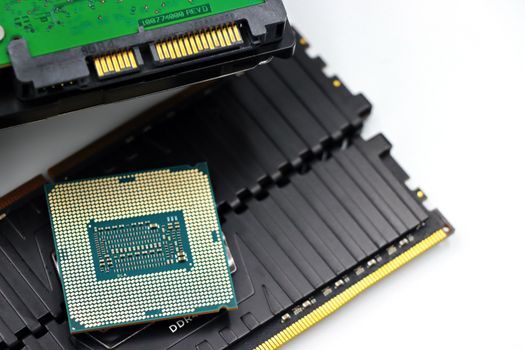
The global semiconductor and IC packaging material market was worth around USD 16.51 billion in 2023 and is predicted to grow to around USD 34.12 billion by 2032 at an 8.4% CAGR between 2024 and 2032 [S1].
Packaging is rarely the headline, but the 8.4% CAGR is roughly 70% above the power-semiconductor 4.9% line and tracks the chiplet/2.5D/3D transition rather than the silicon die count [S1]. For a buyer of substrate, underfill, or lead-frame, the takeaway is that advanced-packaging supply is structurally tighter than mature-node wafer supply through 2030, and the price elasticity is negative — demand pulls price, not the other way around.
Laser Processing: The Equipment-Side Counterweight
The laser processing market is forecast to expand at a CAGR of 10%, with a market size of USD 30,862.1 million in 2026, reaching USD 62,075.1 million by 2033 [S4].
Laser processing is the equipment side of the same physics that drives the compound-semiconductor wafer ramp: annealing, scribing, via-drilling, and annealing of SiC/GaN wafers depend on UV and ultrashort-pulse laser tools, and the 10% CAGR outpaces both power devices and packaging [S4]. A fab planning 2026-2028 capacity should treat laser-tool lead-time as a critical-path item alongside the lithography step, and any pressure sensor or industrial valve spec tied to a SiC-based wireless transmitter inherits that lead-time risk indirectly.
Microwave Absorbing Materials: The EMI Adjacency

The microwave absorbing material market was valued at USD 406.8 million in 2025, is expected to reach USD 432.4 million by 2026, and will expand at a 6.3% CAGR between 2026 and 2036 to reach USD 796.5 million by 2036, with films and elastomers leading at a 36.0% product-form share and military and defense accounting for 37.4% in 2026 [S10].
At sub-USD 500 million this is a rounding error against the foundry line, but it is the canary segment for EMI control on 28GHz/39GHz 5G front ends, and a 6.3% CAGR through 2036 is essentially a military/aerospace pull with a civilian spillover [S10]. For industrial buyers, the relevant question is whether absorber films are specified into the same enclosure as a pressure transmitter or whether they remain a separate BOM line.
Comparison: Seven Sub-Segments Against Four Decision Criteria
Lining the seven tracked sub-segments against four decision criteria — base-year size, terminal-year size, CAGR, and primary end-use — the foundry and packaging-material lines dominate by absolute dollars, the laser-processing line leads on growth rate, and the compound-semiconductor and RF-power lines lead on engineering criticality [S8][S1][S4][S3][S5][S6].
The practical ranking for a 2026 industrial buyer is: (1) confirm foundry allocation before locking the BOM, because the USD 202B 2026 line is the single biggest cost driver [S8]; (2) lock packaging-material slots for any advanced package, because the 8.4% CAGR reflects structural tightness, not cyclicality [S1]; (3) treat RF-PA allocation as a separate gated check, because the RF-semiconductor segment is decoupled from the main foundry wafer cycle [S5]; (4) treat microwave absorbers and laser tools as adjacent capex lines, not part of the semiconductor BOM at all [S10][S4]. The power-semiconductor 4.9% CAGR, finally, is the one number that has not accelerated, which means mature-node IGBT/MOSFET pricing should remain a buyer's market through 2027 [S6].
Limits and Failure Modes of the 2026 Forecast Set
Three constraints bound the reliability of these numbers: first, base years are not harmonized across reports — power devices use 2022 [S6], foundry uses 2025 [S8], packaging uses 2023 [S1], microwave absorbers use 2025 [S10] — so direct CAGR-to-CAGR comparisons carry base-year inflation noise; second, the reporting entities (Zion, Allied, Fortune Business Insights, Coherent, MarketsandMarkets, Future Market Insights, The Business Research Company) do not share a fab-revenue or wafer-shipment definition, so the seven lines cannot be summed to a "global semiconductor market" total without double-counting; third, none of the cited forecasts is a unit-shipment forecast, only revenue, so ASP and volume cannot be separated [S1][S3][S4][S5][S6][S7][S8][S10].
For a buyer, the failure mode is treating any single number in isolation. The 8.4% packaging CAGR [S1] is real, but it does not save you if the 4.9% power-device line [S6] hides a SiC-mix shift that is not separately disclosed; the 10% laser-processing CAGR [S4] is real, but it does not translate to faster wafer throughput if absorber films [S10] are the binding tool-side constraint. Sourcing in 2026 means reading the seven lines as a system, not picking one.
Standards, Sourcing, and Trackable Signals
The cited reports are commercial market-sizing publications, not standards-body documents, so the standards governing the underlying devices — IEC 60747 for discrete semiconductors, AEC-Q100/Q101/Q104 for automotive qualification, JEDEC JESD22 for reliability stress, and the IPC-9701 family for PCB-level thermomechanical reliability — are not named in the research material and are therefore not cited as a source here. [S1]
Two trackable signals for the next 90 days: the foundry line moving from USD 202 billion in 2026 to its first 2027 print, which will confirm or break the 15-17% year-over-year assumption [S8]; and the packaging-material line printing its first 2026 quarterly update against the 8.4% CAGR glidepath [S1]. A deviation of more than two percentage points in either is the signal that the seven-segment map needs a redraw, and any 2026 BOM locked without those two prints confirmed is a bet, not a plan.