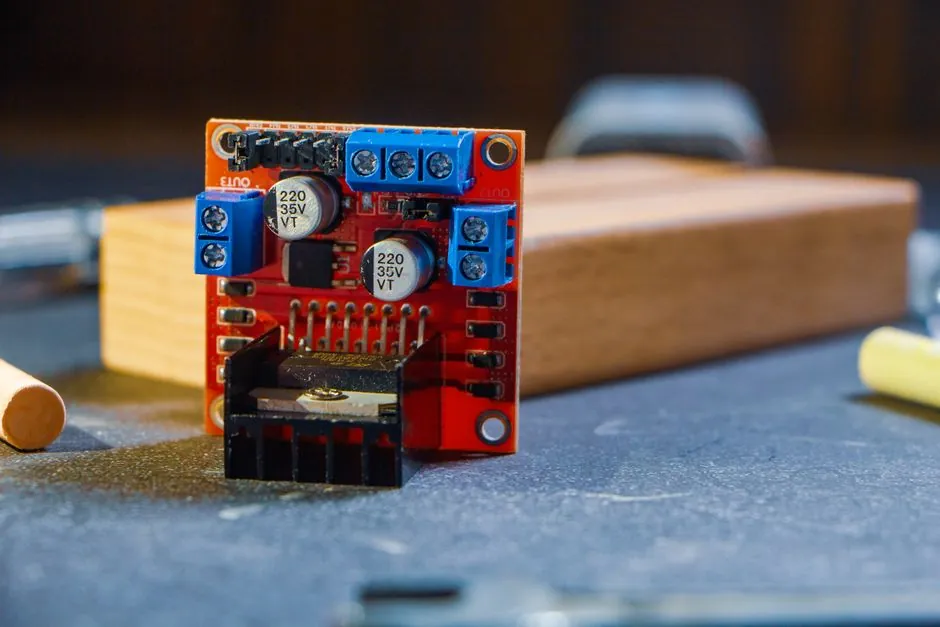
A servo motor uses feedback to control speed and torque, rotates machine parts with high efficiency and great precision, and can move its output shaft to a specified angle, position, or velocity [S1].
Closed-loop position feedback makes servo systems suited to robotics, CNC machinery, material handling, and other applications requiring controlled rotary or linear motion [S1][S3][S4].
Closed-loop control defines the servo motor
A servo system combines an electric motor, a feedback device, a controller, and a drive that executes position, velocity, or acceleration commands. An encoder commonly supplies shaft position and speed information, while the controller compares measured motion with the command and applies corrections [S1].
Typical industrial architectures cascade three control functions: an inner current loop limits motor current and protects against overload, a velocity loop regulates speed, and an outer position loop commands the velocity controller [S5]. This structure explains both the accuracy and the engineering burden of a servo system. It is more capable than open-loop actuation, but it also introduces feedback devices, parameter tuning, signal matching, and drive commissioning.
For conventional rotary and linear motion, engineers can review the functional distinctions in the servo motor reference before comparing drive and actuator requirements.
Performance advantages over ordinary and stepper motors
Servo motors combine high output power relative to size and weight with accurate motion control. One published comparison states that servo-motor efficiency can reach 90% under light-load conditions [S3]. These values describe specific comparison conditions rather than a universal guarantee for every motor or drive combination.
The clearest operating advantage is high-speed torque behavior. A servo motor uses positional feedback to control its output shaft and can move it to a specified angle, position, or velocity [S1]. Servo motors also run more smoothly than stepper motors except where microstepping is used [S1].
These characteristics suit robotic arms, precision assembly machines, CNC equipment, automated material handling, and laboratory or medical mechanisms. The choice of rotary or linear construction does not remove the feedback requirement: both formats rely on closed-loop position control to correct movement error [S1].
Servo motor versus stepper motor
The main selection decision is not simply motor type, but required speed, torque behavior, positioning certainty, and control-system complexity. A servo motor uses continuous motor rotation plus feedback to regulate position and velocity, while a stepper motor advances through discrete steps and can operate without position feedback [S4].
Servo motors are used in applications where precision and stability are crucial, including robotics and other industrial motion-control applications [S1][S3][S5]. Steppers remain practical when open-loop positioning, simple control, and low initial system complexity matter more than high-speed performance [S4]. A detailed comparison with stepper motors should include the complete load and motion cycle rather than rated torque alone.
Main disadvantages are integration, cost, and tuning
The most cited servo disadvantage is tuning difficulty. PID control can improve command following, but it requires adjustment to obtain stable speed, acceleration, and distance performance [S1]. Poor tuning can produce unacceptable overshoot, vibration, noise, or slow settling, and the feedback device, motor, drive, mechanical load, and control settings must operate as one system.
Servo architecture also adds hardware compared with an open-loop stepper arrangement. It requires a position sensor, encoder or resolver signal wiring, a matched servo drive, control parameters, and commissioning expertise. The controller or PLC software may implement proportional, integral, and derivative functions, but the controller alone does not provide the complete motor system [S1].
The system should also be reviewed through the servo drive, especially when sizing continuous and peak current, encoder compatibility, braking, and cable requirements. A high peak-current rating is not useful if its permitted duration exceeds the motor’s thermal capability.
Best suited to demanding motion, not every drive

A servo motor is appropriate when the process needs fast response, high starting torque, a wide speed range, accurate position, or controlled acceleration. Robot joints are a representative use because the commanded output must map directly to rotational displacement or angular velocity [S5]. Collaborative-robot servos also need compact size, low weight, and a hollow structure where those properties are required for the mechanical design [S5].
A servo system is less attractive when motion is simple, duty is intermittent, low purchase cost dominates, and an open-loop stepper can meet the load and resolution requirements. It is also a poor shortcut for machinery that has not defined its motion profile, acceptable error, thermal duty, or stopping requirements. A motor selected only by peak torque can still fail when acceleration, inertia, regeneration, or continuous thermal load is not included in the calculation.
Verify the complete duty cycle before purchase
The decisive specification set includes rated torque, peak torque and permitted peak duration, rated and maximum speed, acceleration, rotor and load inertia, encoder resolution and type, feedback polarity, drive voltage and current, braking requirements, and allowable thermal duty. Continuous performance should be checked against the full operating cycle rather than isolated catalogue values [S1][S3][S4].
Commissioning should confirm commanded position against measured position, verify zero-speed and overtravel behavior, and establish that the drive does not exceed motor current or thermal limits. Encoder feedback type and drive matching deserve a separate review using the servo drive specification checklist.
Track two signals before approving a servo installation: the maximum commanded speed at the load, and the motor temperature reached during the longest repeating cycle. If both remain within the manufacturer’s limits while position error and tuning settle acceptably, the closed-loop benefits justify the added complexity.