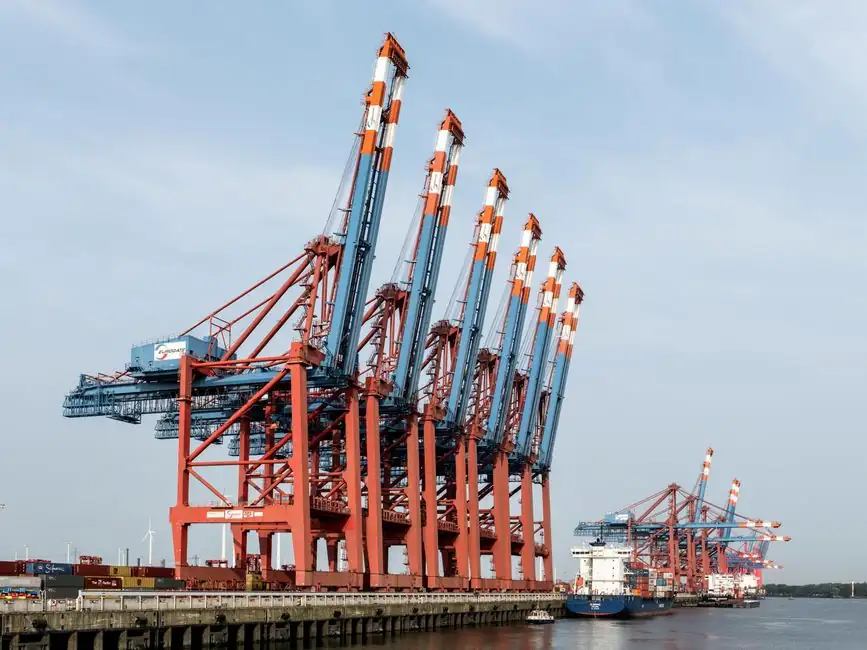
Rubber-tired gantry cranes are capable of stacking containers from 1-over-3 to 1-over-6 high, with lifting heights ranging from 12.3 to 21 metres [S7].
The crane is the primary yard variable: its hoist height determines stack height, while span determines how many container rows it can straddle [S2].
What the Stacking Design Must Achieve
For a more general explanation of the equipment, rubber-tired gantry cranes use a wheeled frame, horizontal trolley, hoist rope, and telescopic spreader to place boxes within a yard block. Stack height alone does not determine yard density: row count, lane length, truck lane, turning space, and retrieval sequence must be resolved together.
Compare the Main Stack Height Options
The comparison is about engineering fit, not a universal rule. A six-high crane can be specified where the yard geometry and operating process support it, but a four-high crane may be cheaper to maintain and produce fewer retrieval moves if the terminal has lower dwell time or more frequent truck pickups [S1].
Derive Height from the Real Box Stack
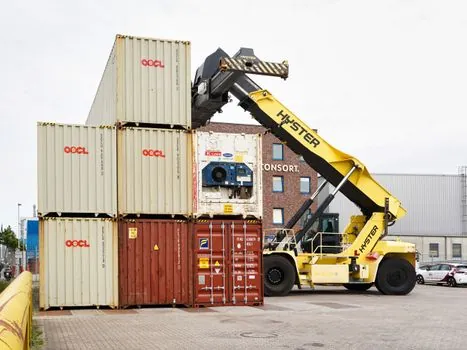
The required lift height is not simply the number of container tiers multiplied by one nominal container height. The calculation must include the container being placed, the target tier, spreader and lifting-sling geometry, structural deflection, ground and tire conditions, and the site’s required safety clearance. [S2]
Light poles, buildings, equipment, and road geometry can reduce the usable vertical envelope, so the layout survey must precede the procurement drawing.
A separate supplier description allows spans up to eight container rows plus a truck lane and stacking up to 1-over-6 [S5]. These figures describe configurable limits, not a guarantee that every crane can operate safely across every listed layout.
Use the Yard Profile to Choose 3 to 6 High
Three-high stacking is appropriate when quick individual retrieval and limited rehandling outweigh the value of storing more boxes on the same footprint. At the Halifax terminal, three-high stacks were used to minimize rehandlings, yet random truck collection still required upper boxes to be moved when the requested container was underneath [S1].
Four to five high is the middle range for conventional port storage: four is among the usual terminal lift heights, while five is supported by the seven-lane RTG block example [S4][S6][S2]. Six-high storage suits constrained yards where maximum land utilization justifies greater handling complexity, but it should not be selected solely from a rated lifting-height table.
This decision is not for facilities that need RMG precision on fixed, linear, high-throughput blocks, because RTGs trade fixed positioning for block-to-block mobility. RTGs can move between blocks without rails, while RMGs can use more storage lanes within a fixed block because their wheel rows are separated by intervening lanes [S2].
Control the Failure Modes of Taller Stacks
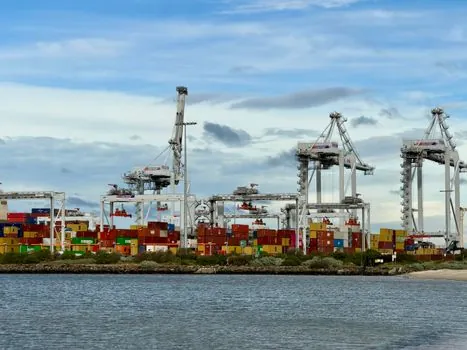
Stack selection must account for how an RTG services the block. Its wheelbase, steering modes, tyre load ratings, and turning radius affect whether it can transfer between blocks without interfering with adjacent traffic or road furniture [S3][S4].
Spreaders for ISO containers need the correct telescopic range and twist-lock arrangement, while the gantry structure, hoist system, trolley, and rubber tyres each carry separate design ratings [S3]. Comparing only headline lifting capacity is inadequate for a six-high configuration, because component limits and site geometry can govern usable performance.
Power configuration also changes operating exposure. These figures concern fuel and energy strategy, not structural height, but power availability affects the economically viable duty cycle for a taller yard.
Set the Procurement and Acceptance Envelope
A procurement specification should state the required stacking pattern, working lift height, span, number of container rows, truck-lane arrangement, container lengths, laden box weights, travel routes, power system, and operating duty cycle.
Acceptance testing should verify travel through the yard, positioning over the outer rows, placement at the highest required tier, spreader engagement, and operation with the designated truck lane active. The container-handling envelope must also be checked against the tank container population only where those specialized boxes are permitted, because their permissible stacking arrangement cannot be inferred from standard dry-container practice.
For higher-capacity procurement, compare structural and wheel-system requirements against forged versus cast steel wheels for gantry cranes, since wheel-system selection forms part of the RTG’s movable gantry structure. No supplied source establishes one wheel material as mandatory for every 4-to-6-high RTG, so the comparison should remain a project-specific engineering review.
Track Two Signals Before Ordering
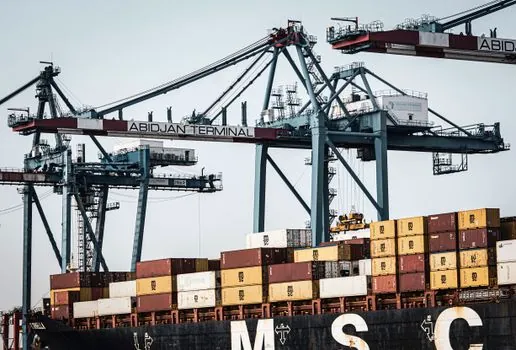
Finalize the stacking height only after confirming two measurable items: the highest usable lift point under all yard obstructions, and the actual retrieval profile for the container mix. The first requires a surveyed clearance model, while the second requires the expected dwell time, truck-arrival pattern, and proportion of containers assigned to lower tiers. [S4]
The first trackable signal is the approved yard drawing, showing rows, truck lanes, cantilevers, roads, lighting, buildings, and travel envelopes. The second is the operating simulation, counting lifts and rehandles for at least 1-over-4, 1-over-5, and 1-over-6 alternatives; this exposes the productivity penalty that a nominal land-capacity gain can conceal [S1].