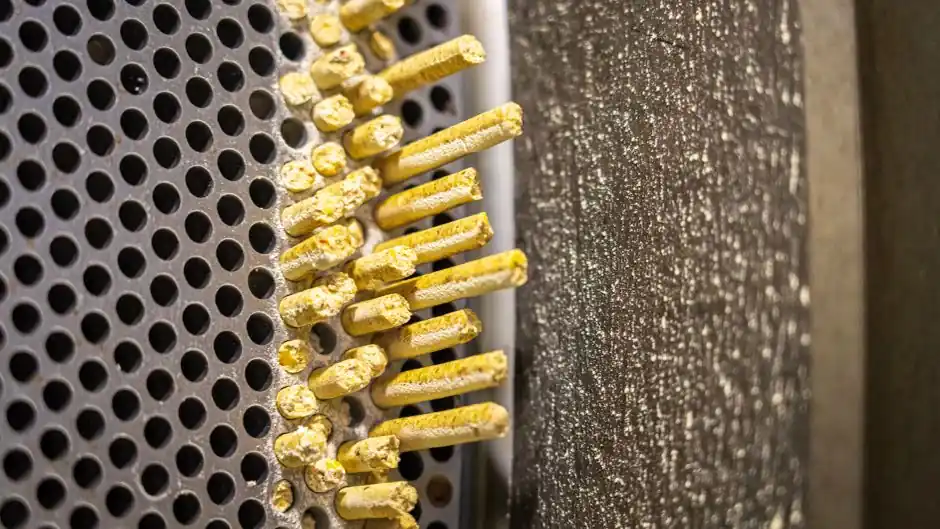
A shell core machine datasheet resolves to six numbers buyers must validate: hopper capacity in pounds, platen size in inches, core weight capacity, gas volume in cu ft/hr, gas pressure in oz/sq in., and air consumption in SCFM [S1].
Those six values define whether a candidate unit can physically form the core you need, and whether the facility has the gas and compressed-air service to feed it. The machines in service across U.S. foundries span 40 lb core capacity on a 13x15 in platen (Redford 43) up to 370 lb on a 36x44 in platen (Shalco U-360) [S2].
What the Shell Process Actually Demands from a Machine
The shell process uses a coated sand mixture, typically silica sand plus a thermosetting resin, blown pneumatically into a heated core box where the resin partially cures into a thin rigid shell; excess sand is dumped and the shell is fully cured before ejection [S2].
That sequence drives every spec on the datasheet. A 200 lb sand hopper with roughly 10,000 lb total machine weight, 400 cu ft/hr gas volume, 400,000 Btu output, 8-10 oz/sq in. cure pressure, 80 psi maximum, and 120 SCFM (approx) air consumption describes a mid-range gas-fired platform suitable for cores in the 40-100 lb bracket [S1]. A shell core machine on a shell molding machine line trades cure cycle time against gas BTU input, and that trade shows up directly in the gas-volume and air-consumption rows of the datasheet.
Platen Size and Core Capacity: The Two Numbers That Gate Every Quote
Platen size sets the maximum envelope of the core; core weight capacity sets how much coated sand the machine can hold and cure in one shot [S1].
Across the installed U.S. fleet, platen sizes cluster in five families: 13x15 to 16x17 in (small Redford 16/43 platforms, 40 lb core), 18x20 to 22x25 in (Redford 22, Harrison 24, Redford 43 in larger config, 40-70 lb core), 24x24 to 27x20 in (Harrison 24, Dependable 400, EMI U-180, Shalco U-180, 55-100 lb core), 30x20 in (EMI U-180, 100 lb core), and 36x44 in (Shalco U-360, 370 lb core) [S2].
Buyers tend to under-size platen because the core "fits" the part outline; in practice the platen must clear the core box plus clamping margins, and the 100 lb core-capacity platform is a common upgrade path for shops that started on a 40 lb unit [S1][S2].
Gas, Air, and Cure Pressure: The Utility Side of the Datasheet
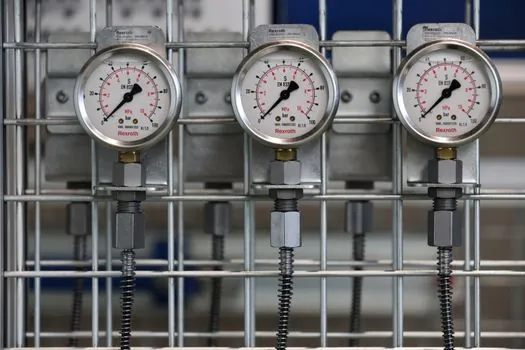
Gas-fired shell machines need 400 cu ft/hr at 400,000 Btu with cure pressure regulated to 8-10 oz/sq in. and a hard 80 psi ceiling, while compressed air at roughly 120 SCFM drives the sand shooting and dump cycle [S1].
These four utilities must exist in the building before a machine is selected. A 400,000 Btu gas load on a single platform implies a dedicated gas train with a properly sized regulator, and the 80 psi air ceiling means a 100 psi plant air header with adequate receiver tank volume; otherwise shooting pressure drops and cores come out light or unfilled [S1]. A core machine compared with a hot-box core machine shares the same heated-tool logic but the shell machine's gas consumption scales with platen area because heat is supplied to the entire box, not just to a small hot-blow port.
Sand-to-Resin Mix and How It Shows Up in Cycle Specs
A working shell mix is roughly 95% silica sand, 3-4% urea-formaldehyde resin, and 1-2% hardener, and the resin percentage largely controls cure time and therefore the cycle number on the datasheet [S3].
Resin content in the upper part of the 3-4% range yields faster cure and higher tensile strength, but it raises gas consumption because more heat has to migrate into the shell wall before dump; the datasheet will show the trade as a lower cycle-time rating and a higher gas-volume requirement. Fine, dry, clean sand with consistent grain size is the upstream precondition, and operators add a release agent to the core box before each shot to keep the cured shell from sticking on dump [S3].
Single-Station vs Dual-Station vs Tiltable Configurations

Shell core shooters fall into three mechanical configurations: fixed-shot single-station, dual-station with 180 degree roll-over tooling, and tiltable oscillating machines aimed at complex hollow cores [S4][S5].
Dual-station platforms run two core-production centers on one frame by rolling the tooling 180 degrees between stations, so one station is shooting while the other is dumping and curing, effectively halving the per-core cycle on a single footprint [S5]. Tiltable machines with oscillation suit complex hollow geometries where sand distribution is uneven in a fixed box [S4]. Single-station fixed-shot units remain the lowest-cost option and dominate the 40-70 lb core capacity bracket across the Redford 16, Redford 22, Redford 43, and Harrison 24 installed base [S2]. The shell core shooter market maps cleanly to these three configurations, and a cold-box core machine is the amine-cured alternative when the gas-fired utility package is not available.
Where Shell Cores Win, and Where They Lose
Shell cores win on dimensional accuracy, surface finish, and thin-wall strength for complex castings such as engine blocks, valve bodies, and detailed manifolds [S2].
They lose on energy intensity per pound of core, on tooling cost for small-lotive parts (every core box is heated and water-cooled), and on resin cost relative to green-sand or cold-box systems when the geometry is simple. The datasheet's 400,000 Btu and 120 SCFM numbers are the operational penalty a buyer pays for the dimensional and surface gains; that trade is justified at high mix-complexity job shops and most original-equipment casting lines, but is hard to absorb in a high-volume commodity foundry running a single part number [S1][S2].
Reading a Used or Rebuilt Machine Datasheet
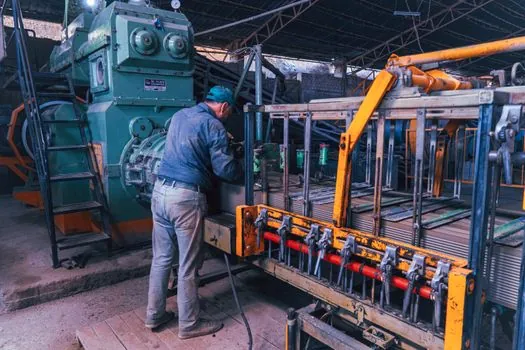
Used-machine listings usually redact gas pressure and air consumption, but those two rows are the first ones to verify on a pre-purchase inspection because worn sand valves, leaking cure regulators, and undersized air receivers all degrade the same numbers the OEM published new [S1].
Buyers comparing two otherwise equal 100 lb / 27x20 in platen units (Dependable 400 vs Shalco U-180 vs EMI U-180) should weigh platen dimensions first, then gas volume, then air consumption, then machine weight and footprint; the 9,000-10,000 lb mid-range weight class signals a cast frame that has not been cut down, while a sub-7,000 lb unit has often had a sub-frame modification that affects rigidity and gas-train routing [S1][S2]. Two reference signals worth tracking: any future rise in 370 lb / 36x44 in platen installs in the U.S. jobbing market (Shalco U-360 class), and any tightening of cure-pressure tolerance below the 8-10 oz/sq in. range as resin chemistry shifts toward lower free-formaldehyde formulations.
For a deeper look at how the shooting side of these datasheet values is selected, the shell core shooter sizing map walks through the weight, parting line, and cure-time tradeoffs, and the 2026 shell core shooter supplier spec map lines up the manufacturer coverage behind each platen family. A spec-first buyer's perspective from a process-engineer vantage is in the shell core shooter selection guide, and the closely related hot-box core shooter sizing map is the right cross-reference when cure-temperature and dwell time, not resin chemistry, are the gating parameters.