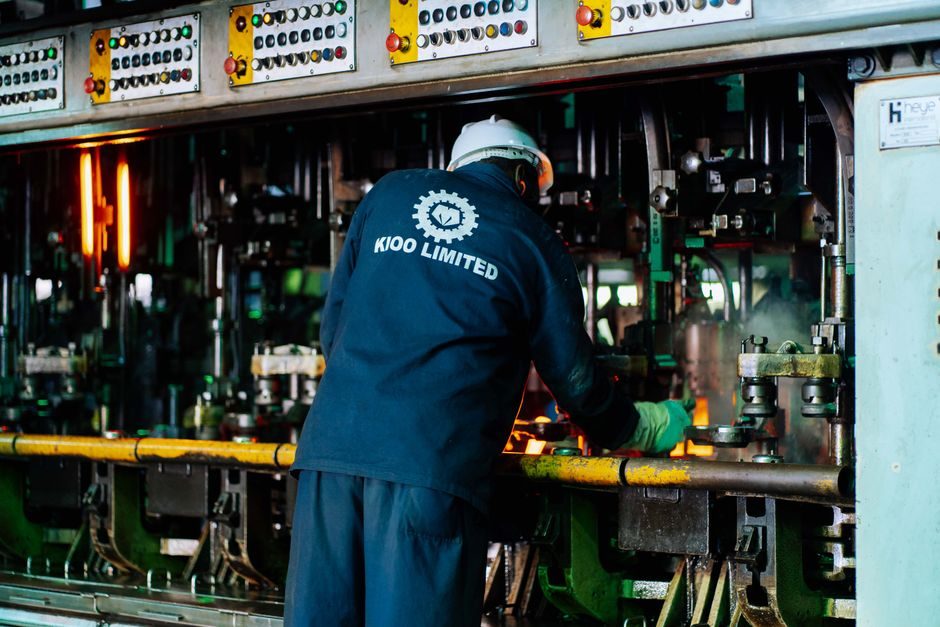
A shell core shooter is a foundry machine that uses compressed air to project thermosetting resin-coated sand into a heated core box, where the sand cures against the box wall to form a thin-walled "shell" core [S4]. Two primary configurations dominate the global market: the top-blow shell core shooter and the rollover (swing-door) shell core shooter, both running the same Croning-process chemistry but differing in how the sand is introduced and how the box is opened for part ejection [S1].
Within each family, machines split further by automation level (manual, semi-automatic, fully automatic), by core-box plate size, and by cure gas where CO2-cured variants exist as a separate cold-process offshoot [S1][S2]. Indian suppliers Galaxy Machines (Pune) and Sumangal Industries (Kolhapur) currently list both top-blow tit-door machines and rollover swing-door machines in standard plate sizes from 300×400 mm up to 600×800 mm [S1][S2].
Top-Blow (Tit-Door) Shell Core Shooters: Geometry and Cycle
Top-blow shooters fire sand vertically downward through the upper half of the heated core box, making them the workhorse for cores whose parting line allows the shooter nozzle to enter from above [S1]. The standard plate sizes quoted by Indian OEMs for tit-door machines start at 300×400 mm and step up through 400×500, 500×600, and 600×800 mm, with a 3 Lakh INR entry price for a new MS-framed tit-door unit listed on the ExportersIndia 2026 catalog [S2].
The shoot head sits on a swing-open "tit door" that seals against the top of the box during the blow, then swings clear for box opening and core ejection [S1]. Foundry engineers pick this geometry when the core print is symmetric around the vertical axis and when cycle time is the priority — top-blow cycles on a 3 Lakh INR-class machine typically run faster than rollover cycles because the box does not have to be inverted between sand fill and cure.
Rollover (Swing-Door) Shell Core Shooters: Geometry and Cycle
Rollover shell core shooters invert the heated core box 180° after the blow, draining excess sand and returning the box upright with the cured shell core resting on the lower half [S1]. This configuration is favored for asymmetric cores, for cores with deep draws that would trap sand if shot from one side only, and for cores where the parting line is horizontal rather than vertical [S1].
Galaxy Machines lists Rollover Shell Core Shooters alongside Top Blow Shell Core Shooters as a distinct product line out of Pune, and Sumangal Industries markets its "Automatic Shell Core Shooters (Swing Door Type)" at 400×600 and 600×800 mm plate sizes for foundry-industry buyers [S1][S2]. The rollover family is mechanically more complex than the top-blow family because of the swing-door clamping and the box-rotation axis, which raises both price and maintenance interval but unlocks core shapes that a tit-door cannot reach.
Comparison Table: Selection Criteria Across Both Types

The two configurations line up against four decision criteria that a process engineer can score without visiting the foundry floor. Top-blow wins on cycle speed and capital cost; rollover wins on core-shape flexibility and sand-drain cleanliness. [S1]
Criteria 1 — Cycle time: top-blow is faster because the box stays in one orientation; rollover adds a 180° inversion step that typically adds 5-15 seconds to a 30-45 second shell cycle. Criteria 2 — Core shape envelope: rollover accepts asymmetric, deep-draw, and side-port cores; top-blow is limited to shapes with a clear vertical shoot path. Criteria 3 — Sand reclaim: rollover's inversion dumps excess sand straight back into the hopper for immediate reuse, while top-blow relies on box design to vent and drain. Criteria 4 — Plate size scaling: both families are offered up to 600×800 mm by Indian OEMs [S2], but the rollover frame scales to larger plates more readily because the inversion axis can be lengthened without redesigning the shoot head.
CO2-Cured and Cold-Box Variants: Separate Process Families
CO2-cured core shooters and cold-box core shooters sit in a different process family from shell shooters, even though some Indian OEMs list all three under one product catalog [S1]. The CO2 process gasses sodium-silicate-bonded sand with CO2 at room temperature, while the cold-box process gasses phenolic-isocyanate-bonded sand with amine vapor (typically triethylamine, TEA) [S1]. Neither requires a heated core box, so the "shell" descriptor — which refers to the Croning thermoset cure against a hot box wall — does not apply to either.
Within the cold-box family, three sub-classes are listed by Galaxy Machines: Cold Box Core Shooters, Rotary Cold Box Core Shooters (3-station semi-auto configuration), and Universal Cold Box Core Shooters (4-way parted) [S1]. The cold-box family is the more common choice for high-volume automotive and diesel foundries because amine-cured cores strip cleaner from complex water jackets than shell cores do, and they tie into the same cold-box core shooter equipment base that production lines already run.
Sizing, Materials, and Electrical Envelope for Procurement
Standard plate sizes for shell core shooters in the 2026 Indian supplier catalog step in 100 mm increments: 300×400, 400×500, 500×600, 400×600, and 600×800 mm [S2]. Frame material across both types is mild steel (MS) with a polished finish, and ancillary pneumatic ovens are offered at 50,000 INR for a 700-1000 kg, 220 V / 50 Hz unit aimed at industrial buyers [S2].
Foundries specifying a shell core machine should lock plate size, shoot pressure (typically 4-6 bar working), and heating power (matched to the 200-260°C box-wall temperature window) before requesting quotes, because the same vendor can swing price by 30-50% across the size and automation matrix. Galaxy Machines has supplied the Pune-Maharashtra cluster for 12 years and Sumangal Industries has supplied the Kolhapur cluster for 9 years, with both verified on ExportersIndia as of April 2026 [S2].
Who Should (and Should Not) Specify a Shell Core Shooter
Foundries producing thin-walled, high-surface-finish cores in iron, aluminum, or brass — including cylinder-head cores, water-jacket cores for small-block engines, and hydraulic-valve body cores — are the primary fit for shell processes, because the Croning process yields the smoothest surface and the thinnest wall section of any cold-curing method. Jobbing foundries running low-to-medium volume mixes (under 50,000 cores/year per SKU) also fit, because shell tooling costs less than dedicated cold-box tooling for short runs. [S1]
Foundries should NOT specify a shell core shooter when the core weight exceeds roughly 15-20 kg (shell cores are thin-walled by design and crack on heavy sections), when the alloy pour temperature exceeds 1450°C (shell resin burns back aggressively above this band, leaving sand inclusions in the casting), or when the production volume is high enough to amortize cold-box tooling — in which case the cold-box core shooter family delivers a lower per-core cost. The broader shell molding machine equipment class is also worth evaluating when both cores and molds are needed, since shell molding reuses the same hot-box principle for full mold halves rather than just cores.
Standards, Sourcing, and Sourcing Watch-Outs

Indian OEM frames are mild-steel fabrication per the ExportersIndia catalog descriptions, with no exotic-alloy content in the heated platens [S2].
For buyers comparing a shell core shooter line item against a cold-box line, the cold-box path is the more common choice for high-volume automotive work; the lifecycle math across a 15-20 year foundry horizon is detailed in the related TCO analysis at Cold Box Core Shooter TCO: Cost Drivers Across a 15-20 Year Foundry Lifecycle, and the cold-box curing/parting sub-classes are mapped in Cold Box Core Shooter Types: Curing, Parting, and Station Classes. Two trackable signals to watch through late 2026: Indian OEM price moves on the 600×800 mm top-blow platform (entry at 3 Lakh INR in April 2026 [S2]), and any Pune-Maharashtra cluster expansion announcements from Galaxy Machines as that supplier crosses its 12-year operating mark [S1][S2].