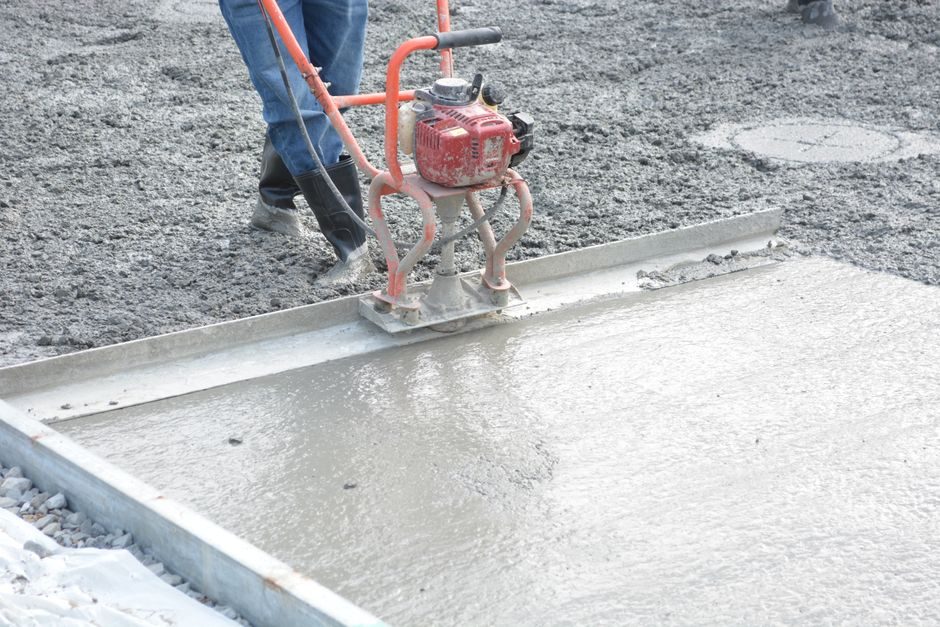
A shotcrete machine is a concrete-pumping-and-projecting unit engineered for vertical and overhead placement, while a power trowel is a rotary finishing tool used after the slab has been placed and has gone through initial set [S1].
These two machine classes solve different problems on a concrete-construction site, share no common working interface, and are typically purchased on separate equipment budgets: the shotcrete unit on the structural-concrete line, the trowel on the flatwork-finishing line [S1][S2].
Functional Scope: Placement vs Finishing
Shotcrete machines - whether the robotic-arm type promoted for tunnel and slope work or the wet-mix skid/track type - move wet concrete through a delivery hose and project it at velocity onto a substrate, with built-in acceleration set or accelerator dosing at the nozzle [S1]. A shotcrete machine is specified when the geometry forbids conventional form-and-pour placement: tunnel linings, rock-slope stabilization, pool shells, and shaft walls.
Power trowels operate on a slab that has already been placed, screeded, and floated. Walk-behind units typically run 600-1,000 mm diameter pans or combination blades, while ride-on trowels carry two or three rotors of 600-900 mm each [S2]. They are finishing tools, not placement tools, and engage the slab only after initial set has progressed past bleed-water dominance.
Throughput and Operating Envelope
Wet-mix shotcrete rigs from Chinese OEMs such as the Keda robotic line are routinely quoted at 7-30 m³/h theoretical output, with practical output governed by hose diameter (commonly 50-65 mm), piston stroke, and compressor air supply when accelerator is dosed at the nozzle [S1]. Gaodetec's diesel and electric screed-mixer pumps sit on the lower-output end of the same family at roughly 4-8 m³/h, aimed at floor-screed and small-structural pours rather than tunnel faces [S2].
Power trowels are not throughput-rated in m³/h. A 36-inch (≈900 mm) walk-behind covers roughly 80-150 m² per pass, and a ride-on twin-rotor covers 200-400 m² per pass, with the limiting variable being rotor rpm (90-180 rpm) and blade pitch (0-30°) rather than material feed [S2]. Comparing the two on m³/h is a category error.
Selection Criteria Side by Side
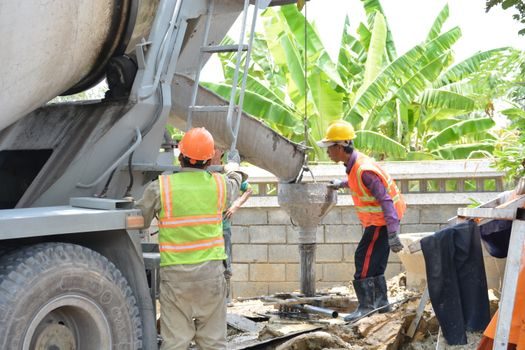
For procurement purposes, the two equipment classes diverge on every spec gate a buyer normally applies. The shotcrete line is driven by hose reach (vertical m + horizontal m), pump pressure (commonly 40-80 bar on piston pumps), accelerator dosing (liquid or powder), and air consumption for the nozzle; the trowel line is driven by rotor diameter, engine power (5-9 kW walk-behind; 17-30 kW ride-on), blade type (float pan / combination / finish), and pitch range [S1][S2].
Power source also splits: shotcrete rigs are commonly diesel-driven for site mobility or electric for tunnel work where diesel exhaust is prohibited, while power trowels are sold in gasoline, diesel, electric, and propane variants - the propane and electric versions are specified for indoor slabs and food-grade floors where engine exhaust cannot enter the workspace. Buyers should not attempt to cross-spec a single engine platform across both product lines.
Who Each Machine Is For
A shotcrete machine is the correct tool for tunneling crews, mine-passage crews, slope-stabilization contractors, swimming-pool builders, and structural shotcrete applicators working to ACI 506R / EFNARC guidelines, with throughput needs in the 7-30 m³/h range and vertical reaches beyond 10 m [S1].
A power trowel is the correct tool for commercial flatwork contractors, warehouse-slab finishers, and industrial-floor specialists who have already received a screeded and bull-floated slab. The same contractor rarely operates both machines on the same pour - shotcrete and hand-float/early-trowel work is the more common pairing for shotcrete-lined tunnel inverts, with ride-on trowels restricted to horizontal slab pours.
Failure Modes and Site Constraints
Shotcrete placement fails on rebound (oversize aggregate, excessive velocity, wrong accelerator dose), hose pulsation (worn delivery hose, starved feed), and pump cavitation (inconsistent mix water/cement ratio). Operators mitigate these by holding the nozzle at 0.8-1.5 m from the substrate, maintaining 60-90° impact angle, and using a wet-mix pump rated for the aggregate top size [S1].
Power trowels fail on premature engagement (rotor spins on still-plastic slab and tears the surface), excessive pitch on early trowel passes, and pan-vs-blade mismatch for the slab's age. A crew that walks a 90 kg ride-on onto a 200 mm thick slab at hour 2 will see tracking; standard practice is float-pan at low rpm first, then combination blades at increasing pitch as the slab hardens [S2].
Standards, Sourcing, and Cost Levers
Shotcrete work ties to ACI 506R ("Guide to Shotcrete"), EFNARC European Specification for Sprayed Concrete, and the relevant concrete-substrate prep standards; power trowel work is governed mainly by ACI 302.1R ("Guide for Concrete Floor and Slab Construction") and the finish-spec callouts in ACI 117. Buyers should require these documents as part of the equipment vendor's submittal package rather than treating either machine as a generic commodity purchase [S1][S2].
On the sourcing side, Chinese OEMs dominate the wet-mix and robotic shotcrete line (Keda among the more visible brands), while the power trowel market is split across ride-on specialists (Bartell, Wacker Neuson, Allen), walk-behind volume brands, and OEM/private-label supply. Spec-driven readers can cross-check the floor grinder cost levers for the same engine-power and head-size logic that drives ride-on trowel pricing, and the power-mixer overview for the upstream mixing equipment that feeds a wet-mix shotcrete pump. For buyers building a flatwork finishing fleet alongside placement gear, the floor-grinder selection gates read like a sibling spec sheet to ride-on trowel selection.
For 2026 procurement: shortlist wet-mix shotcrete pumps with verified piston-bore and stroke data, demand a factory acceptance test on rebound and accelerator dosing, and confirm hose reach against the deepest shaft or longest tunnel face on the project; for power trowels, lock rotor diameter and engine power to slab thickness and square-meterage per shift, and order float pans, combination blades, and finish blades as separate line items so blade changeover does not become a site bottleneck.